Showing posts with label SEPTEMBER 18. Show all posts

Thursday, 19 October 2017

PHYLLIS KIRK ,HOLLIWOOD ACTRESS DIED 2006, OCTOBER 19


PHYLLIS KIRK ,HOLLIWOOD ACTRESS 
DIED 2006, OCTOBER 19


Phyllis Kirk (born Phyllis Kirkegaard; September 18, 1927 – October 19, 2006)[1] was an American actress.

Early life[edit source]

Kirk was born in Syracuse, New York,[2] although some sources state her birthplace as Plainfield, New Jersey. She contracted polio as a child, which resulted in health problems for the rest of her life.[3] Kirk graduated from Battin High School, Elizabeth, New Jersey.

Career[edit source]
As a teenager, Kirk moved to New York City to study acting and changed her last name from Kirkegaard to Kirk. She began her career on Broadway before embarking on a television and film career.[4]

Kirk is best known for her many roles throughout the 1950s. She appeared with Vincent Price in the 3-D horror film House of Wax (1953). Her most notable television role was opposite Peter Lawford in The Thin Man (1957–1959), wherein they played Nick and Nora Charles. A newspaper columnist described what distinguished Kirk's role in the program: "[I]t's her brains that keep her flying high on 'The Thin Man' series."[5]

She also appeared with Jerry Lewis in his 1957 film The Sad Sack and the 1956 film Back from Eternity. Kirk was a regular on The Red Buttons Show and appeared as a guest on some television programs, including an episode of The Twilight Zone ("A World of His Own"). As her acting career slowed down, Kirk began serving as an activist for various social causes. She vocally opposed death row inmate Caryl Chessman's death sentence and visited Chessman in prison until his execution in 1960. After the Watts Riots in 1965, she funded preschool programs for underprivileged families in South Los Angeles.[4]

She granted interviews and wrote for the American Civil Liberties Union newspaper. Kirk made her last onscreen appearance in a 1970 episode of The F.B.I. before leaving show business altogether to enter public relations. She worked as a publicist for CBS News, and retired in 1992.[6]

Personal life[edit source]

Kirk was married to television producer and screenwriter Warren Bush until his death in 1992.[6] A Democrat, she attended the 1960 Democratic National Convention in Los Angeles, California.[7]


Death[edit source]
On October 19, 2006, Kirk died of a cerebral aneurysm at age 79 in Woodland Hills, California.[8] She was buried with her husband Warren Bush in the Arlington National Cemetery in Virginia.


Filmography[edit source]

Film[edit source]

YearTitleRoleNotes
1950Our Very OwnZaza
1950A Life of Her OwnJerry
1950Two Weeks with LoveValerie Stresemann
1950Mrs. O'Malley and Mr. MaloneKay
1951Three Guys Named MikeKathy Hunter
1952Just This OnceYoung Lover on FerryUncredited
1952About FaceAlice Wheatley
1952The Iron MistressUrsula de Varamendi
1952Stop, You're Killing MeNurseUncredited
1953House of WaxSue Allen
1953Thunder Over the PlainsNorah Porter
1953World by the TailTelevision film
1954Crime WaveEllen Lacey
1954River BeatJudy Roberts
1955Canyon CrossroadsKatherine Rand
1956Johnny ConchoMary Dark
1956Back from EternityLouise Melhorn
1957That Woman OppositeEve Atwood
1957The Sad SackMajor Shelton

Television[edit source]

YearTitleRoleNotes
1952The Philco Television PlayhouseDolly1 episode
1952Tales of Tomorrow1 episode
1952–1956Studio OneVarious Characters4 episodes
1953Armstrong Circle Theatre1 episode
1953The United States Steel HourBetty Lou1 episode
1953–1954Lux Video Theatre2 episodes
1953–1954Goodyear Television PlayhouseGirl3 episodes
1953–1954The WebMeg Loomis2 episodes
1953–1957Robert Montgomery PresentsVarious Characters4 episodes
1954Suspense1 episode
1954Your Show of Shows1 episode
1954Justice1 episode
1955Appointment with Adventure (CBS anthology series)1 episode
1955Playwrights '56Girl Friend1 episode
1955Letter to LorettaJess Blackston1 episode
1955The Red Buttons ShowVarious CharactersUnknown episodes
1955–1956Climax!Various Characters3 episodes
1956Schlitz Playhouse of StarsBarbara Hunter1 episode
1956Celebrity PlayhouseLaurie Westbrook2 episodes
1956Playhouse 90Nancy Tennant1 episode
1956–1957The Ford Television TheatreVarious Characters4 episodes
1957The Errol Flynn Theatre2 episodes
1957The 20th Century Fox HourBarbara Sherwood1 episode
1957–1959The Thin ManNora Charles72 episodes
1958The Ford Show, Starring Tennessee Ernie FordHerself1 episode
1960Dick Powell's Zane Grey TheaterAnn Bagley1 episode
1960The Twilight ZoneVictoria WestEpisode: "A World of His Own"
1970The F.B.I.Nora Tobin1 episode

Award nominations[edit source]


YearAwardCategorySeriesResult
1959Emmy AwardBest Actress in a Leading Role (Continuing Character) in a Dramatic SeriesThe Thin ManNominated

Monday, 18 September 2017

GRETA GARBO ACTED AS SPY IN WW II REALLY BORN 1905 SEPTEMBER 18


GRETA GARBO  ACTED AS SPY IN WW II REALLY
BORN 1905 SEPTEMBER 18


Garbo - A Spy in WW II?

“When my husband asked her about that, 
she didn't deny it.” 
- Garbo's niece, Gray Reisfield, mid 1990s -

Sources
The following re-written informations were taken from:
Garbo - by Barry Paris, Greta Garbo: A Life Apart – by Karen Swenson and Conversations with Greta Garbo - by Sven Broman


Introduction

In her 1928 MGM film, The Mysterious Lady (USA 1928), Garbo played Tania Fedorovna, a Russian spy charged with stealing secrets from the Austrians and she some years later she played Mata Hari (USA 1931) who was the most famous woman spy ever but was Garbo was once a real spy in WW II?

  
Garbo in The Mysterious Lady


Garbo in Mata Hari

World War II

World War II, or the Second World War, was a worldwide military conflict which lasted from the late 1930s to 1945. World War II was the amalgamation of two conflicts, one starting in Asia, 1937, as the Second Sino-Japanese War and the other beginning in Europe, 1939, with the invasion of Poland. World War II was the most widespread war in history, and countries involved mobilized more than 100 million military personnel.

Total war erased the distinction between civil and military resources and saw the complete mobilization of a nation's economic, industrial, and scientific capabilities for the purposes of the war effort; nearly two-thirds of those killed in the war were civilians. For example, nearly 11 million of the civilian casualties were victims of the Holocaust, which was largely conducted in Eastern Europe.


Garbo as real-life Mata Hari

It is said that there is evidence to suggest that Garbo played a small role in the Allies' wartime intelligence apparatus. Due to its neutrality, Sweden was a hotbed of espionage activity on all sides, and Hitler's war machine – especially in the early years of the struggle – depended on the crucial assistance of the Swedish steel industry and its agents.


The real Mata Hari:
Margaretha Geertruida Zelle (1876 – 1917)


British spy chief William Stephenson maintained that Garbo identified important Nazi collaborators in Stockholm to British agents there.  Author Charles Higham, after examining a thousand declassified US government files, said Garbo became involved with the British secret service in 1939 through director Alexander Korda, a middleman for recruiting celebrities to the war effort.

She reportedly served as gobetween for the British with shipping magnate Axel Johnson and members of the Swedish royal family. She was also credited with helping obtain the release of physicist Niels Bohr from occupied Denmark to Sweden and later to America, where he worked on the Manhattan Project. If those claims are true, they are a redemptive manifestation of Garbo as real-life Mata Hari.


Greta's feelings about the war

Like everything else in her life, Greta kept her feelings about the war to her-self. She did not attend rallies choreographed to sell war bonds; she did not appear on the USO circuit or at the Hollywood Canteen.

Harry Crocker and Salka Viertel often found themselves defending Garbo in the press regarding her “silent support” of the war effort; Crocker even hired a clipping service to keep track of what was being said and to correct “any mistaken ideas.”


A 5,000 $ check war-orphans


Known for a fact is that on 12 December 1939 she wrote a 5000 dollar check to the Finnish Relief Fund for its war-orphans program during the ‘Winter War' in which Stalin overran Finland. But the donation was made under a strict condition of anonymity, and as the war progressed there was increasing criticism in the press of her apparent uninvolvement and her failure to join the great majority of other stars in war-bond drives and in entertaining the troops.


A GI's request for her autograph

One published story claimed she had even refused a GI amputee's request for her autograph – and it was true. Actor-director Orson Welles was a witness to that most mindless faux pas. As neighbours in Brentwood during the war, he and Garbo were good acquaintances and spent a few evenings together.

One night, he told biographer Barbara Leaming, they emerged from a restaurant to find ‘a soldier in uniform without a leg, standing on his crutches with an autograph book and she refused it. “That is how dumb she was! She refused him, in front of my eyes!”


War bonds

Many critics complained about Garbo while she didn't want to sell war bonds like many other Hollywood stars. Salka Viertel came to her defense: “If anyone has made the suggestion that Garbo isn't selling bonds because her sympathies are on the wrong side, it's too preposterous even to be discussed. There are some people who just cannot face crowds, no matter for what cause. Garbo is such a person. Instead she buys many bonds herself [and] has done her utmost to help me in my work of rescuing anti-Fascist refugees from Europe.”


Leif Leifland

Former ambassador Leif Leifland believes that both Greta Garbo and Ingrid Bergman “were anxious to show their sympathy with the Allied force. Garbo wasn't a spy, he says, but she cooperated with the Allied effort.America was her second home. I don't find it surprising that Greta Garbo was anxious to prove her allegiance.”


Patriotic radio message

Despite the urging of the State Department, Swedish diplomats, and friends such as Swedish artist Einar Nerman – she refused a request to tape a patriotic radio message to be broadcast to Scandinavia.

Neutrality would not have been the issue, but rather Greta's belief that it was not her place to articulate what other people must do; Sweden and America had their own political leaders who were better equipped for that.


A “fan letter” from Adolf Hitler 

Conversely, Garbo revealed to friends that she had actually received a “fan letter” from Germany's ruthless dictator. “I wonder how it would feel to stand face to face with a man like Hitler,” she mused.


Hitler admired Camille

Early in World War II, Garbo was told that Adolf Hitler loved her films and admired Camille so much that he allowed its wide distribution in Germany, despite the ‘racial impurity' of director Cukor. The Führer reportedly “retained” a private copy of the film confiscated by his customs officers.

  
Garbo in Camille


Garbo to shot Hitler

Garbo, in turn, reportedly said she wanted to meet him and try to convince him to stop the war. She felt the power of her personality could alter the course of history, but “if not – I could shoot him”.  Who would dare to search Greta Garbo on a special invitation from the Führer?

The romantic idea that Garbo was willing to martyr herself by assassinating Hitler sounds apocryphal, but her friend Sam Green confirms it: “Once she said, ‘Mr Hitler was big on me. He kept writing and inviting me to come to Germany, and if the war hadn't started when it did, I would have gone and I would have taken a gun out of my purse and shot him, because I'm the only person who would not have been searched.'

That's a direct quote. She said it to me over dinner, and it was so out of character. It wasn't her habit to make up such a story to stop a dinner party. Or maybe not so out of character. As a child, she had had fantasies that ‘I might shorten the life of a cruel king and replace him by a romantic knight'”.

Considering her abhorrence of brutality of any kind, the scheme was uncharacteristically bold – especially from a woman who fretted that nothing she might do could possibly make a difference.


She neither confirmed nor denied

Some acquaintances would later take this intriguing suggestion as proof that Garbo had agreed to spy or carry messages for the Allies. It was a romantic notion. Nevertheless, MGM's Mata Hari was typically sly when asked to comment on such rumors; she neither confirmed nor denied them. Most of these stories emanated from a book about the British Secret Service entitled A Man Called Intrepid.

Canadian William Stephenson – code name Intrepid – helped to set up a special office coordinating activities between the British Secret Service and its counterpart in the States, and was known to use key entertainment industry figures as covers. Charles Higham, author of several books on wartime espionage, maintains that Garbo was asked by Stephenson to help keep an eye on Axel Wenner-Gren.


Axel Wenner-Gren

Axel Wenner-Gren was a Swedish entrepreneur and one of the wealthiest men in the world during the 1930s. During the war the censors would even open private letters. It may be more than coincidence, if you are inclined to be suspicious, that the only one of Garbo's letters to her friend Hörke Wachtmeister that they opened was one in which she wrote about Axel Wenner-Gren.

In the autumn of 1989 Garbo was being discussed in a very delicate context. Sweden's ambassador to London, Leif Leifland, published a book intended to exonerate Axel Wenner. Wenner-Gren, the industrial magnate, from the suspicion that he had worked for Hitler during the war: Svartlistningen av Axel Wenner-Gren (The Blacklisting of Axel Wenner-Gren).

The book lists documents from Allied intelligence 

organizations that were believed to prove that Garbo had been used as an agent in order to get inside information on what Wenner-Gren was up to. In common with David Niven and Noel Coward, she was supposed to have been made use of to get facts about the Swedish businessman's activities. Quite simply, Garbo was presented as a spy for the Allies. It is said that Garbo had met Axel Wenner-Gren, who loved being surrounded by celebrities.

But according to Garbo her contacts with him were of a superficial nature.Olof Lagercrantz tells a much saucier story about Garbo and Wenner-Gren, concerning a favourite experience of Bertil Malmberg, the writer and Academician: “I saw Greta Garbo naked.” Malmberg and Garbo and a few others were guests of the Wenner-Grens at Häringe Castle outside Stockholm.

Early one morning after a late night, Malmberg saw Garbo from his window, walking on her own down to the deserted swimming-pool in the garden. Garbo took off all her clothes there and jumped naked into the water, little knowing she was being observed Maybe it was Bertil Malmberg who was the spy.


Her first assignment as a “spy”

Her first assignment would have been the trip to Nassau from Miami in February 1940. “For the rest of the war, she would devote herself to the allied cause,”  he declared. “She would risk her life involving herself in the mass rescue of Jews from Denmark, and would bring to bear a strong influence upon King Gustav of Sweden ...”

Stephenson's original claim was much more vague. “As a member of the Stephenson-Churchill group, [Garbo] provided introductions and carried messages,” his Intrepid biographer recorded.

When Stephenson called on her royal admirers, he was quietly arranging escape routes – especially for [Denmark's pioneering nuclear physicist] Professor Niels Bohr ...” For his part, Stephenson made no connection between the actress and “tainted” Swedish businessmen such as Axel Wenner-Gren or Axel Johnson. “I would have died of shame if I had ever had anything to do with spying,” Greta said later.

But would she have carried messages? First, there is no indication that Garbo ever left the United States between 1938 and 1946. However, in the 1960s, after meeting U.N. secretarygeneral Dag Hammarskjöld, she would confide that there were “some things that hap, pened a long time ago that we had to talk about. We spoke Swedish to each other,” she told Raymond Daum. “It was very painful for me ... but I can't tell you that story.”


Dag Hammarskjöld

In later years, Garbo made puzzling references to Dag Hammarskjöld, the Swedish diplomat and United Nations secretary-general, who had intimate knowledge of Allied intelligence operations in Scandinavia.

She and Hammarskjöld subsequently met in New York City, after which she told Ray Daum, “There were some things that happened a long time ago that we had to talk about. We spoke Swedish to each other. It was very painful for me – but I can't tell you that story.


Garbo told Sven Broman

Garbo's friend Broman once rang Garbo in New York and told her what he had read. At the same time he  pointed out that it was bound to be seen as an honourable deed to have helped to find out information that led to the downfall of Hitler's Germany. 

“I would have died of shame if I had ever had anything to do with spying,'‘ Garbo said. “But it is made clear you were on the right side,” Nerman answered . “That makes no difference. No one asked me to do anything like that. No, you can deny it, Mr Broman,” Garbo replied.


Did you know?

In Dublin on September 2005, a international conference given at the Irish Film Institute in order to celebrate Garbo's centennial. Among the speakers there was film historian Kevin Brownlow who presented his new TCM documentary on the Divine called Garbo.

He spoke, among others, about interviewing Garbo's family (her niece etc) about Garbo for the documentary and said that among the surprising things he learned was the family's insistence (and he said that they had proof as well) of Garbo's intense activity in famour of the Allies during World War II. He said that he was amazed, but he simply could not fit all that info in a TCM documentary so he chose not to include that, since it would almost seem incredible to some people.


Garbo - the real spy
Juan Pujol Garcia (1912-1988) was a Double Agent For Britain During WWII. His codename was GARBO due of his mystic and because people who knew him said that he was without doubt the finest actor they have ever seen.


Juan Pujol Garcia aka "Garbo"

Was Garbo in England 1942?
There is a small Hotel in a rather remote part of England, called "The Wheatsheaf", in Carperby, North Yorkshire, which advertises itself as having a SECRET!!

They claim that Garbo stayed there in 1942. In the Hotel's own words she stayed during a break from performances at nearby Catterick Garrison, the UK Army's largest base. When enquiries were made as to what evidence was available to substantiate the story of Garbo's stay, i.e. a visitors book, etc...


The reply was:
"Greta Garbo stayed here with Henry Hall in Jan 1942 after entertaining troops at Catterick. We have the original register with entries and have independently verified these. We only have a photograph of Greta around that time but not here at the Wheatsheaf.”

It's an interesting story but unfortunately there is no indication that Garbo ever left the United States between 1938 and 1946.

Sources:
Garbo – A Biography – by Barry Paris, Greta Garbo: A Life Apart – by Karen Swenson and Conversations with Greta Garbo – by Sven Broman


Sunday, 18 September 2016

GRETA GARBO , INTERNATIONAL SUPER STAR OF SILENT FILMS SERVED AS SPY IN WWII- FREED DANISH JEWS BORN 1905 SEPTEMBER 18


   GRETA GARBO ,
INTERNATIONAL SUPER STAR OF SILENT FILMS
   SERVED AS SPY IN WWII- FREED DANISH JEWS 
BORN 1905 SEPTEMBER 18


Greta Garbo (born Greta Lovisa Gustafsson; Swedish: [ˈɡreːˈta lʊˈviːˈsa ˈɡɵstafˈsɔn]; 18 September 1905 – 15 April 1990), was a Swedish-born American film actress and an international star and icon during the 1920s and 1930s. Garbo was nominated three times for the Academy Award for Best Actress and received an honorary one in 1954 for her "luminous and unforgettable screen performances." In 1999, the American Film Institute ranked Garbo fifth on their list of the greatest female stars of Classic Hollywood Cinema, after Katharine Hepburn, Bette Davis, Audrey Hepburn, and Ingrid Bergman.


Garbo launched her career with a secondary role in the 1924 Swedish film The Saga of Gosta Berling. Her performance caught the attention of Louis B. Mayer, chief executive of Metro-Goldwyn-Mayer (MGM), who brought her to Hollywood in 1925. She immediately stirred interest with her first silent film, Torrent, released in 1926; a year later, her performance in Flesh and the Devil, her third movie, made her an international star.[1]


Garbo's first talking film was Anna Christie (1930). MGM marketers enticed the public with the catch-phrase "Garbo talks!" That same year she starred in Romance. For her performances in these films she received the first of three Academy Award nominations for Best Actress. (Academy rules at the time allowed for a performer to receive a single nomination for their work in more than one film.)[2] In 1932, her popularity allowed her to dictate the terms of her contract and she became increasingly selective about her roles. Her success continued in films such as Mata Hari (1931) and Grand Hotel (1932).

Many critics and film historians consider her performance as the doomed courtesan Marguerite Gautier in Camille (1936) to be her finest. The role gained her a second Academy Award nomination. Garbo's career soon declined, however, and she was one of the many stars labeled "Box Office Poison" in 1938. Her career revived upon her turn to comedy in Ninotchka (1939), which earned her a third Academy Award nomination, but after the failure of Two-Faced Woman (1941), she retired from the screen, at the age of 35, after acting in twenty-eight films.

From then on, Garbo declined all opportunities to return to the screen. Shunning publicity, she began a private life, and neither married nor had children. Garbo also became an art collector in her later life; her collection, including works from painters such as Pierre-Auguste Renoir, Pierre Bonnard, and Kees van Dongen,[3] was worth millions of dollars when she died.


Childhood and youth[edit]

Monument on the building which now stands where Greta Garbo was born on Södermalm.


Greta Lovisa Gustafsson was born in Södermalm, Stockholm, Sweden. She was the third and youngest child of Anna Lovisa (née Karlsson, 1872–1944)—a housewife who later worked at a jam factory—and Karl Alfred Gustafsson (1871–1920), a laborer.[4][5] Garbo had an older brother, Sven Alfred (1898–1967), and an older sister, Alva Maria (1903–1926).[6]


Monument on the building which now
 stands where Greta Garbo was born
 on Södermalm.

Her parents met in Stockholm where her father visited from Frinnaryd. He moved to Stockholm to become independent and worked in various odd jobs—street cleaner, grocer, factory worker and butcher's assistant.[7] He married Anna, who had recently moved from Högsby.[8][9] The Gustafssons were impoverished and lived in a three-bedroom cold-water flat at Blekingegatan No. 32. They brought up their three children in a working class district regarded as the city's slum.[10] Garbo would later recall:


Beginnings (1920–1924)[edit]

Garbo first worked as a soap-lather girl in a barber's shop but eventually, on the advice of her friends, applied for, and accepted, a position in the PUB department store running errands and working in the millinery department. Before long, she began modeling hats for the store's catalogues which led to a more lucrative job as a fashion model.[25] In late 1920, a director of film commercials for the store began casting Garbo in roles advertising women's clothing. Her first commercial premiered on 12 December 1920 and was followed by others the following year.[26] Thus began Garbo's cinematic career. In 1922, Garbo caught the attention of director Erik Arthur Petschler who gave her a part in his short comedy, Peter the Tramp.[27]


Garbo in her first leading role in the Swedish film 


From 1922 to 1924, she studied at the Royal Dramatic Theatre's Acting School in Stockholm. She was recruited in 1924 by the prominent Swedish director Mauritz Stiller to play a principal part in his classic film The Saga of Gösta Berling, a dramatization of the famous novel by Nobel Prize winner Selma Lagerlöf.

She played opposite Lars Hanson, a well-known Swedish actor. Stiller became her mentor, training her as a film actress and managing all aspects of her nascent career.[28] She followed her role in Gösta Berling with a starring role in the 1925 German film Die freudlose Gasse (Joyless Street or The Street of Sorrow), directed by G. W. Pabst and co-starring Asta Nielsen.[29]


Silent film stardom (1925–1929)[edit]

In 1925, Garbo, then twenty and unable to speak English, was brought over from Sweden at the request of Mayer. Both Garbo and Stiller arrived in New York in July 1925 after a ten-day trip on the SS Drottningholm.[33] However, they remained in New York for over six months without any word from MGM. They chose to go Los Angeles on their own, but another five weeks passed with no contacts from the studio.[34][35] Now on the verge of returning to Sweden, she wrote to her boyfriend back home: "You're quite right when you think I don't feel at home here. . . Oh you lovely little Sweden, I promise that when I return to you my sad face will smile as never before."[36]
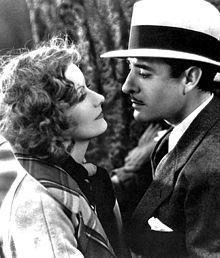
Garbo with John Gilbert in A Woman of Affairs (1928).
A Swedish friend in Los Angeles decided to help her by contacting MGM producer Irving Thalberg, who agreed to give her a screen test. According to author Frederick Sands, "the result of the test was electrifying. Thalberg was impressed and began grooming the young actress the following day, arranging to fix her teeth, making sure she lost weight, and giving her English lessons."[36]

During her rise to stardom, film historian Mark Vieira notes that "Thalberg decreed that henceforth Garbo would play a young but worldly-wise woman . . . "[37] However, according to Thalberg's actress wife, Norma Shearer, Garbo did not necessarily agree with his ideas:


Garbo in Flesh and the Devil (1926) withJohn Gilbert

Miss Garbo at first didn't like playing the exotic, the sophisticated, the woman of the world. She used to complain: "Mr. Thalberg, I am just a young gur-rl!" Irving tossed it off with a laugh. With those elegant pictures he was creating the Garbo image.[37]


Despite her popularity as a silent star,[66] the studio feared that her Swedish accent might impair her work in sound and delayed the shift for as long as possible.[67][68] MGM itself was the last Hollywood studio to convert to sound[69] and her last silent film, The Kiss (1929), was also the studio's.[70] Garbo would go on to become one of the biggest box office draws of the next decade.

Transition to sound and continued success (1930–1939)[edit]

"Garbo talks!" in Anna Christie (1930).
In late 1929, MGM cast Garbo in Anna Christie (1930), a film adaptation of the 1922 play by Eugene O'Neill, her first speaking role. 


"Garbo talks!" in Anna Christie(1930).

The screenplay was adapted by Frances Marion and the film was produced by Irving Thalberg and Paul Bern. Sixteen minutes into the film, she famously utters her first line, "Gimme a whiskey, ginger ale on the side, and don't be stingy, baby." The film premiered in New York City on 21 February 1930 publicized with the catchphrase "Garbo talks!", and was the highest-grossing film of the year.[71] Garbo received her first Academy Award for Best Actress nomination for her performance, although she lost to MGM colleague Norma Shearer. Her nomination that year included her performance in Romance (1930). After filming ended,

Garbo—along with a different director and cast—filmed a German-language version of Anna Christie that was released in December 1930.[72] The film's success certified Garbo's successful transition to talkies. In her follow-up film, Romance (1930), she portrayed an Italian opera star opposite Lewis Stone. She was paired opposite Robert Montgomery in Inspiration (1931), and her popularity was used to boost the career of the relatively unknown Clark Gable in Susan Lenox (Her Fall and Rise) (1931). Although the films did not match Garbo's success with her sound debut, she was ranked as the most-popular female star in the United States in 1930 and 1931.

Garbo followed with two of her most famous roles. In 1931, she played the World War I German spy in the lavish production of Mata Hari, opposite Ramón Novarro. When the film was released, it "caused panic with police reserves required to keep the waiting mob in order." [73] The following year, she played a Russian ballerina in Grand Hotel (1932), opposite an ensemble cast, including John Barrymore, Joan Crawford, and Wallace Beery among others.

The film won that year's Academy Award for Best Picture. Both films had been MGM's highest-earning films of 1931 and 1932, respectively, and Garbo was dubbed "the greatest money-making machine ever put on screen."[24][74][75][76] Garbo's close friend Mercedes de Acosta then penned a screenplay for her to portray Joan of Arc[77] but producers rebuffed the idea and the film was shelved. After appearing in As You Desire Me (1932), the first of three Garbo films which co-starred Melvyn Douglas, Garbo's MGM contract expired and she returned to Sweden.

Garbo and Fredric March in Anna Karenina (1935).


Garbo and Robert Taylor in Camille (1936).

Although her domestic popularity was undiminished in the early 1930s, high profits for Garbo's films after Queen Christina in 1933 depended on the foreign market for their success.[80][81] The type of historical and melodramatic films she began to make on the advice of Viertel were highly successful abroad but considerably less so in the United States. In the midst of the Great Depression, American screen audiences seemed to favor "home-grown" screen couples, such as Clark Gable and Jean Harlow.


Garbo and Fredric March in Anna Karenina (1935).
Garbo and Robert Taylor in Camille(1936).

In 1935, David O. Selznick wanted to cast her as the dying heiress in Dark Victory, but Garbo chose Leo Tolstoy's Anna Karenina (1935) in which she played another of her renowned roles.[82] Her critically acclaimed performance won her the New York Film Critics Circle Award for Best Actress. The film was internationally successful and did better than MGM expected domestically.[83] Still, its profit was significantly diminished because of her exorbitant salary.[84] Garbo selected George Cukor's romantic drama Camille (1936) as her next project.
Thalberg cast her opposite talents Robert Taylor and former co-star, Lionel Barrymore. Cukor carefully crafted Garbo's portrayal of Marguerite Gatier, a lower-class woman, who becomes the world-renowned mistress Camille. Production was marred, however, by the sudden death of Thalberg, then only thirty-seven, which plunged the Hollywood studios into a "state of profound shock," writes David Bret.[85]:272 Garbo had grown close to Thalberg and his wife, Norma Shearer, and had often dropped by their house unannounced. Her grief for Thalberg, some believe, was more profound than for John Gilbert, who died earlier that same year.[85]:272 His death also added to the sombre mood required for the closing scenes of Camille. When the film premiered in New York on 12 December 1936, it became an international success, Garbo's first major success in three years. She won a New York Film Critics Circle Award for Best Actress award for her performance, and she was again nominated for an Academy Award.

Garbo and Melvyn Douglas in a scene from Ninotchka (1939).

After the box office failure of Conquest, MGM decided a change of pace was needed to resurrect her declining popularity. For her next movie, the studio teamed her with producer-director Ernst Lubitsch to film Ninotchka, her first comedy. The film was one of the first Hollywood movies which, under the cover of a satirical, light romance, depicted the Soviet Union under Joseph Stalin as being rigid and gray when compared to its prewar years. Ninotchka premiered in October 1939, publicized with the catchphrase "Garbo laughs!", commenting on the departure of Garbo's serious and melancholy image as she transferred to comedy. Despite the film's critical favoritism and box office success in the United States and abroad, it was banned in the Soviet Union and its satellites.

Last work and early retirement (1941–1948)[edit]

With George Cukor's Two-Faced Woman (1941), MGM attempted to capitalize on Garbo's success in Ninotchka by casting her in a romantic comedy which sought to portray her as a chic, modern woman. She played a "double" role that featured her dancing the rumba, swimming, and skiing. The film was a critical failure, but, contrary to popular belief, performed reasonably well at the box office.[86] Garbo referred to the film as "my grave."[87] Two-Faced Woman was her last film; she was thirty-six and had made twenty-eight feature films in sixteen years.


Although Garbo was humiliated by the negative reviews of Two-Faced Woman, she did not at first intend to retire.[88][89] But her films depended on the European market and when it fell through with the war, finding a vehicle was problematic for MGM.[90][91] She signed a one-picture deal in 1942 to make The Girl from Leningrad but the project quickly dissolved.[90] She still thought she would continue when the war was over[90][92] though she was ambivalent and indecisive about returning to the screen. Salka Viertel, Garbo's close friend and collaborator, said in 1945 "Greta is impatient to work. But on the other side, she's afraid of it."[93] Garbo also worried about her age. "Time leaves traces on our small faces and bodies. It's not the same anymore, being able to pull it off."[93] George Cukor, director of Two-Faced Woman, and often blamed for its failure, said "People often glibly say that the failure of Two-Faced Woman finished Garbo's career. That's a grotesque oversimplification. It certainly threw her, but I think that what really happened was that she just gave up. She didn’t want to go on."[92]


Personal life[edit]

War service[edit]


During World War II, Garbo secretly worked for MI6.

[115] In tandem with fellow MI6 operative, British-born producer Alexander Korda, they used the pretense of film production to gain access to locations of intelligence interest. Specific accomplishments included 

gathering information on Axel Wenner-Gren, 


a Swedish millionaire industrialist and reputed friend of Hermann Goering,


 and paving the way to a meeting between Danish physicist Niels Bohr and King Gustav V of Sweden, which helped lead to the rescue of the Danish Jews.[116]


Relationships[edit]

Garbo never married, had no children, and lived alone as an adult. Her most famous romance was with her frequent co-star, John Gilbert, with whom she lived intermittently in 1926 and 1927.[144] Soon after their romance began, Gilbert began helping her acting on the set, teaching her how to behave like a star, how to socialize at parties, and how to deal with studio bosses.[145] They costarred again in three more hits, Love (1927), A Woman of Affairs (1928), and Queen Christina (1933). Gilbert allegedly proposed to her numerous times, with Garbo agreeing but backing out at the last minute.[145][1][146] "I was in love with him," she said. "But I froze. I was afraid he would tell me what to do and boss me. I always wanted to be the boss."[145]


In 1937, she met conductor Leopold Stokowski with whom she had a highly publicized friendship or romance while traveling throughout Europe the following year.[147][148] In his diary, Erich Maria Remarque discusses a liaison with Garbo in 1941[149] and in his memoir, Cecil Beaton described an affair with her in 1947 and 1948.[150][151] In 1941 she met the Russian-born millionaire, George Schlee, who was introduced to her by his wife, fashion designer Valentina. Nicholas Turner, Garbo's close friend for 33 years, said that, after Garbo bought an apartment in the same building, "Garbo moved in and took Schlee right away from Valentina."[145] Schlee would split his time between the two, becoming Garbo's close companion and advisor until his death in 1964.[152][153]


Garbo signing her US citizenship papers in 1950

Recent biographers and others believe that Garbo was bisexual or lesbian, and that she had intimate relationships with women as well as with men.[154][155][156][157][158] In 1927 Garbo was introduced to stage and screen actress Lilyan Tashman and they may have had an affair, according to some writers.[159][160] Silent film star Louise Brooks stated that she and Garbo had a brief liaison the following year.[161] In 1931, Garbo befriended the writer and acknowledged lesbian Mercedes de Acosta,[162] introduced to her by her close friend, Salka Viertel, and, according to Garbo's and de Acosta's biographers, began a sporadic and volatile romance.

The two remained friends—with ups and downs—for almost thirty years during which time Garbo wrote de Acosta 181 letters, cards, and telegrams which are kept at the Rosenbach Museum & Library in Philadelphia.[163][164] Garbo's family, which controls her estate,[165] has made only 87 of them available to the public.[166] In 2005 Mimi Pollak's estate released sixty letters Garbo had written her in their long correspondence. Several letters suggest she may have had romantic feelings for Pollak for many years. After learning of Pollak's pregnancy in 1930, for example, Garbo wrote "We cannot help our nature, as God has created it. But I have always thought you and I belonged together".[167] In 1975, she wrote a poem about not being able to touch the hand of her friend with whom she might have been walking through life.[168]

Death[edit]


Garbo was successfully treated for breast cancer in 1984.[169][170] Towards the end of her life, only Garbo's closest friends knew she was receiving dialysis treatments for six hours three times a week at The Rogosin Institute in New York Hospital. A photograph appeared in the media in early 1990, showing Koger assisting Garbo, who was walking with a cane, into the hospital.
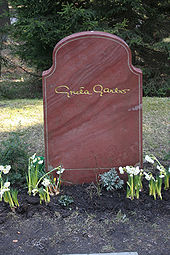
Gravestone of Greta Garbo

Greta Garbo died on 15 April 1990, aged 84, in the hospital, as a result of pneumonia and renal failure.[171] Daum later claimed that towards the end, she also suffered from gastrointestinal and periodontal ailments.


Garbo was cremated in Manhattan, and her ashes were interred in 1999 at Skogskyrkogården Cemetery just south of her native Stockholm.[172]


Garbo had invested wisely, primarily in stocks and bonds, and left her entire estate, $32,042,429—$57,000,000 by 2013 rates—to her niece, Gray Reisfield.[173]