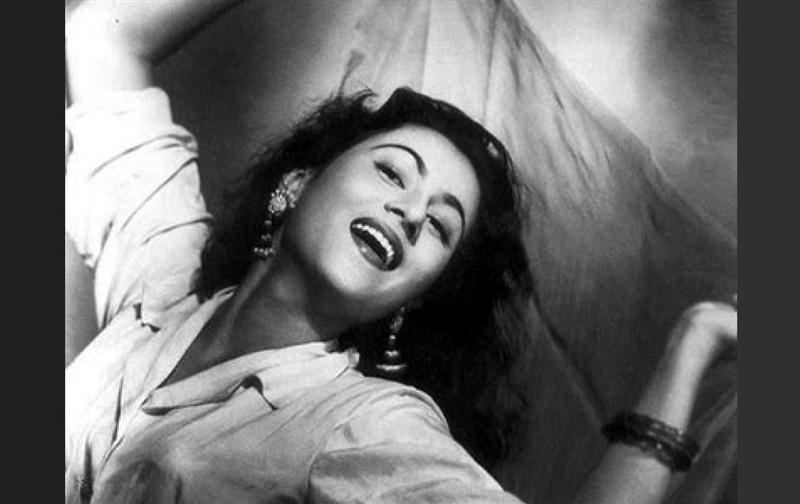
ASHA PAREKH DOESN'T LIKE DILIP KUMAR WHY?
SO ASHA PAREKH DOESN'T LIKE DILIP KUMAR! A REVELATION INDEED!
An Article by Nasir Ali:
According to PTI reports, when Asha Parekh was asked why the audience did not see her and Dilip Kumar romancing on the screen, the former replied: “Who I don’t like, I don’t work with.” She was being felicitated by the IFFI at Panaji for her completion of 50 years in Bollywood.
Yes, everyone has a right to his or her dislikes, including Asha Parekh. However, this was one of the most unexpected statements coming from an actress who is only 3 three years away from 70. In normal course, such statements when they come in a package labeled, “Grapes are Sour” should be consigned to the trash-can. However, her statement forces me to rewind to the past to examine the merit of her said statement. The question is, whether any role was offered to her at all opposite Dilip Kumar. Or rather, did Dilip Kumar need an Asha Parekh.

When Asha Parekh was born in 1942, Yusuf Khan (Dilip Kumar) was in jail overnight, he refused to have his breakfast of eggs, toast and tea that was offered to him the next morning because that day Mahatma Gandhi was on on fast. The nation was busy with the Quit India Movement of 1942, for driving out the British Raj. During the next two years life was to take unexpected turn for Yusuf Khan when Devika Rani, the lady boss of Bombay Talkies, offered him a contract to act in her films.
After initial hiccups Yusuf Khan accepted the offer and thus landed a role in Jwar Bhata (1944) under the name that the First Lady of the Indian Screen selected for him – Dilip Kumar - the name that was to cast spell on generations of film goers and fraternity for the next six decades. Thus he made his debut as an actor opposite Mridula and Shamim under the direction of Amiya Chakarborty. Dilip Kumar did two more films, Pratima (1945) and Milan (1946) after Jwar Bhata.
Now, when Asha Parekh started out as Baby Parekh in Aasmaan (1952) which is only remembered for the full-fledged musical debut of the king of rhythm, O.P. Nayyar (after scoring background music in Kaneez 1949), Dilip Kumar had mesmerized the nation with his powerhouse of acting talent and charisma in the following movies: Jugnu (1947), Ghar Ki Izzat, Mela, Shaheed, Anokha Pyaar and Nadiya Ke Paar (all 1948); Shabnam and Andaz (1949); Jogan, Babul and Arzoo (all 1950); Hulchal, Tarana and Deedar in 1951; Aan, Sangdil, and Daag (1952). Daag which was inspired by the 1950 Marathi movie, Mee Daaru Sodli, won for Dilip Kumar his first Filmfare Award in 1953 for his stellar performance of an alcoholic who having set out to purchase medicines for his dying mother, instead succumbs to his temptation and buys liquor for himself, and who finally manages to give up his drinking habits for good. In 1953, Dilip Kumar featured in Shikast and his favourite Foot-Path “where stark reality was mingled with thought-provoking romanticism.”

Baby Parekh got a small role in Kishore Kumar-Usha Kiran starrer, Dhobi Doctor (1954). The same year, Asha Parekh was noticed by Bimal Roy who cast her in Baap Beti (1954) when she was twelve.
At that time, Bimal Roy was busy shooting with Dilip Kumar his prestigious Devdas which was based on the Bengali novel of Sharatchandra Chattopadhyay.
In 1954, Mehboob Khan released his Amar, starring Dilip Kumar, Madhubala and Nimmi. From 1955 till 1959 Dilip Kumar starred in such movies as Devdas and Udan Khatola, (1955); Insaniyat, and Azaad (1956); Naya Daur and Musafir (1957), Madhumati and Yahudi (both Bimal Roy’s – 1958). During these years, Dilip Kumar won the Filmfare Best Actor Awards for his roles in Devdas, Azaad and Naya Daur! He also got the nomination for the said Award in Madhumati. Dilip Kumar did Paigham (1959) along with Raj Kumar, Vyjayantimala and B. Saroja Devi. He was cited for the Filmfare Best Actor Award nomination.
Asha Parekh was doing uncredited roles in some films, and Aasha (1957) was one of them. She continued her schooling and later joined the Filmalaya School of Acting. This school belonged to Sashadhar Mukherjee who was once a producer in the famous Bombay Talkies of Devika Rani and Himanshu Rai. In 1943, he left the Bombay Talkies to form his own Filmistan Studio at Goregaon, Mumbai, in partnership with Rai Bahadur Chunilal, Gyan Mukherjee, and Ashok Kumar whose brother in law he was, having married the only sister of the last-named Super Star of that era. Nasir Hussain was one of the regular writers with Filmistan. Sashadhar Mukherjee gave Nasir Hussain an opportunity to direct Filmistan’s Tumsa Nahin Dekha (1957), starring Shammi Kapoor and Ameeta. This movie proved to be a great hit, especially for the hero who tasted success after his nine films had flopped in a row. When Sashadhar broke away from Filmistan to set up his Filmalaya Studio at Amboli, Mumbai, he again asked Nasir Husain to direct a movie for him. This time it was Dil Deke Dekho (1959). In the meantime, Asha Parekh tried her luck for a heroine’s role in Vijay Bhatt’s Goonj UThi Shehnai (1959) but was rejected since according to the film-maker she was not a heroine material. That role went to Ameeta – also known as the Tumsa Nahin Dekha girl. The very next day, Sashadhar Mukherjee asked Nasir Husain to choose between Sadhna, and Asha Parekh, and Nasir Hussain chose the latter for the tomboyish role in Dil Deke Dekho. Thus she landed her first role as the leading lady opposite Shammi Kapoor.
Nasir Hussain’s choice of Asha Parekh as against Sadhna for the heroine’s role in Dil Deke Dekho set off a long term of relationship between them, on both professional as well as personal level. So when Nasir Hussain also turned producer by establishing his own production house under the banner of Nasir Hussain Films he never failed to take Asha Parekh as his leading heroine right from Jab Pyaar Kisise Hota Hai (1961) till Caravan (1971). His other films with Asha Parekh were Phir Wohi Dil Laya Hoon (1963), Teesri Manzil (directed by Vijay Anand, 1966), Baharon Ke Sapne (1967), and Pyar Ka Mausam (1969). After 1971, he turned in favour of younger heroines such as Zeenat Aman, Kajal Kiran, Padmini Kolhapure, Dimple Kapadia and Jaya Pradha for his films. Nasir Hussain was already a married man with wife Ayesha, and a daughter Nuzhat and son Mansoor Khan who took over the reins of direction from Nasir Hussain for Qayamat Se Qayamat tak pairing the almost-debutantes, Amir Khan and Juhi Chawla.
Asha Parekh acted in some 85 Bollywood movies. It is from 1960 onwards that Asha Parekh began getting the lead roles in films such as Hum Hindustani and Ghunghat. Of course in Ghunghat she was totally eclipsed both in acting and beauty by her senior heroine, Bina Rai. Her most successful movies are the ones mentioned above. Her other hit films include Ziddi (1964), Mere Sanam (1965), Love in Tokyo (1966), Aaye Din Bahar Ke (1966), Shikar (1968), Kati Patang (1970), being the most prominent. As a young heroine, her roles have mostly been glamorous except in a few movies such as Do Badan (1966), Kati Patang (1972), Chiragh (1969), Bahaaron Ke Sapne (1972) and Main Tulsi Tere Angan Ki (1978) where she has short role, which was in fact the last of her roles as the film heroine. Thereafter her roles were limited to that of a supporting actress and that chain continued till 1995 when Andolan was released. She also became a Distributor with the release of Bahaaron Ke Sapne which had its premier at the Apsara Cinema in Mumbai but that film did not click as it was not in the league of the usual Nasir Hussain movies. She also continued with her classical dances and performed live on stage especially during 1972-73 when she went abroad. She also dabbled in TV show production line.

As for Dilip Kumar, in 1960 he had two releases: Kohinoor and Mughal-e-Azam. He again won the Filmfare Best Actor Award for Kohinoor.
In 1961 he wrote and produced and acted in Ganga Jamuna which was a trend-setting movie in many respect. This mile-stone of a movie elicited a very powerful performance from Dilip Kumar.
This was the role that not only swayed the entire film industry but was also to inspire the future Super-Stars Amitabh Bachchan and Kamala Hasan. In the west, it was Sophia Loren, the two times Oscar Winner, who was influenced profoundly. Astonishingly, Dilip Kumar did not win the Filmfare Award. He was of course nominated under that category.
After a three-year hiatus, Dilip Kumar accepted the role of Leader (1964) for Sashadhar Mukherjee. He also wrote the film-story which is as relevant today as it was then. His comedy role fetched him another Filmfare Award in the Best Actor Category. His other movies in the Sixties are: Dil Diya Dard Liya (1966); Ram Aur Shyam (1967), Sungharsh, and Aadmi (both 1968). . He was nominated in the Best Actor Category in all the four films. In Ram Aur Shyam Dilip Kumar played the full-fledged double role for the first time and his impact in the movie was such that it won many acclaims, including the prestigious Filmfare Award for his diverse, sensitive and powerful performance. His adverse critics, who thought he was finished, were deservingly dealt a serious blow.
In Nineteen Seventies we have four Dilip Kumar movies: Gopi (1970), Dastaan (1972), Sagina (1974) and Bairaag (1976). All the three movies, excluding Dastaan, had his better-half, Saira Banu, as his heroine, while B.R. Chopra’s Dastaan which was a remake of Afsaana (1951) had Sharmila Tagore. Anokha Milan (1972) had Dharmendra along with him. In the Seventies he also had a guest appearance Phir Kab Milogi (1974) – a Mala Sinha-Biswajeet starrer.
Sagina Mahato (1970) was his diamond-jubilee hit Bengali film which was directed by Tapan Sinha. It created box-office records in Bengal. Regarding Dilip Kumar's performance in Sagina Mahato, Uttam Kumar the versatile, charismatic and the most popular Bengali film-star had this to say to Tapan Sinha later in July 1972: “Tapan da, thank God you did not cast me as Sagina. It would have been a blunder as I could not have matched Yusufda who has brought Sagina alive on screen.”
In Bairaag, Dilip Kumar had triple roles, that of a father and his two sons. Bairaag additionally had the beautiful Leena Chandavarkar also as his heroine. This was the last movie of Dilip Kumar where he was the hero. Thus from 1944 to 1976 he played the roles of a film hero for 32 long years.
When Dilip Kumar came back to the silver screen after five years in Kranti (1980) it was his second innings but a successful one too. Stories were written by contemplating him in a central role. Thus we have Shakti and Vidhata (1982), Mazdoor (1983), Duniya and Mashal (both 1984), Karma and Dharam Adhikari (Both 1986), and Kanoon Apna Apna (1989), Izzatdaar (1990)) and Saudagar (1991) and Qila (1998). In Shakti Dilip Kumar had Amitabh Bachchan, the super-star of the time, pitted against him. However Dilip Kumar came out with such a brilliant performance that it won him yet another Filmfare Award in the Best Actor category. He was also nominated for the said Award in Mashal and Saudagar. Dilip Kumar's performance in Mashal was again a trend-setter and his AY BHAI....scene has been emulated in many Bollywood movies.
In 1993, Dilip Kumar was given the Filmfare Award for Lifetime Achievement. The Government of India awarded him the Dadasaheb Phalke Award which is given for cinematic excellence in India. In 1997 the Pakistan Government awarded him the Nishan-e-Imtiaz which left him traumatized though the highest civilian award was also awarded to Morarji Desai much earlier. The NTR National Award was given to him in 1997. He was also awarded the Phalke Ratna Award in 2007 and the CNN-IBN Indian of the Year Lifetime Achievement Award in 2009, along with hosts of many other awards.
For the sake of brevity, we have omitted mentioning the cameo roles down the decades. We have not mentioned the names of the films that were shelved, except one which we shall presently broach. Similarly we have not mentioned the other Awards won by the Thespian and Asha Parekh.
Dilip Kumar movies have gone on to become great classics of Indian Cinema. In his early films, Dilip Kumar mirrors the frustration of youth in upholding life’s values and ideals. For him, it was not the case of “Everything is fair in love and war.” For him, being noble was more important than winning love by aggression or deception or crossing the limits of civility. His romantic losses and longings endeared him greatly to his generation and the next who did not want any shades of grey in the roles he played as in Amar (1954) and Qila (1998). His swashbuckling roles in Aan and Azaad sent the message of fighting evil with will and determination, taking pains in strides. When he came on the screen the hearts missed the beat and the entire audience hall lighted up at the very sight of him. There is something enthralling about him, his mutterings, his pauses, meaningful shifting of eyes, furrowed forehead, gesturing hands, short chuckles, smiling lips, inspiring speeches, tragic monologues, Heathcliffian determination, rustic innocence, romantic disposition, and the face that expresses tragedy of the mind and happiness of the heart. No doubt, then that he has been the inspirer of generations of film stars such as Rajendra Kumar, Manoj Kumar, and Amitabh Bachchan who very openly profess their admiration for his style of acting and even the younger generations of film stars who don’t deny his immense stature.
As for Asha Parekh most of her roles were glamourous ones, requiring her to look pretty and tomboyish, with little emotions and histrionics. Again, most of her heroes such as Joy Mukherjee (1961 - debut in Love in Simla), Biswajeet (hindi debut in Bees Saal Baad 1961), Jeetendra (debut in Geet Gaayaa Pathron Ne - 1963) and Rajesh Khanna (debut in 1967 in Raaz/Aakhri Khat) were junior to her. Even Dharmendra (debut in 1961: Dil Bhi Tera Ham Bhi Tere) and Shashi Kapoor (minus his roles as a child-artiste in Forties-Fifties; debut in Char Diwari in 1961) were her juniors acting-wise. The film directors other than Nasir Hussain who cast her in films were Shakti Samanta, Vijay Anand, Raj Khosla, Mohan Sehgal, Pramod Chakravothy, Raghunath Jhalani and J.P. Dutta.

Her role in Chiragh won her the nomination while that in Kati Patang won her the Filmfare Best Actress Award. Incidentally, in her interview with Jitesh Pillai, published in Film Fare magazine of September 2001 Mumtaz stated: "I should have won the Best Actress Award for Tere Mere Sapne. I really deserved it. Instead it went to Asha Parekh for Kati Patang in which she wore white and stood in front of piano doing precious little. Khair, jaane do (let it go). God has given me so much..." Earlier, the Kati Patang role had been offered to Sharmila Tagore who turned it down for "some silly reasons."
The other movies that won Asha Parekh the Filmfare nominations in the Best Supporting Actress category were Udhar ka Sindur (1976) and Main Tulsi Tere Angan ki (1978). She won the Filmfare Lifetime Award in 2002.
Dilip Kumar was the most eligible bachelor of his time. When he finally tied the knots with Saira Banu he was 44 years old and she just 22 . Despite gloomy predictions and some unexpected happenings, this marriage has remained as one of the most enduring ones in the film industry.
Asha Parekh never married though according to her nothing is more therapeutic in life than companionship. She confides that men found her unapproachable. Even Shammi Kapoor who is her favourite and who played hero opposite her in four films, Dil Deke Dekho (1959), Teesri Manzil (1966), Pagla Kahin Ka (1969), and Jawan Mohabbat (1971) used to call her Bhatijee (“Niece”) while she addressed him as “Chacha” (i.e.Paternal Uncle).
She admitted that she had had a longtime boy friend and it was good while it lasted. Dev Anand was the other senior actor who paired with her in Jab Pyar Kisise Hota Hai which did silver jubilee at the Alankar Cinema in Mumbai.
To take the bull by the horns: What prompted Asha Parekh to make such a sweeping statement? Was it her comparative past youth? Was it her past beauty? Was it acting talent?
On seeking the answers to the above questions, we find that Dilip Kumar, even in his Fifties, has romanced a much younger and beautiful actress viz., Leena Chandavarkar when she played the role of heroine opposite Dilip Kumar in Bairaag (1976).

Again, his spouse Saira Banu was 2 years younger than Asha Parekh and 22 younger than Dilip Kumar at the time of her marriage in 1966. Then there’s the case of Rakhee who acted opposite Dilip Kumar as his wife in Shakti (1982). She is twenty-five years younger than Dilip Kumar and five years younger than Asha Parekh. Then we had the gorgeous Rekha acting opposite him in the shelved Aag Ka Darya (1982) and later in 1998 in Qila as his romantic interest where she is even “raped” by him. She is 32 years his junior. One can see some twelve-year old Rekha along with many other children, twisting away to the song and music of AAYEE HAIN BAHAAREN MITE ZULM-O-SITAM in Ram Aur Shyam. So what was it? Dilip Kumar has acted with beautiful actresses such as Madhubala and Saira Banu to name just a couple. Being an institution of acting unto himself, Dilip Kumar has acted with most powerful actresses such as Nargis, Meena Kumari, Nalini Jaywant, Vyjayantimala, Nimmi, Waheeda Rehman and Nutan. So we can conclude that there was no question of youth or beauty or acting talent involved in the reported statement of Asha Parekh that she doesn’t like Dilip Kumar.

Was it something personal then? Nasir Hussain had announced a movie, called Zabardast, starring Dilip Kumar (not the one that was later directed by him in the Mid-Eighties). But this one did not see the light of the day and was shelved. This much we know. (see the poster below: courtesy my FB friend Rajesh bhai)
Maybe Asha Parekh was selected as the heroine as usual by Nasir Hussain, along with other star-casts. Maybe she refused to work with Dilip Kumar, we don't know. Sadly, there are no details. The loss is ours! If it was Dilip Kumar who refused then we can only conclude by quoting Congreve: "Heaven has no rage like love to hatred turned / Nor hell a fury like a woman scorned."
(
based on information from internet sources)
NASIR.
Nasir at 10:29:00 PM
Share
34 comments:
34 comments:
AnonymousMarch 26, 2010 at 12:42 AM
This comment has been removed by a blog administrator.
Reply
UnknownJuly 20, 2010 at 4:47 PM
quite an interesting information!lot of effort must have gone into collection of the same.I really appreciate.
Of course, it's outright silly of Asha Parekh, if she really said it!We all can have a hearty laugh out of it.She can as well say she was offered the Prime Ministership,but rejected!
dbs,hyd
Reply
NasirJuly 20, 2010 at 5:08 PM
Most welcome balasubrahmanyam! You're right that it was outright silly for Asha Parekh to make that statement. At the end of the day, we all make silly mistakes especially with a glib tongue. She still remains one of my favourite heroines, bubbly and beautiful as she was during her early career.
Reply
FArHEeNDecember 6, 2010 at 1:44 PM
Excellent!
Reply
kiran8December 11, 2010 at 11:28 PM
There may be some truth in what you say ! I, for one feel that the two would have made a great pair - she, so bubbly and pretty and Dilip kumar, so dashing ...the loss is ours !
Reply
NasirDecember 12, 2010 at 10:02 PM
I certainly agree with you Kiran, especially since Asha Parekh joined Bollywood quite early as the heroine, i.e. in 1959. Now, ten years later if Dilip and Saira could give a great hit such as Gopi, surely this pair too could have worked wonders I believe. But the conspiracy of the circumstances went against them.
Reply
UnknownJanuary 31, 2011 at 8:52 AM
Dear Sir,
I came across your blog and was delighted to know that Rekha can be spotted in a song from 'Ram aur Shyam'!
Perhaps you can clear a doubt of mine.. I think that Dharmendra appears in Kaagaz ke Phool,being introduced to Waheeda as "Mr.Gupta, is sheher ke rayees".He has no words to utter.Please tell me if I am right in my supposition.
Thanks
Preeta rao
Reply
NasirJanuary 31, 2011 at 10:29 AM
As you know, KAAGHAZ KE PHOOL is a 1959 movie, and Dharmendra's first movie as a hero is DIL BHI TERA HAM BHI TERE (1961). Based on your observation, the probability is certainly there, since he must have struggled before 1961 for a couple of years at least. Having said that, I will have to watch KAAGHAZ KE PHOOL and get back to you.
We do get confused on seeing some faces that become famous later in life. A classic example can be seen in MUGHAL-E-AZAM. Just watch that qawwali TERI MAHFIL MEIN QISMAT... Try guessing the faces of the girls there. Minoo Mumtaz can be discerned easily. But there are others too!
Reply
UnknownJune 7, 2011 at 1:00 AM
Dear Nasir Sir,
Appreciate your effort of collecting such a huge piece of information.
I am not from the Dilip Kumar or Asha Parekh era. I have grown on Mithun Chakraborty movies and all the mid eighties movies.
My dad was a huge fan of Dilip Kumar and it used to exaspirate me, being a Mithun fan. We would always want to play a Mithun film, rather than a Dilip Kumar film, in the limited time (That was the time of rented VCP and Video cassettes).
Almost 20 years later, I had discovered Dilip Kumar saab...And now I understand his charisma and skills. I have collected all hits of Dilip Saab and it feels EXTREMELY good and nostalgic to see him perform. I almost wish, that I were from his era.
Asha Parekh is mostly remembered for her pairing with Shammi Kapoor and Rajesh Khanna. Barring these, she did not have many memorable roles. The comment she made was unacceptable and childish. Everyone has likes/dislikes. But making it public...and that too agaist a legent, whom the nation has loved and who has accomplished much more than you, is irresponsible.
Whether Dilip Saab wanted to pair with Asha Parekh or not, is another question ofcourse!
Reply
NasirJune 7, 2011 at 2:50 PM
Thanks Munim for taking time to read the article and also posting your valuable comments.
Your comment that you discovered Dilip Kumar 20 years later is not surprising. It requires certain maturity. It happened with me too: For example, when I was a kid I liked Mahipal and Ranjan fr their swashbuckling roles and excitement. When I reached adolescence, it was Shammi Kapoor who took my fancy and I imitated him as a young man. In the meantime, I began watching Dilip Kumar's movie and was really struck by his myriad expressions on the face and a certain pain in his eyes and the the enforced smile in tragedy. I could go and on. Thus I discovered Dilip Kumar.
However, the VCD/CD's don't do justice to him. It is only on the big screen that we can catch the Emperor in his splendour. For example, his LEADER has been butchered to a great extent and people wonder how he won the FF Award for it.
Bye for now, and have a nice day Munim.
Reply
ParasmaniJuly 16, 2011 at 4:30 AM
Very interesting. Enjoyed reading it.
I am a Dilip Kumar fan...big time!
Reply
NasirJuly 16, 2011 at 12:39 PM
I'm glad you liked the article Parasmaniji. Thanks a lot. I'm gladder that you are a Dilip Kumar fan too.
Best regards.
Reply
Sapphire Eagle ©August 9, 2011 at 1:25 PM
Really beautifully studied and responded to article, I simply love it! Parasmanji, you excel, I am a fan! You studied a simple flawed comment by a beautiful lady made perhaps defencively in a moment of weakness, and your reply was itself wonderfully executed. Dilip-ji, a flawless artist.
Reply
IhcéneMarch 31, 2012 at 4:58 AM
i really apreciate this article , thanks for posting it .
I do respect a lot the legedary Dilip Kumar. and it's so shameful coming from the mouth of Asha Parekh.
Reply
MalavikaAugust 11, 2012 at 10:24 PM
Mr Nasir, as impressive as your rejoinder to the lady is, it is equally impressive that you do not make your case in a petty or harsh manner; you have tried to be factual, objective and forgiving, at the end of it. That is indeed commendable. But as a lady myself, I always flinch whenever I hear that Congreve quote. Afterall, men can also be quite vindictive if scorned because everyone knows that men and women, whites and blacks, the poor and the rich, are all essentially the same, and therefore, equally egotistic or otherwise. Really, there should be no such sexist prejudice in a modern, civilised mind. Congreve, great as his talent may be, belongs to the past and there he should remain at least in so far as his prejudices are concerned!
Reply
Replies
NasirAugust 23, 2012 at 4:01 PM
Thanks a lot for your excellent comments Malavika and I feel so good and appreciated. I agree with you that men can be vindictive and I remember an excellent Victorian novel of Marie Correlli, The Vendetta [the I.S. Johar script for Afsana (1950) and Dastan (1972)] in this regard. I believe that Congreve himself was not sexist despite his quote about woman’s fury. See what he writes about a woman whom he admired very much: “....Would I were free from this restraint/ or else had power to win her/Would she could make of me a saint/Or I of her a sinner..”
Reply
N.R.RAMAPRIYAApril 6, 2013 at 9:19 PM
dear sir,
I am now 62, and I have been Dilip saab's ardent fan ever since teenager.I have seen all generation of actors and frankly none matches the histronics capability of Dilip saab including the legend Amitabh. I have wept,laughed,angered , danced along with him on the screen and frankly he is part of my life. he is one in a million actor and indians should be proud of such a giant of an actor. I can't think of film industry without dilip saab. may God bless him eternal life
By
Ramapriya
Reply
NasirApril 15, 2013 at 2:55 AM
Thanks for your heartfelt comments N.R. Ramapriya,
Yes, our generation was indeed mesmerized by Dilip Kumar. In addition to his unparalleled prowess in acting, his charm and magnetism swayed one and all which extended to later generations as well.
Reply
UnknownMarch 26, 2014 at 9:32 AM
How much effort & research has gone into this post bogs my mind Mr.Nasir ! Both I used to like . It was an unwarranted comment from Asha. Probably old fire still glows and erupts occasionally.
Reply
NasirApril 2, 2014 at 6:49 PM
Indeed it was an unwarranted comment Rajagopalan ji. Most of us are also at one time or the other guilty of such unwarranted comments. At the end of the day, Asha Parekh remains the family friend of Dilip Kumar and Saira Banu.
Reply
Replies
Rajamane N P (Ex-SERC, Now at SDRM University)December 25, 2015 at 10:29 PM
You are right, Nasir. I agree that most us make silly comments which makes us guilty later on.
Reply
Uma Maheswar NakkaDecember 22, 2014 at 7:08 PM
Bismillahir Rahmanir Rahim
Assalamu’alaikum warahmatullahi wabarakatuh Nasir bhai
Very impressive and interesting.
Though I am not at all qualified to comment on this Legend of the Legends and A Lion of the Lions, still I will say with no favouritism,
" He did a great injustice and damage to the life of Madhubala ji which is beyond any doubt not pardonable or forgiven. I always get tears when ever I think, see, read about them.
Apologies for writting like this.
I also join Asha Parekh ji.
Regards and blessings to you.
Uma Bhai
Reply
Replies
NasirDecember 22, 2014 at 8:24 PM
This comment has been removed by the author.
NasirDecember 22, 2014 at 8:32 PM
You are entitled to your own opinion Uma ji. If you read Dilip Kumar's autobiography The Substance and the Shadow, you will know the real reasons why Madhubala and Dilip Kumar never married. It therefore appears that Dilip kumar was not interested in just a wedding: he was more interested in a marriage that would not affect them professionally and individually as persons. In other words, Actors Dilip Kumar and Madhubala would have been together had her father not tried to make a business venture out of their proposed marriage which did not go down well with the actor, who did not want someone else to dictate his career choices.
Reply
Dilip ApteJune 19, 2015 at 11:38 AM
Hi Nasir,
Has anyone noticed the squint in this heroine's eyes. When she delivers a high pith dialogue- it sounds like a scream- like Rani Mukherjee.. She doesn't even have a smooth lady like voice. I liked her in only 1 film- Phir wohi dil laya hoon. In addition to Nasir Hussain, she was also alleged to be having an affair with Chandru Raheja [ G L Raheja's younger brother ]. I don't think this frivolous actress deserves this much space
Reply
Replies
Rajamane N P (Ex-SERC, Now at SDRM University)December 25, 2015 at 10:26 PM
I do not know why Mr Apte, you are so strong critic of Asha and even comment on her personal life. Let us remember that artists are human beings with feelings like any of us. Any how, you are entitled for your opinion. Despite your observations, Asha was admired, liked, loved by many in this country,we are fortunate in that.
Reply
NasirJuly 3, 2015 at 3:54 PM
Dear Dilip, The popularity of Asha Parekh down the years right from 1958 suggests otherwise. She is said to have starred in more hit films than any other actress, and thus "Fortune's Favourite". . Chandru Raheja figures among the top 50 Richest Indians and once figured among the Billionaires' Club. Frankly Dilip, I have no knowledge of the alleged scandal.
Reply
UnknownSeptember 8, 2015 at 4:14 AM
A lot of trouble definitely has gone into this piece and for that thanks!! These actors were of my parents era but I enjoyed so much watching the golden oldie films nevertheless! Asha Parekh is one of my favourite actresses and teesri manzil is brilliant (as was Shammi Kapoor!). I must confess though I never took to Dilip kumar..apologies but I always thought him quite a bland screen presence. I'm more of the Amitabh & Dharmendra era myself! Anyway I feel Asha is entitled to her opinion and in MY opinion when a women makes such a statement about one man (not every man) you can bet there is a reason!! I don't think it silly as she's a seasoned professional and therefore can say whatever she likes - she's earned it!! Great article, thanks!
Reply
NasirOctober 2, 2015 at 12:23 AM
Thanks for your comments Anj Rizvi. Not to worry since you are more of the Amitabh and Dharmendra era. For both these super stars, Dilip Kumar is their icon. Regarding Asha's statement, let me say that All's Well that ends Well. Asha Parekh is very close friend of Dilip and Saira. According to the reports in the DNA of 7th December 2013, Asha Parekh has rubbished the "animosity" story and labelled it as a figment of jjournalist's imagination. Be that as it may, the Lady has stated that she is still waiting to act opposite Dilip Kumar who by the way had retired after QILA in 1998. We say Hip Hip Hurrah to that.
Reply
Rajamane N P (Ex-SERC, Now at SDRM University)December 25, 2015 at 10:18 PM
Excellent piece of information on Asha and Dilip. Very nice inputs by others. I am 65 now. I used to wonder why Asha and Dilip did not have film together. A good objectively written article to place the facts. I presume something personally must have between them privately forcing Asha to make such public strong statement (though such opinions are acceptable while they remain in private domain). Let us say we have a missed a great pairing. Probably, similarly we have missed Dilip-Late Sadhana pairing, I wish I am wrong here
Reply
Tom ShawMarch 17, 2017 at 10:22 AM
Even Nutan worked with Dilip only during his second innings (Karma). They were not paired during his hero-heydays!
Reply
J sahuMay 28, 2017 at 2:41 PM
Dillip Kumar may be a Great actor but it does not mean that he has to be admired by everyone.If AshaParekh might have some negative opinion regarding Dillip Kumar .It is her personal like therefore there is nothing 'silly'in her statement .
Reply
UnknownDecember 1, 2017 at 10:33 PM
I AM A GREAT FAN OF ASHA PAREKH. ASHAJEE MAY BE OUTSPOKEN LADY. EVERYBODY HAS RIGHT TO EXPRESS HERE VIEWS. I THINK SHE MADE SUCH STATEMENT BECAUSE WHEN ASHAJEE BECAME A FULFLEDGED YOUTHFUL HEROINE AT THAT TIME DILIP KUMAR GROWN AS AN OLD MAN. SO, AS CO-STAR, SHE MIGHT REJECTED DILIP KUMAR - IT'S VERY PERSONAL MATTER. LACS OF PEOPLE MAY LIKE A PERSON BUT I MAY NOT BE IN THAT GROUP. ASHAJEE HAD A BEAUTIFUL PHYSIQUE. HER REDISH AND EXPRESSIVE EYES MESMERISES ME WHENEVER I SIT TO WATCH HER MOVIES. ASHAJEE IS THAT TYPE OF PERSON WHO HAS BOLDNESS TO EXPRESS HIS/HER MIND OPENLY.
Reply
Replies
NasirMarch 28, 2018 at 12:33 PM
To each his own.
Reply
‹
›
Home
View web version