Showing posts with label BIKINI. Show all posts

Tuesday, 27 July 2021

KANCHANAMALA, THE FIRST BIKINI ACTRESS IN TELUGU CINEMA BORN 1917 MARCH 5 - 1981 JANUARY 24


KANCHANAMALA, THE FIRST 

BIKINI ACTRESS IN TELUGU  CINEMA 

BORN 1917 MARCH 5 - 1981 JANUARY 24


Kanchanamala MARCH 5,1917–JANUARY 24,1981) was an Indian actress known for her works in Telugu cinema.[1][ 

Personal life[edit]

She was born in TenaliAndhra Pradesh. During her childhood days, she went to live with her uncle who was a violin teacher. She was married to Gali Venkaiah, who died of tuberculosis.


Career[edit]

Kanchanamala and Umamaheswara Rao in Illalu (1940)

She started her film career in Srikrishna Tulabharam, in a minor role as Mitravinda in 1935. The film was based on a play by Telugu cinema's first lyricist Chandala Kesava Dasu. Relangi Venkataramaiah played a bit role in the movie.

She captured the audience with her beauty and played lead roles in films such as VeerabhimanyuGruhalakshmi and Malapilla.

During his stint as a production director with Vel Pictures, Ramabrahmam felt that she was not fit for acting and rejected her. As she rose in her career, he realised he was wrong and signed her for the harijan village girl Sampalatha in Malapilla, based on Gudipaati Venkata Chalam's unpublished novelette. Sceptics commented that she was a misfit for such a complex character. But she rendered a scintillating performance in the first half as an illiterate downtrodden village belle and as the literate modern city woman in the later portions.


Her next role was as Uthara in Veerabhimanyu (1936) produced by Sagar Movietone in Bombay. Kodavatiganti Kutumba Rao debuted as a screenwriter with this film. Mesmerised by her beauty, Jaddan Bai, actor and producer and mother of Hindi cinema's most elegant actress, Nargis, asked her to act in Hindi films. Mehaboob Khan and popular hero of the time Motilal also told her to learn Hindi so that they could make her a big star in Hindi cinema. Kanchanamal, still a teenager, spurned their offers. Her third starring role, Vipra Narayana catapulted her to stardom.

In Vandemataram, Chittoor Subrahmanya Pillai's Madhuranagarilo challanamma bodhu was used as a duet rendered by Nagaiah and Kanchanamala. Under the production of Gemini Movies, Kanchanamala signed a contract for the role of Nagamma in the movie Bala nagamma which included clause to work only under Gemini movies. During the filming of the movie, she had differences with the director and producer S. S. Vasan which led to legal entanglement. Unable to work in movies outside Gemini movies and having lost her husband caused despair and led to mental imbalance.

She later moved into her sister's place in her hometown Tenali.

Cultural impact[edit]

Mothers of those days used to put their child to sleep humming this lullaby, "Dina Dinamu Papadni Deevinchi pondi Devalokamuloni Devathallaara", first performed by Kanchanamala.

Kanchanamala's photograph from the Malapilla film's promotional calendar adorned many homes and she generated such a "craze" among the cinema patrons.


Kanchanamala: The first pin-up girl of Telugu cinema


Kanchanamala: The first pin-up girl of Telugu cinema June 17, 2018  Actors
Kanchanamala etched her name permanently in the history of Telugu cinema with a career spanning just 11 films. She was the first dream girl of Indian cinema and the first pin-up girl of Telugu cinema. She was a bold actress and the first heroine of Telugu film industry to wear a bikini. After a humongous stardom and Nationwide following, her career ended abruptly to the conspiracies of the industry.
049 kanchanamala telugu actress 1
EARLY CAREER:
Kanchanamala was born in 5th March, 1917 in Tenali, Andhra Pradesh. She had a keen interest on music and acting since her childhood. She started her acting career with a minor role as Mitravinda in the 1935 film, Srikrishna Tulabharam. The filmmaker who popularized social films in Telugu, Gudavalli Ramabrahmam, assumed that she couldn’t act and eventually rejected her. The music director Bhimavarapu Narasimha Rao criticized her voice. But Kanchanamala rose in her career with each film. Her next role was Uthara in Veerabhimanyu, which is also another minor role.


The Bollywood actor and producer, Jaddan Bai (the mother of most elegant Hindi actress, Nargis), was mesmerized by her beauty and asked her to act in Hindi films. Even Mehboob Khan and renowned hero Motilal requested Kanchanamala to learn Hindi and promised her stardom in Bollywood. Being a teenager, she rejected all these offers and is content with her career in Telugu film industry.


049 kanchanamala telugu actress 2 mala pilla
 

SUCCESS AND STARDOM:
Her next movie, Vipranarayana, made her a big star. She was seen in a supporting role in the film. She acted in Two sensational films in the year 1938. Kanchanamala enacted the role of a depraved dancer in the film, Gruhalakshmi, which was a milestone in her career. Gudavalli Ramabrahmam, who rejected her earlier, realized that he was wrong and signed her for the Harijan village girl Sampalatha in the film Malapilla. It is based on Gudipaati Venkata Chalam’s unpublished novelette.
During the times when inter-caste marriage campaigns are active, Malapilla narrates the story of an orthodox Brahmin guy falling in love with a Harijan girl. The critics ruled her out calling her misfit for such a complex character. But the audience embraced her performance as an illiterate downtrodden village girl in the first half of the film and as a learnt modern city damsel in the second half. Bhimavarapu Narasimha Rao, who criticized her voice, had to make her sing for the film. Malapilla turned out to be the highest grossing Telugu film of its time.
049 kanchanamala telugu actress 5
FIRST PINUP GIRL OF TOLLYWOOD:
The promotional calendars of Malapilla with the picture of Kanchanamala wearing sleeveless blouse, fancy ear rings, plaited hair on shoulders with a coffee cup in her hands decorated houses all over the state at that time. Her craze was so phenomenal that sarees, blouses and bangles were sold after her name. The producers and directors started believing that her name is enough for the success of the film and lined up for her.
Her subsequent films were Vande Mataram, Malli pelli and Illalu. The leading lawyer from Kadapa with stage experience, Uma Maheswara Rao, produced Illalu while debuting as a hero. The film attained commercial success. In 1940, Andhra Patrika started their first film ballot and Illalu won best film, best director and best actress (Kanchanamala) awards. Kanchanamala sang the song “Dina dinamu papadni deevinchi pondi devalokamuloni devathalaara,” which was so popular at that time that mothers used to hum this song as a lullaby to put their children to sleep.
049 kanchanamala telugu actress 4
CONSPIRACIES AND DOWNFALL:
She was married to her childhood friend, Gali Venkaiah. She enacted the role of Chandrasena in the film Mahiravana. The founder of Gemini studios, S. S. Vasan, selected her for the title role in Balanagamma. No one knows how they’ve convinced her but Kanchanamala ended up signing the contract for Balanagamma which included clause to work only under Gemini studios. According to the contract, she couldn’t work for other studios and the permission of Gemini studios is required to work for others. She had differences with the producer and director of Balanagamma, S. S. Vasan, which lead to the legal entanglement. Balanagamma was released and became a blockbuster with huge profits to Gemini studios. There was another conspiracy happening within the Gemini studios. Some other director in Gemini studios made them not to work with her. This marked the abrupt end of her acting career.
049 kanchanamala telugu actress 3
PERSONAL PROBLEMS AND END OF CAREER:
Kanchanamala had to deal with the problems in her personal life during the same time. Her husband, Gali venkaiah, suffered from tuberculosis. She tried hard for his treatment but eventually lost him. Later fell prey to depression and lost mental imbalance. She later moved to her younger sister’s home in her hometown in Tenali. She stopped talking to people and spent her time sitting under a tree staring into the sky. Several people tried to help her but she couldn’t recover from it. Tripuraneni Gopichand announced a film titled ‘Anadha Bala’ with Kanchanamala during 1950s, but the film never happened. She later performed in stage dramas which couldn’t be as successful as her films. She stopped acting in dramas and eventually disappeared.
The producer of Nartanasala (1963), Lakshmi Rajyam, offered her a role in the hope that she could recover if she returns to Madras. After learning about her return, many admirers, friends and industry personnel met her and tried to remind her of the past. She didn’t recognize anyone. After 40 years of despair, she left this world on 24th January, 1981. We have lost our first glamourous actress to the deception and conspiracies of the film industry.
Save


The song ‘Dina dinamu paapadni deevinchi pondi’: Lullaby of the 40s 


The year was early 1940. Gudavalli Ramabrahmam was holding a song composing session at his office for his movie, Illalu. Saluru Rajeswara Rao was signed to compose the music. Kanchanamala, who was playing the female lead, had to sing two songs in the movie. Ramabrahmam introduced Rajeswara Rao to her. Looking at him mockingly, she said, “Is this boy going to teach me how to sing?” and left the room. Recalling that incident, Rajeswara Rao once said, “I was 19 then. She made fun of me with these words, Ee kurrakunka sangeetha darsakudigaa naaku ishatam ledu (I do not like this little fellow as the music director). However, Ramabrahmam garu managed to persuade her for about 10 days and made her agree to sing.”

In fact, it was just two years earlier, with Gudavalli Ramabrahmam‘s Malapilla (1938), that Kanchanamala had attained stardom. Recognising her new status as a superstar, Gudavalli Ramabrahmam had signed her for his next movie, Illalu, on a monthly salary of ₹3,000 with a four- month contract — the total of ₹12000 was a whopping salary for an actor in those days (when a gram of gold was being sold at less than nine rupees). Kanchanamala, who had by then turned hauteur, refused to listen to her mentor, despite his coaxing. Gudavalli Ramabrahmam hit upon an idea. He asked Rao Balasaraswati, who was also a part of the project as a singer-actress, to sit next to Kanchanamala and hum a few lines from one of the two songs, a lullaby, which Kanchanamala had to sing in the movie. That did the trick. Captivated by Balasaraswati’s mellifluous humming, Kanchanamala, realising her folly, agreed to sing the song for the young composer.

Kanchanamala and Umamaheswara Rao in ‘Illalu’

Kanchanamala and Umamaheswara Rao in ‘Illalu’   | Photo Credit: By arrangement

The dialogues and the lyrics for Illalu were credited to Tapi Dharma Rao. However, Gudavalli Ramabrahmam used a couple of songs penned by Basavaraju Apparao, including the duet, Kavyapaanamu jesi kaipekkinaane, rendered by and filmed on Rajeswara Rao and Balasaraswathi.

One of the most popular songs from Illalu was the lullaby Dina dinamu paapadnni deevinchi pondi, rendered by Kanchanamala. It is largely believed to have been written by Tapi Dharma Rao. But neither the 78 rpm gramophone records nor the song book mention the lyricist’s name.

The song

Dina dinamu paapadni deevinchi pondi / Devalokamu loni devathallaaraa / Dina dinamu... / Naa papa niduralo navvukuntaadu / Aassekaalaadeno apsarasalathonu apsarasalathonu / Kannayya niduralo kannu gilikenu / Verri lokamu joochi vekkirinchenu/ Dina dinamu paapadni deevinchi pondi / Devalokamu loni devathallaaraa devathallaaraa.

The scene

Indira (played by Kanchanamala) is happily married to Murthy (Umamaheswara Rao) till Murthy falls in love with Leela (Lakshmi Rajyam) and brings her as his second wife. Though it leaves Indira in anguish, she performs her duty as a devoted wife and a doting mother of her child. While patiently bearing with her husband, she sings the lullaby to put her child to sleep in the swing.

Breaking away from the convention in vogue then, Rajeswara Rao designed a new pattern for the lullaby with only the background music for the first 30 seconds and then followed it up with the singer’s melodious rendition. “Dina dinamu paapadni deevinchi pondi was the most popular jola paata (lullaby) of the time. Almost every mother in the Telugu home used to sing this song to put their offspring to sleep,” recalls J Madhusudana Sarma, an expert in Telugu and Hindi film music up to the 60s. “Prior to this the popular lullaby was Jo Achhutaananda jo jo mukunda enacted and rendered by C Krishnaveni playing Anasuya in the all children star cast — Sati Anasuya — Dhruva Vijayam (1936).” On a lighter note he adds, “with due respect to Ramatilakam as a veteran actress, however, her rendition of the lullaby, Jo jo jo komala syamala gokula bala in Sri Krishna leelalu (1935) used to wake up even those children who were in deep slumber.”

Journalist turned actor and film historian Ravi Kondala Rao says that he first heard the song as a nine year old, when his eldest sister-in-law used to sing the lullaby to put her child to sleep. “It remained the most popular lullaby for the next many years.”

Though Saluru Rajeswara Rao made his debut as a music director with Jayaprada (1938), it was Illalu which established him in the field, with songs from the film appealing to all and sundry.


Kanchanamala was a bold actress of Telugu film industry. In fact, she was the first heroine of Telugu film industry to wear a bikini. Born in the year 1923, Kanchanamala was known as the “Queen of the 70s”. 


Kanchanamala kick started her career in film industry with the1935 film Srikrishna Tulabharam when she was just 12 years old. That was not a major role. She wooed the audience with her beautiful eyes and acted in some other films, including Veerabhimanyu, Malapilla and Gruhalakshmi. 


Born in Tenali, Kanchanamala has only 19 movies to her credit. There is an interesting story in the film career of Kanchanamala. Director-producer Ramabrahmam assumed that this beautiful actress was not fit for acting. He eventually ignored her. But Kanchanamala steadily had an upswing in her career, and this is when Ramabrahmam realized that he made a mistake. He later cast her in the role of Harijan, a rural girl in the film Malapilla. Hardcore critics ruled her out, but nevertheless this beauty came with a brilliant performance as an illiterate village girl in the initial half and as a learnt modern city damsel in the second half. 


Later Kanchanamala acted in the 1936 flick Veerabhimanyu in a supporting role. Jaddan Bhai, who is a producer as well as an actress (Bollywood’s good actress Nargis is her daughter), was attracted towards Kanchanamala, and expressed her wish to see the Telugu star in Hindi films. Even Mehboob Khan, and renowned hero Motilal requested Kanchamala to get to know Hindi. They wanted Kanchanamala to be a great star of Bollywood. But Kanchanamala rejected all these offers. She was just a teenager then. The flick Vipra Narayana made her a big star. She was seen in a supporting role in this film. 


The film Gruhalakshmi was a milestone in Kanchanamala’s career, and she enacted the significant role of a depraved dancer in the film. 


Kanchanmala was mainly known for her glamour. The Telugu song "Dina Dinamu Papadni Deevinchi Pondi Devalokamuloni Devathallaara" in which Kanchanamala acted was such a hit that mothers used to sings this as a lullaby. Also such was Kanchanamala’s magnetic presence that her photograph decorated several homes.


Filmography[edit]

  1. Srikrishna Thulabhaaram (1935) as Mitravinda
  2. Veerabhimanyu (1936) as Uttara
  3. Vipranarayana (1937) as Devadevi
  4. Gruhalakshmi (1938) as Madhuri
  5. Malapilla (1938) as Shampalatha
  6. Vande Mataram (1939) as Janaki 


  1. Malli Pelli (1939) as Lalitha
  2. Illalu (1940)
  3. Mahiravana (1940) as Chandrasena
  4. Bala Nagamma (1942) as Balanagamma
  5. Narthanasala (1963) in a guest role
Monday, 9 December 2019

A Brief History of the Bikini


A Brief History of the Bikini

How the tiny swimsuit conquered America.


This holiday weekend, Americans will be cavorting on the beach, many of them in swimwear that covers as little as possible. In 2006, Julia Turner traced the history of the bikini to explain its exploding popularity. The article is reprinted below.

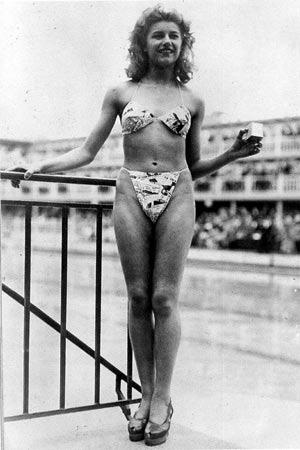
Micheline Bernardini, 1946.
Photo courtesy Wikimedia Commons

Sixty years ago, the world’s first bikini made its debut at a poolside fashion show in Paris. The swimsuit is now so ubiquitous—and comparatively so demure—that it’s hard to comprehend how shocking people once found it. When the bikini first arrived, its revealing cut scandalized even the French fashion models who were supposed to wear it; they refused, and the original designer had to enlist a stripper instead. The images below illustrate how the bikini slowly gained acceptance—first on the Riviera, then in the United States—and became a beachfront staple.
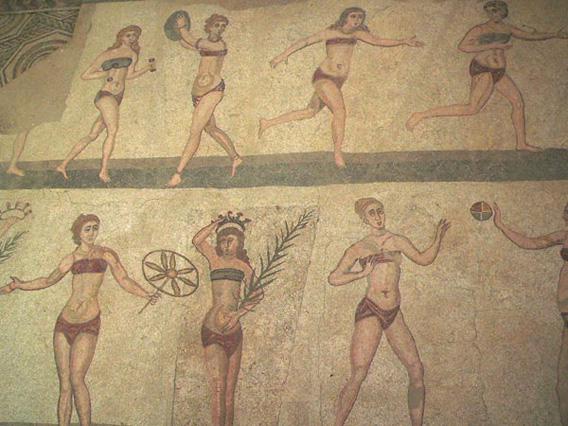
When the bikini was unveiled in 1946, it was by no means the first time that women had worn so revealing a garment in public. In the fourth century, for example, Roman gymnasts wore bandeau tops, bikini bottoms, and even anklets that would look perfectly at home on the beaches of Southern California today.

Image of the "bikini girls" mosaic at the Piazza Armerina in Sicily.
Image of the “bikini girls” mosaic at the Piazza Armerina in Sicily.
Photo courtesy Wikimedia Commons

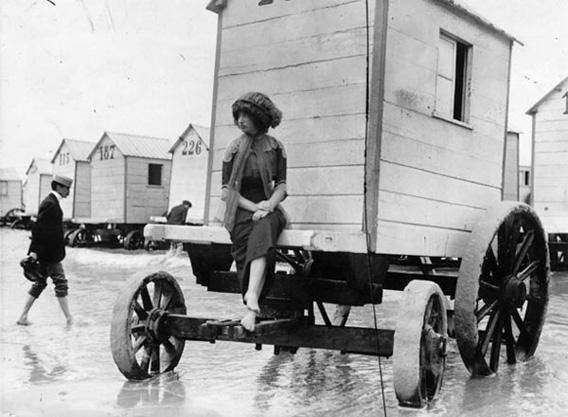
At the turn of the 20th century, though, such displays would have been unthinkable. Female swimmers went to extraordinary lengths to conceal themselves at the beach. They wore voluminous bathing costumes and even made use of a peculiar Victorian contraption called the bathing machine, essentially a small wooden or canvas hut on wheels. The bather entered the machine fully dressed and donned her swimming clothes inside. Then, horses (or occasionally humans) pulled the cart into the surf. The bather would disembark on the seaside, where she could take a dip without being observed from the shore.

Woman perching on the edge of a bathing machine at an Ostend, Belgium, beach.
Photo by Topical Press Agency/Getty Images
Annette Kellerman circa 1905.
Photo by Hulton Archive/Getty Images

In the decades that followed, the seaside dress code loosened up considerably. In 1907, Australian swimmer and silent-film star Annette Kellerman—a vocal advocate of more hydrodynamic swimwear—was charged with indecent exposure for appearing on Boston’s Revere Beach in a form-fitting, sleeveless tank suit. The ensuing high-profile legal scuffle led beaches across the nation to relax their swimwear restrictions. By 1915, American women commonly wore one-piece knitted maillots.
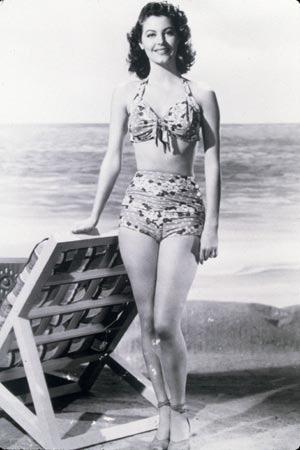
Oddly enough, the two-piece swimsuit—which usually consisted of a structured halter top and modest bottom that covered the navel, hips, and derrière—arrived with much less fanfare than the bikini. By the early ‘40s, film stars including Ava Gardner, Rita Hayworth, and Lana Turner were all wearing the two-piece, and it was seen frequently on American beaches. Why were the inches of skin above the bellybutton so much less controversial than those below it? Hollywood’s Hays production codes allowed two-piece gowns but prohibited navels on-screen. That meant the rib cage earned a ho-hum reputation, but the bellybutton was uncharted territory.

Ava Gardner, Hollywood California, 1941.
Ava Gardner, Hollywood, Calif., 1941.
Photo by SNAP/Zuma Press

In the 1940s—as Kelly Killoren Bensimon details in The Bikini Book—attractive women were known as “bombshells,” and anything intense was “atomic.” So, when two Frenchmen independently designed skimpy alternatives to the two-piece in the summer of 1946, both suits got nuclear nicknames. The first designer, Jacques Heim, created a tiny suit called the atome. The second, Louis Reard, introduced his design on July 5, four days after the United States had begun atomic testing in the Bikini Atoll. In a rather bold marketing ploy, Reard named his creation le bikini, implying it was as momentous an invention as the new bomb.
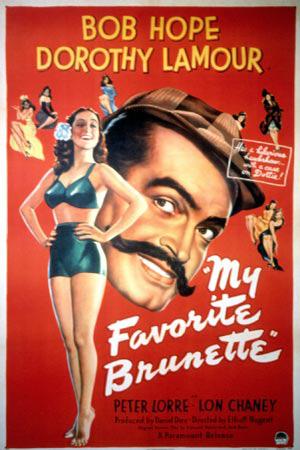
Thanks to its provocative name and cut, the bikini made international headlines. Photos of Micheline Bernardini, the stripper Reard had enlisted to model it, circulated across the globe. But in the United States, women—including actresses in movies like 1947’s My Favorite Brunette and the model on this 1948 cover of Life magazine—stuck with the traditional two-piece.

Poster of My Favorite Brunette, 1947.
Image courtesy Everett Collection

In 1950, Time interviewed American swimsuit mogul Fred Cole and reported that he had “little but scorn for France’s famed Bikini bathing suits,” because they were designed for diminutive Gallic women. “French girls have short legs,” he explained to Time. “Swimsuits have to be hiked up at the sides to make their legs look longer.”

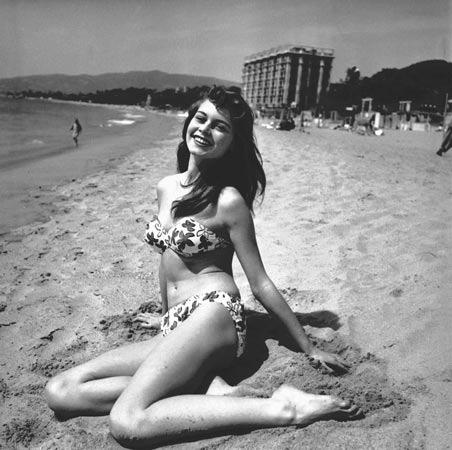
Brigitte Bardot
Brigitte Bardot at the 6th International Cannes Film Festival, 1953.
Photo by LIDO/SIPA

Whether or not the thong ever makes it out of the lingerie drawer, though, the bikini is here to stay. Still, like most sexagenarians, it’s gotten a bit tame: It still has the power to titillate, but it’s lost the power to shock.
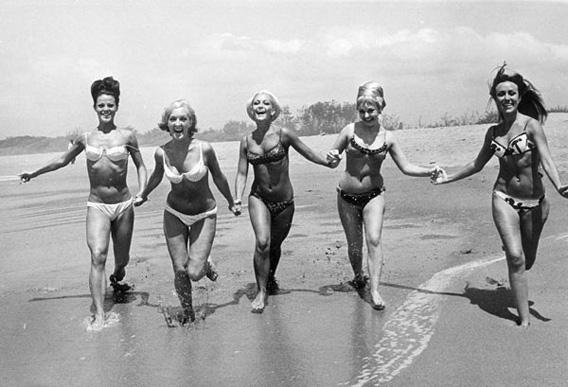
Just three summers later, though, the bikini had established a beachhead on these shores. This was in large part because of the increasing popularity of the private pool, which gave women a secluded place to test out the new look. A Neiman Marcus buyer classified the bikini as “a big thing” for 1960. Brian Hyland also had a hit that year with the song “Itsy Bitsy, Teenie Weenie, Yellow Polka Dot Bikini,” which takes on new meaning when you realize the swimsuit was still catching on at the time. No wonder the song’s protagonist was “afraid to come out of the water.”

Bikini beach scene, 1965.
Photo by Michael Irwin/Rex Features


by Sasha Djoric July 05, 2017 7 min read 1 Comment
First Bikini 1946
Michelin Bernardini, Paris, July 5th, 1946

In the spirit of freedom and rebellious creativity, AMARA proudly raises its fist to the sky in honour of Louis Reard and the 71st anniversary of his design - the modern bikini. Circa July 5th, 1946 Michelin Bernardini donned the prototype of the modern bikini crafted by this French engineer. This was also the year in which the United States and the Soviet Union began their nuclear dance that resulted in the start of the Cold War. 4 days earlier, the US had nestled on the peaceful cluster of islands of Bikini Atoll to test their atomic bombs. Subsequently, Louis had borrowed the name for his new inspiring design 
hoping the bikini would create an "explosive commercial and cultural reaction". What would be more controversial than testing nuclear weaponry? Women in scandalous swimwear, without a doubt.
Bikini Atoll, July 1st, 1946

The test areas for the atomic bombs included the sea, parts of the local reef, in the air above the islands and underwater. Unsurprisingly, this was a huge devastation to its local populous, on land and in water. At the time, however, this catastrophe was nothing to some, compared to seeing a woman in a two piece bathing suit. The Catholic Church had much to say; which at the time, didn't have the best track record of honouring femininity and female empowerment. Some facets of the media and general public thought the bikini -that every women in the world now owns- was outrageous. But of course, even the most outrageous things build traction, and the vixens, rebels and women of freedom had no plan on stepping down.

Bridgette Bardot in Capri during the production of Jean-Luc Godard’s 1963 movie Contempt
Fast forward to 1951, where many contestants of the World Beauty Pageant squeezed into the provocative and curve adoring bikinis. With every silver lining in life, there is a darker cloud that looms ahead to block the sun, as it did back then when the bikini was banned from the competition. Yet still, women and fashion persisted in the game of activism and freedom. Iconic women of their time like Brigitte Bardot, Rita Hayworth and Eva Gardner wore the daring new bikini and flaunted their own unique shapes across beaches. The dames who wore it were mostly upper middle-class Europeans linked with the vanguard and celebrities. Despite the support and praise he had received, the bikini was banned from the beaches in Italy and Spain and continuously shunned by a greater societal resistance. Pope Pius XII claimed it sinful. With the design still largely shunned throughout the 50's, the beachwear crusade was far from over. No promised land would be reached until we had the right to bear our bods. His design eventually spread around the world from France; bearing the female form in all its glory to scrutinizing onlookers, who were stuck in the archaic undertow of sexism.

Ursula Andress in Dr. No, 1964
This went beyond our exposed feminine curves, in an age where it was mind-boggling to see a woman’s bare stomach in public. This was about equality and breaking the boundaries on conformity. The outdated points of view on the definition of being a woman was held on trial and failing. We had reached an impasse where the once delicate, quiet female creature was blooming into a beautiful force to be reckoned with. We were coming into our own, at the time when the world had manipulated and abused our power and capabilities for far too long. The innate female sexuality had begun to reveal itself in the most empowering way possible. This was one of the final frontiers of equilibrium between men and women. For centuries we’d been the praise and muse for artists, yet still snuffed out and dubbed powerless aside from two chauvinistic traits: childbearing and arm candy. But the irony is how many powerful and affluent women dominated our world history before and after, despite these notions. Women who didn’t have children, or husbands either. Women had played essential roles in the first and second world wars. From immersing ourselves in respective government roles, acting as nurses and doctors in battlefields and working long hours in factories making guns and ammunition. Queen Elizabeth the 1st never married or bore children, yet she’s considered one of the most accomplished, peaceful and intelligent sovereigns in England to this day. Cleopatra ruled her time at the ripe age of 18, spoke 7 different languages and united Egypt with the Roman Empire. Marie Curie was the first women to win a Nobel Prize- twice.Frida Kahlo, from AMARA’s backyard of Mexico, is still admired as a feminist icon. Harriet Tubman. Hellen Keller. Perhaps these women hadn’t owned bikinis, but they sure as hell would have looked beautiful in one. Countless times we’d proven ourselves as formidable and capable of any feat in the face of threats and subtleties of daily life. All of us were decorated in finesse, refinement, and femininity. Yet with all that we had proven to ourselves and the world, we were continuously silenced.
Bridgette Bardot, A Very Private Affair 1962
Following the release of the bikini, Reard received over 50,000 fan letters in support of the design. The feminine limit that had been set in place was beginning to crumble, and it was a shining example that we were far from giving up. The modern bikini was another lighthouse on the stormy shores of sexual equality. It was a new way of looking at ourselves and our bodies- and being proud. He had created a tool for us to transform ourselves into something more free and stunning, another way in which we could celebrate ourselves. He’d given us a mirror in which our beauty was reflected. Bikinis are all different, as are the women who wear them. Whether a gal back in the day was curvy, thin or any of the beautiful variants in between, Reard’s design had helped pull back the curtain and showed us just how beautiful our bodies were. Our days of hiding away in the shade were dwindling, and soon we would be basking in the sun.

Bridgette Bardot in Cannes, 1953
Yet despite the sliver of support the modern bikini had received compared to the unceasing resistance on religious and societal fronts, freedom had prevailed and thus began the bikini revolution. The arts had been a great help in the movement. Most prominently, it was the Cannes Festival and style icon Bridget Bardot that had greatly helped this scandalous swimsuits popularity gain traction. Although not showing a film that year, Bardot stole the headlines when she wore a strapless floral bikini at the festival in ’53. However, it wasn't until the early 1960’s that the bikini became socially acceptable and sought after from the every day. The bombshell design had even begun to integrate into the creative arts: from television to songs to movies. How can we forget Brian Hyland’s song "Itsy Bitsy Teenie Weenie Yellow Polka Dot Bikini”? A fashion cult classic. Strangely enough, the modern bikini made its true splash in the sea of activism right around the time of the sexual revolution in the United States. Can you think of a better way to rebel against sexism than in a bikini?


Rachel Welsh in Fathom, 1967

Louis had continued to push the boundaries of the modern bikini with daring designs throughout the 70’s and 80’s, along side women pushing the boundaries of female fashion. Sadly, in ’84 he had passed away, with his company eventually closing 4 years later. In the aftermath, this was the period in which public awareness on skin cancer grew exponentially. With this new global focus came a decline in the skimpy and scandalous modern bikini, and the rebirth of the one piece and simpler swimwear designs created to cover. This shift in society and design however opened up a whole new world of variants of modern swimwear. Which in turn, gave women more room to play around and strut their stuff in equally cute and sexy designs; ultimately continuing to empower them in different ways. From the tankini to the monokini we could use fashion to explore ourselves and what we loved best about our bodies. We’d had ruffles, suspenders, straps and daring cut outs. In the end, it wasn't about how many designs we could play with, but the ways in which we could express ourselves.
Marilyn Monroe High Waisted BikiniMarilyn Monroe wearing a high-waisted bikini

It's upsetting to think how women were relentlessly oppressed and ridiculed for wanting freedom. Freedom of expression and creativity. Freedom to vote, to make our own important decisions. It’s strange that our bodies once held such power over the opinions people and society had of us. That a little extra skin on the beach could cause such an uproar; that those who wore a bikini were indecent and undeserving of basic respect is an almost non-existent thought in our modern society. But that was the reality of being a woman of that time wanting freedom. And though our views have matured and expanded over the last 70 years, it's strange to think that to this day, women still face body shaming and belittlement when it comes to bearing their charms. Either your bathing suit is too skimpy or too conservative. You’re too chubby for that bikini or your hips are too wide for that one piece. You aren’t curvy enough to wear a high waisted bathing suit, or your breasts are too big for that top. Yes, us women have still continued to rise together, to empower each other and the world in accepting our individual and beautiful quirks. But we are far from the goal of truly accepting each other, and ultimately ourselves.
Evelyn Eugene Turner 1955
Evelyn Eugene Turner wearing one of Renard's designs, 1955

The modern bikini was a call to action for all women, those in the past and us of the future to cut down the barriers that we and an oppressive society had built around ourselves. Reard helped us to break our chains by showing us we were much more than our curves, and yet could still honour our female form with confidence and liberty. Our voices never wavered in the quest to fearlessly bear our beauty and Reard’s was among the loudest of us to sing in the rebellion. Keep singing. Dive fearlessly, eyes open, into the sea of femininity. In your favourite bikini, of course.
Naomi Campbell, Tyra Banks, and Beverly Peele. Photographed by Patrick Demarchelier, Vogue, May 1992Naomi Campbell, Tyra Banks, and Beverly Peele. Photographed by Patrick Demarchelier, Vogue, May 1992