MGR Remembered – Part 22
MGR Remembered – Part 22
Sibling Rivalry and Siblicide in DMK of 1950s
 MGR with S.S.Rajendran (in late 1950s)
by Sachi Sri Kantha, November 3, 2014
In the previous chapter, I introduced Erik Erikson’s generativity concept by MGR as a member of DMK in 1950s. As previous observers of DMK politics of that era, especially Robert Hardgrave Jr., had noted MGR was not alone in promoting DMK policies. Due credit should be given to other film artistes, who were MGR’s contemporaries. Apart from leader Anna himself, there were actors N.S. Krishnan, K.R. Ramasamy, D.V. Narayanaswamy, Sivaji Ganesan, S.S. Rajendran (Narayanaswamy’s brother in law), music director-playback singer Chidambaram S. Jayaraman (Karunanidhi’s brother in law), lyricist Udumalai Narayana Kavi, scriptwriter-lyricist M. Karunanidhi, lyricist-script writer Kannadasan and script writer-producer Murasoli Maran (Karunanidhi’s nephew) as well. The death of S.S. Rajendran (SSR) on October 24 at the age of 86, closes one chapter among the DMK’s ‘heavies’ of that era. This death leaves Karunanidhi alone, as the ‘last man standing’!
MGR with S.S.Rajendran (in late 1950s)
by Sachi Sri Kantha, November 3, 2014
In the previous chapter, I introduced Erik Erikson’s generativity concept by MGR as a member of DMK in 1950s. As previous observers of DMK politics of that era, especially Robert Hardgrave Jr., had noted MGR was not alone in promoting DMK policies. Due credit should be given to other film artistes, who were MGR’s contemporaries. Apart from leader Anna himself, there were actors N.S. Krishnan, K.R. Ramasamy, D.V. Narayanaswamy, Sivaji Ganesan, S.S. Rajendran (Narayanaswamy’s brother in law), music director-playback singer Chidambaram S. Jayaraman (Karunanidhi’s brother in law), lyricist Udumalai Narayana Kavi, scriptwriter-lyricist M. Karunanidhi, lyricist-script writer Kannadasan and script writer-producer Murasoli Maran (Karunanidhi’s nephew) as well. The death of S.S. Rajendran (SSR) on October 24 at the age of 86, closes one chapter among the DMK’s ‘heavies’ of that era. This death leaves Karunanidhi alone, as the ‘last man standing’!
Difference between Madras and Bombay movies of 1950s
During the 1950s, there were two big differences between the movies produced in Madras and Bombay. First, Hindi movies produced in Bombay, in the spirit of newly independent India, the call was for unity and nation-building. Contrastingly, due to the influence of DMK’s then secessionist principle and its major players in the drama-movie world, Tamil movies promoted separate state idea for Tamils, and the separate culture of Northern Aryans and Southern Dravidians. Secondly, Muslims played a major role Hindi movies as actors (carrying masked Hindu stage names), play back singers, lyricists, music directors and directors. But, in Tamil movies, Muslims couldn’t gain a prominent strong hold. In 1950s, among the Muslims who shined in the Hindi movies the following deserve mention. Actors: Dilip Kumar (Yusuf Khan), Madhubala (Begum Mumtaz Jehan), Nargis (Fatima Rashid), Waheeda Rehman; Playback singer: Mohammed Rafi; Music director: Naushad Ali; Director: Mehboob (Ramjan Khan); Lyricist-director: Kamal Amrohi (Syed Amir Haider Kamal).
In the Tamil movies, there was one hero with Muslim name – G.M. Basheer. He couldn’t rise to the top rank. Another actor with a Muslim name, M.K. Mustapha, was in MGR’s drama troupe. Though he acted in a few Tamil movies, he couldn’t elevate himself as a top rank hero. Susequently, there was a stunt Muslim actor C.L. Anandan (as a masked name) who became a ‘hit’ for a few movies, but faded soon. Lyricist Ka. Mu. Sheriff, was the only one Muslim who was able gain distinct name recognition in 1950s. There was one music director with the name T.M. Ibrahim, who scored for a few Tamil movies. In his autobiography, MGR mentions briefly about this Ibrahim (as one “who is younger to me by one or two years”), who later became a music director, though he was more interested in acting and singing. Why Muslims couldn’t make it to the top in Tamil movies deserves an in-depth study. Not that, Hindu parochialism ruled the roost in Tamil Nadu. Afterall, DMK preached atheism and anti-Brahmin sentiments in 1950s.
Leading Heroes of Tamil Movies in 1950s
In chronological order of birth, the leading heroes of Tamil movies in 1950s were as follows: K.R. Ramasamy(1914-1971)–singer/actor, MGR (1917-1987), T.R. Ramachandran (1917?-1990), Gemini Ganesan (1920-2005), T.R. Mahalingam (1923-1978) – singer/actor, SSR (1928-2014), and Sivaji Ganesan (1928-2001). Comedian actor N.S. Krishan (1909-1957) should also be added to this list as a senior contemporary. Among these, five other than T.R. Ramachandran, Gemini Ganesan and T.R. Mahalingam were affiliated with DMK. Among the eight, K.R. Ramasamy, T.R. Mahalingam and N.S. Krishnan belonged to the old school of singer-actor category, and their opportunities waned in the late 1950s, with the rise of triumvirates of Tamil movies (MGR, Sivaji Ganesan and Gemini Ganesan). N.S. Krishnan became an alcoholic and died prematurely in 1957. SSR held on his own, for his polished Tamil dialogue delivery style and occasionally appearing with Sivaji Ganesan, in movies. SSR also appeared with MGR in two costume-adventure movies, Raja Desingu (King Desingu, 1960) and Kaanchi Thalaivan (Leader of Kanchi, 1963).
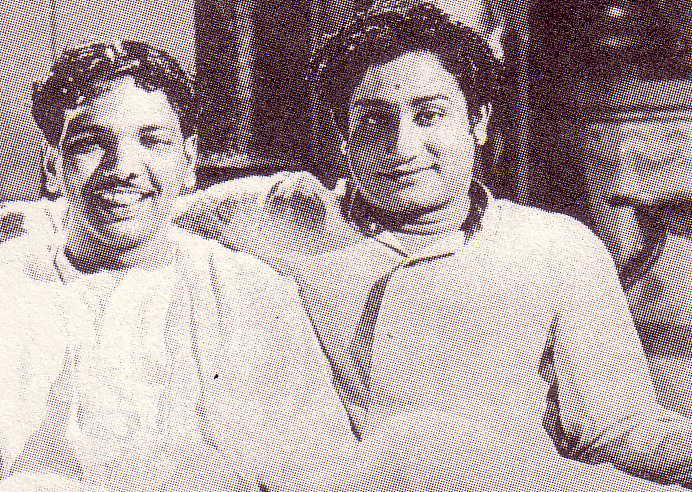 Karunanidhi (lt) and Sivaji Ganesan (rt) in 1950s
Brief Chronology of Political and Cinema Activities of DMK Members (1954-59)
To summarize the activities of MGR’s contemporaries, I provide the following chronology, based on the sources (Film News Anandan, Kannan, Kannadasan, Karunanidhi and Sivaji Ganesan) cited at the end.
1954 March 3: release of Manohara (Manohara) movie, starring Sivaji Ganesan and SSR, scripted by Karunanidhi. A big success in box office.
1954 April 9: release of Illara Jothi (Light of Domesticity) movie, starring Sivaji Ganesan and scripted/lyrics by Kannadasan. A box office failure.
1954 May 25: release of Sorga Vasal (Heaven’s Gate) movie, starring K.R. Ramasamy and scripted by Anna. Moderately received, due to bad mauling by censors.
1954 June 22: First release of Kannadasan’s journal Thenral.
1954 July 22: release of Malai Kallan (Mountain Thief) movie, starring MGR and scripted by Karunanidhi. A big box office success.
1954 July 30: release of Thuli Vizham (Poison Drop) movie, starring K.R. Ramasamy (hero) and Sivaji Ganesan (villain), scripted and directed by A.S.A. Samy.
1954 Aug. 26: release of Koondu Kili (Caged Parrot) movie, starring MGR and Sivaji Ganesan. A box-office failure.
1954 October 15: release of Rathak Kanneer (Blood Tears) movie, starring M.R. Radha and SSR, with Chidambaram Jayaraman as music director. A big success
1955 July 29: release of Gul e Baghavali (Gul e Baghavali) movie, starring MGR. a big success.
1956 January 14: release of Alibabavum 40 Thirudarkalum (Alibaba and 40 Thieves) movie. The first Tamil movie to be produced in color (Geva). A big success.
1956 April 13: release of Madurai Veeran (Hero of Madurai) movie, starring MGR. A big successful movie for MGR, in which the hero character dies at the end!
1956 September 4: release of Thaiku Pin Thaaram (Wife after Mother) movie, starring MGR. The first successful movie in a social theme for MGR. A big success.
1956 November: Tamilnadu suffered from disruptive cyclone damage. DMK launced a fund drive to support victims. Sivaji Ganesan also became a victim of sibling rivalry and discord in receiving deserved recognition. The instigator of such a design, was not identified by him openly, but he hints Karunanidhi.
1957 March 31: Madras State Assembly election. DMK candidates contested for the first time, under Independent label. While Karunanidhi won at Kulithalai constituency, SSR and Kannadasan lost in their respective constituencies Theni and Thirukoshtiyur.
1957: Sivaji Ganesan sidelined from DMK and dissociate himself from the party, after a visit to Tirupathi temple. MGR receives prominent treatment. Kannadasan openly attacks Sivaji Ganesan, in his journal Thenral.
1957 August 30: death of comedian actor and senior contemporary N.S. Krishnan.
1957 December 9: Prime Minister Nehru delivers a speech at Tiruchirapalli that he was ready even for a war against secessionist tendencies promoted by DMK.
1958 January 6: Black Flag protest to prime minister Nehru during his visit to Madras. MGR detained at Madras jail with SSR.
1958 February 22-23: DMK’s regional conference held at Deva Kottai at Ramanathapuram district. Opening address delivered by SSR. Karunanidhi scripted drama ‘Rising Sun’ staged for the first time.
1958 March 1: DMK receives ‘Rising Sun’ as its official symbol from the Election Commission.
1958 June 27: release of Malai idda Mangai (A Virgin, who garlanded) movie, starring T.R. Mahalingam; produced by Kannadasan. Success in box office, but not for Kannadasan!
1958 August 22: release of Nadodi Mannan (Vagabond King) movie, the first movie under ‘MGR Pictures’ banner. A big success in box office.
1959 January: DMK wins prominently at the Madras municipal council elections. DMK candidates won 45 seats (compared to Congress Party candidates winning 37 seats) for 100 seat assembly. Subsequently A.P. Arasu of DMK was elected as the mayor of Madras city. At the felicitation meeting held, Kannadasan was disillusioned with the recognition Karunanidhi received from the hands of Anna.
1959 February: At the general council meeting of DMK held in Puthukottai, E.V.K. Sampath (then ranked no. 2 in DMK hierarchy) accused Anna and Nedunchezhiyan for not spreading the party message to other three (Andhra, Kannada and Kerala) states.
1959 May 6: release of Veera Pandiya Kattabomman (Heroic Pandiya Kattabomman) movie, starring Sivaji Ganesan in the title role. A big success in box office.
1959 May 19: release of Sivagankai Seemai (Distant land of Sivagankai) movie, starring SSR, produced by Kannadasan; failure in box office.
1959 June 16: Left leg injury to MGR at the drama stage in Sirkazhi.
Karunanidhi (lt) and Sivaji Ganesan (rt) in 1950s
Brief Chronology of Political and Cinema Activities of DMK Members (1954-59)
To summarize the activities of MGR’s contemporaries, I provide the following chronology, based on the sources (Film News Anandan, Kannan, Kannadasan, Karunanidhi and Sivaji Ganesan) cited at the end.
1954 March 3: release of Manohara (Manohara) movie, starring Sivaji Ganesan and SSR, scripted by Karunanidhi. A big success in box office.
1954 April 9: release of Illara Jothi (Light of Domesticity) movie, starring Sivaji Ganesan and scripted/lyrics by Kannadasan. A box office failure.
1954 May 25: release of Sorga Vasal (Heaven’s Gate) movie, starring K.R. Ramasamy and scripted by Anna. Moderately received, due to bad mauling by censors.
1954 June 22: First release of Kannadasan’s journal Thenral.
1954 July 22: release of Malai Kallan (Mountain Thief) movie, starring MGR and scripted by Karunanidhi. A big box office success.
1954 July 30: release of Thuli Vizham (Poison Drop) movie, starring K.R. Ramasamy (hero) and Sivaji Ganesan (villain), scripted and directed by A.S.A. Samy.
1954 Aug. 26: release of Koondu Kili (Caged Parrot) movie, starring MGR and Sivaji Ganesan. A box-office failure.
1954 October 15: release of Rathak Kanneer (Blood Tears) movie, starring M.R. Radha and SSR, with Chidambaram Jayaraman as music director. A big success
1955 July 29: release of Gul e Baghavali (Gul e Baghavali) movie, starring MGR. a big success.
1956 January 14: release of Alibabavum 40 Thirudarkalum (Alibaba and 40 Thieves) movie. The first Tamil movie to be produced in color (Geva). A big success.
1956 April 13: release of Madurai Veeran (Hero of Madurai) movie, starring MGR. A big successful movie for MGR, in which the hero character dies at the end!
1956 September 4: release of Thaiku Pin Thaaram (Wife after Mother) movie, starring MGR. The first successful movie in a social theme for MGR. A big success.
1956 November: Tamilnadu suffered from disruptive cyclone damage. DMK launced a fund drive to support victims. Sivaji Ganesan also became a victim of sibling rivalry and discord in receiving deserved recognition. The instigator of such a design, was not identified by him openly, but he hints Karunanidhi.
1957 March 31: Madras State Assembly election. DMK candidates contested for the first time, under Independent label. While Karunanidhi won at Kulithalai constituency, SSR and Kannadasan lost in their respective constituencies Theni and Thirukoshtiyur.
1957: Sivaji Ganesan sidelined from DMK and dissociate himself from the party, after a visit to Tirupathi temple. MGR receives prominent treatment. Kannadasan openly attacks Sivaji Ganesan, in his journal Thenral.
1957 August 30: death of comedian actor and senior contemporary N.S. Krishnan.
1957 December 9: Prime Minister Nehru delivers a speech at Tiruchirapalli that he was ready even for a war against secessionist tendencies promoted by DMK.
1958 January 6: Black Flag protest to prime minister Nehru during his visit to Madras. MGR detained at Madras jail with SSR.
1958 February 22-23: DMK’s regional conference held at Deva Kottai at Ramanathapuram district. Opening address delivered by SSR. Karunanidhi scripted drama ‘Rising Sun’ staged for the first time.
1958 March 1: DMK receives ‘Rising Sun’ as its official symbol from the Election Commission.
1958 June 27: release of Malai idda Mangai (A Virgin, who garlanded) movie, starring T.R. Mahalingam; produced by Kannadasan. Success in box office, but not for Kannadasan!
1958 August 22: release of Nadodi Mannan (Vagabond King) movie, the first movie under ‘MGR Pictures’ banner. A big success in box office.
1959 January: DMK wins prominently at the Madras municipal council elections. DMK candidates won 45 seats (compared to Congress Party candidates winning 37 seats) for 100 seat assembly. Subsequently A.P. Arasu of DMK was elected as the mayor of Madras city. At the felicitation meeting held, Kannadasan was disillusioned with the recognition Karunanidhi received from the hands of Anna.
1959 February: At the general council meeting of DMK held in Puthukottai, E.V.K. Sampath (then ranked no. 2 in DMK hierarchy) accused Anna and Nedunchezhiyan for not spreading the party message to other three (Andhra, Kannada and Kerala) states.
1959 May 6: release of Veera Pandiya Kattabomman (Heroic Pandiya Kattabomman) movie, starring Sivaji Ganesan in the title role. A big success in box office.
1959 May 19: release of Sivagankai Seemai (Distant land of Sivagankai) movie, starring SSR, produced by Kannadasan; failure in box office.
1959 June 16: Left leg injury to MGR at the drama stage in Sirkazhi.
 Sibling Rivalry and Siblicide among DMK Artistes
In early 1950s, DMK was promoted in prose, poetry and stage as a ‘party of siblings’, following the leadership of leader Annadurai; a play on the leader’s personal name ‘Anna’ which means elder brother. As the above chronological synopsis indicates, generativity of DMK-affiliated artistes was unquestionable. But, such generativity also generated rivalry, jealousy and distrust among the participants. As a consequence, siblicide became a factor in eliminating weaklings.
Luckily, one can rely on the autobiographies of four principals – Kannadasan, MGR, Karunanidhi and Sivaji Ganesan – to learn about the inner currents which prevailed then. I have listed the four names in the chronological order they had recorded their versions. Truth has many shades, and one can infer what really happened by comparing notes. Reading these four autiobiographies, one finds that MGR had not mentioned about the friction he had with Sivaji Ganesan, which led to latter leaving DMK fold in 1957. Not only MGR, even Karunanidhi (in his volume 1, which covers his life up to 1968) and Kannadasan do not mention this conflict with Sivaji Ganesan. In a subsequent volume, Karunanidhi had implied that it was MGR who worked ‘behind’ actively to push Sivaji Ganesan out of DMK.
Sibling Rivalry and Siblicide among DMK Artistes
In early 1950s, DMK was promoted in prose, poetry and stage as a ‘party of siblings’, following the leadership of leader Annadurai; a play on the leader’s personal name ‘Anna’ which means elder brother. As the above chronological synopsis indicates, generativity of DMK-affiliated artistes was unquestionable. But, such generativity also generated rivalry, jealousy and distrust among the participants. As a consequence, siblicide became a factor in eliminating weaklings.
Luckily, one can rely on the autobiographies of four principals – Kannadasan, MGR, Karunanidhi and Sivaji Ganesan – to learn about the inner currents which prevailed then. I have listed the four names in the chronological order they had recorded their versions. Truth has many shades, and one can infer what really happened by comparing notes. Reading these four autiobiographies, one finds that MGR had not mentioned about the friction he had with Sivaji Ganesan, which led to latter leaving DMK fold in 1957. Not only MGR, even Karunanidhi (in his volume 1, which covers his life up to 1968) and Kannadasan do not mention this conflict with Sivaji Ganesan. In a subsequent volume, Karunanidhi had implied that it was MGR who worked ‘behind’ actively to push Sivaji Ganesan out of DMK.
Sivaji Ganesan’s Gripe
I present Sivaji Ganesan’s version of truth, as he reminisced to his interviewer before his death.
“…in 1956, the mother of all storms hit Tamil Nadu and disrupted normal life for many persons. Arignar Anna appealed to all of us to raise funds for flood relief. I raised funds in my individual capacity. I spoke the Parasakthi dialogue in Virudhunagar and collected the money that was placed on the cloth that I spread out for this purpose. The first to donate was a man from the Nadar community. I handed over the collections to the party and left for Salem for a shoot. Anna was conducting a function to felicitate the person who raised the maximum collection…I waited at home presuming that someone would telephone or invite me personally for the function but there was no communication. The function took place at six in the evening and for the first time MGR was called on stage and honoured. Such irony! It was I who had collected maximum funds, but the honour went to MGR. Anna had apparently asked the party workers why I was not present and he was told that I was unable to make it! Some elements hovering around Anna wanted to send me away from him. Kalignar [i.e., Karunanidhi] was also present. We were so close, yet he was unable to insist that I be invited. Well! What could he do?
No one acknowledged my presence a fact which unsettled me. I had always been patient, and impervious to all insults but this incident drove me crazy. I had been part of this movement from the time I was very young, and without warning, I was dismissed as someone of no consequence and my anna MGR, admitted instead. He was not in the least bit connected with this movement at that point. They did this just to sideline me. This is the truth and I swear by it. Many were aware of these facts but for reasons best known to them kept the truth under wraps. I wish to disclose everything. This autobiography is like my last will, so I do not wish that anything be hidden.”
In Sivaji Ganesan’s version, both MGR and Karunanidhi were mentioned. But, he had noted, MGR “was not in the least bit connected with this movement at that point.” That more or less leaves Karunanidhi as the plotter in this episode. There are two more issues which deserve consideration. First, Sivaji Ganesan’s autobiography also indicates that he “have never been a member of the DMK…I accepted the principles for which the party stood, but did not become a member.” May be, giving the benefit of doubt to Karunanidhi, (as Sivaji Ganesan had remained outside the party membership since Dec. 1949), MGR who had joined DMK and become a member in 1953, it could be argued that Sivaji Ganesan was eliminated from consideration on a technical point! Secondly, as indicated in the chronological synopsis above, MGR’s three released movies of 1956 had box office success. It could be that he might have donated more funds ‘silently’ to the party coffers without any publicity, as his philanthropy came to be recognized later, even by his enemies. Thus, MGR’s contributions came to be publicly acknowledged. One also finds it difficult to accept, that this particular insult of not receiving due recognition made Sivaji Ganesan so bitter with DMK hierarchy. After all, he was not a stranger to such insults in the cut-throat world of Tamil cinema, before the success of his debut movie Parasakthi in 1952. It is on record that notable producers of that era like A.V. Meiyappa Chettiar, S.S. Vasan, director P. Neelakandan and cameraman Jeeva had ‘insulted’ him with words such as one with ‘horse face and fish mouth’!
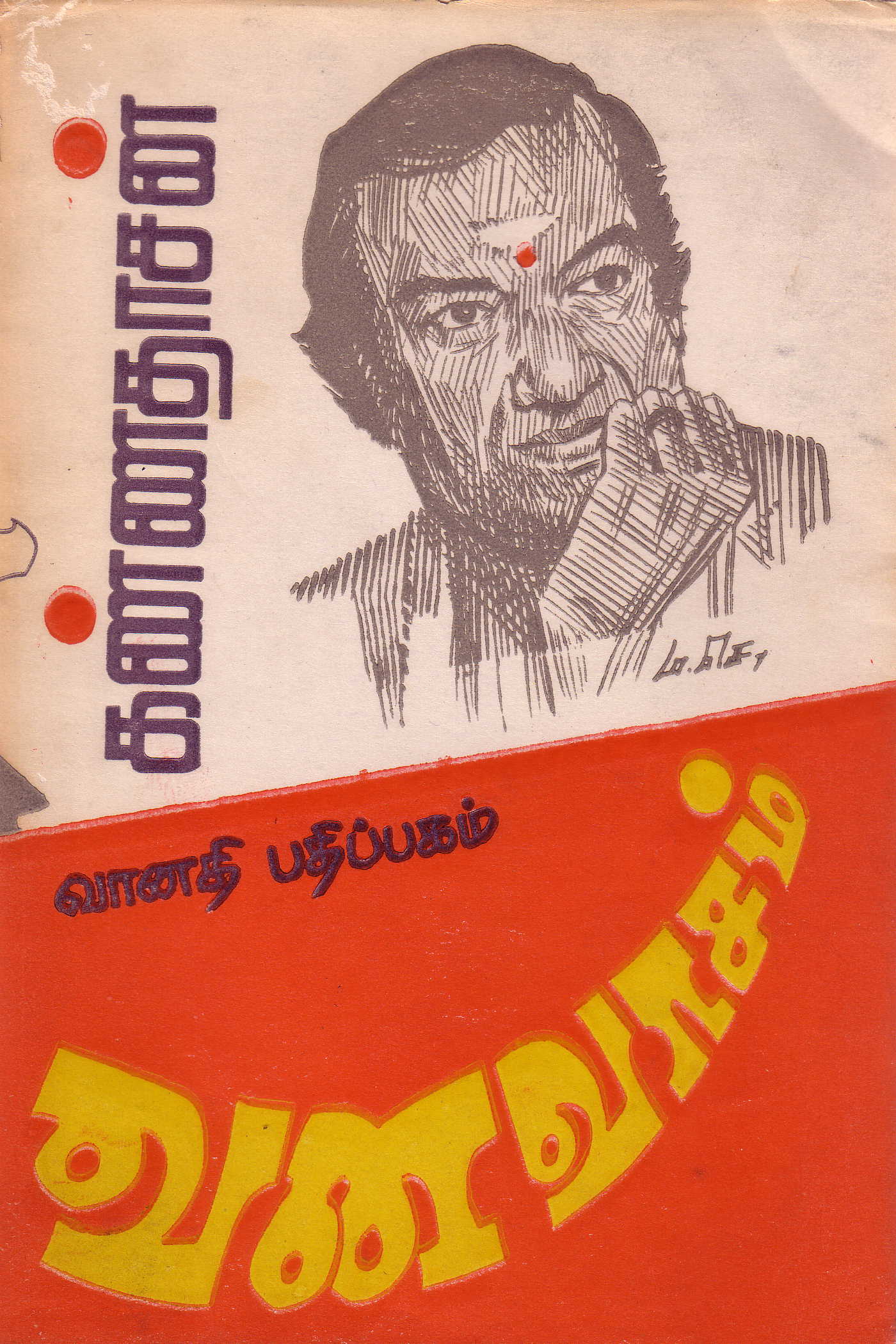 Kannadasan autobiography vol. 1
Kannadasan’s Troubles
Kannadasan did have serious sibling rivalry with Karunanidhi, since 1951. In his autobiography, Kannadasan had noted a few. He mentions that, in 1951 when he married second time (while his first wife, married in 1950, was alive), Karunanidhi had criticized him strongly, even though it was his personal affair. Karunanidhi also ordered him not to participate in the party conference. Kannadasan also mentions that in 1954, when the movie Illara Jothi starring Sivaji Ganesan was released, to which he had written the script, Karunanidhi had mixed ‘a little poison’ about him in his own journal, that a segment to that particular movie was scripted by himself (i.e, Karunanidhi). To this mischief, Kannadasan had mentioned that he delivered a zinger, comparing Karunanidhi to Shakespeare, with a caption ‘Shakespeare gained fame by stealing’! This was after he (Kannadasan) had learnt that even Shakespeare’s play plots were not original. Kannadasan mentioned that in those days, there was a common belief that the writings of Karunanidhi were not his own!
In the 1957 elections to the Madras Legislative Assembly, both SSR and Kannadasan lost. DMK didn’t receive official party recognition then. The election records show, Kannadasan came third, contesting Tirukoshtiyur (constituency 99) as an Independent. He received 9,389 votes (20.15% votes polled), against the victor N.V. Chockalingam’s (Congress Party) 20,611 votes (44.2% votes polled). In between these two, was the Communist Party candidate S. Shanmugam who polled 11,533 votes (24.75% votes polled). For this loss, Kannadasan blames his political naivete. Comparatively, SSR performed better, contesting Theni (constituency 134) as an Independent. He received 31,404 votes (21.9% polled) against the victor N. R. Thiagarajan (Congress Party) 38,185 votes (26.6%). In his autobiography, Karunanidhi had mentioned that the lack of a party symbol was a hindrance for the DMK candidates in that election. As ‘rising sun’ was an independent symbols, in some constituencies other Independent candidates not belonging to DMK had the same ‘rising sun’ symbol. Thus, it was difficult to ask for vote for the ‘rising sun’ symbol in some constituencies, and in other constituency (especially Salem, where DMK leader Nedunchezhiyan contested) another symbol had to be pleaded for voters. In that Salem constituency, Nedunchezhiyan contested under rooster symbol, as another independent candidate had received the ‘rising sun’ symbol.
To contest this 1957 election, Kannadasan had mentioned that he received a loan for 3,000 rupees. To retrieve this sum, he attempted to make a movie, having MGR in the hero role.
In his autobiography, Kannadasan adopted an unusal style, of referring himself in third person singular (he). Thus, depending on the context, in the translation of Kannadasan’s story, ‘he’ appears to reflect himself (Kannadasan) and his acquaintances as well. To quote, “He wrote a story entitled, ‘Oomaiyan Kottai’ [Fort of a Dumb Man]. One well known actor of the party was his close friend. [note by Sachi: Kannadasan do not mention MGR by name; but it was an open secret.] It was wrong to belief that he (MGR) was also a friend in day job; because of friendship, he had made contract with him. Because both were friends, another friend was willing to finance. He talked that ‘he would finish this movie, like that of his own’. But after two months, 62,000 rupees had been spent. The actor didn’t offer call sheets. He didn’t even talk to one’s face. The movie stopped abruptly. The financier lost trust, and he filed a case.”
Kannadasan continued his story further. I translate his story here, because he had provided real numbers for movie production costs during that period. “It was January 5th. The next morning, would be January 6th [1958]. On that day, DMK had planned to make Black Flag protest to Nehru. The news reached in Tiruchi on 5th that many had been arrested. He had received money and car. He feared that if he reach Chennai, he also would be arrested. He feared that those who lent money would distrust him. As such, rather than going to Chennai, he reached Bangalore. Only after the Black Flag protest events, he returned to Chennai. He wrote a poem about Black Flag protest, and escaped from the ‘sin’ of not participating in such a protest.
He had written a story based on Sarath Chandra’s ‘Chandranath’ and titled it as ‘Maalai idda Mangai’ (A Virgin, who garlanded). With 17 songs, he produced as a movie. It was over within three months. It brought him success. But, as he had sold the rights to another guy, all the profit moved to him. Then, he produced a movie with the title ‘Sivagankai Seemai’ (Distant land of Sivagankai). [note by Sachi: The hero of this movie was SSR] There was pro and con debate during the production of this movie. He produced it, in confrontation with another movie [note by Sachi: That movie was Veera Pandiya Katta bomman, with Sivaji Ganesan in title role. There was bad blood between Sivaji Ganesan and Kannadasan then.] Though that movie was of some quality, it flopped in box office, relatively to its competing movie. Credit had increased from 62,000 (rupees) to 150,000 (rupees).”
After describing his conflict and disatisfaction with Anna and Karunanidhi on how his efforts were ignored, following the 1959 Madras municipal council elections, Kannadasan had described his troubles as a third time producer. To quote, “Rather than the disgusting thing Annadurai did to him, what he did to himself was more disgusting! He produced his third movie, entitled, ‘Kavalai Illatha Manithan’ [A Man without any Troubles], as a shareholder. Uncomfortable mind. Couldn’t think seriously without worries. Situation was that one had to produce a movie in borrowed money. His partner would sign carelessly without checking what’s on the paper. Under these circumstances, he thought of something, but wrote another thing and produced it as a movie. All he had done for that movie was wrong. Troublesome story. Miscasting of actors…With all these complications, when the movie was released in September 1960, he became credit unworthy. He had lost, 590,000 rupees, in those days. Later, with interest, the amoung ballooned to 700,000 rupees.”
In sum, Kannadasan had antagonized Karunanidhi, Sivaji Ganesan and was not in good terms with MGR in late 1960s. Though I don’t have documents in my hand, I have read that singer-actor K.R. Ramasamy (who was a favorite of Anna, and senior to Karunanidhi by 10 years) was also sidelined in 1950s due to his conflict with Karunanidhi. Here is a tally, in which Karunanidhi had a dubious hand. Sivaji Ganesan quit his affiliation with DMK in 1957; K. R. Ramasamy was sidelined in DMK during late 1950s; Kannadasan quite DMK in 1961; SSR was sidelined in DMK during late 1960s; MGR was thrown out of DMK in 1972.
Kannadasan autobiography vol. 1
Kannadasan’s Troubles
Kannadasan did have serious sibling rivalry with Karunanidhi, since 1951. In his autobiography, Kannadasan had noted a few. He mentions that, in 1951 when he married second time (while his first wife, married in 1950, was alive), Karunanidhi had criticized him strongly, even though it was his personal affair. Karunanidhi also ordered him not to participate in the party conference. Kannadasan also mentions that in 1954, when the movie Illara Jothi starring Sivaji Ganesan was released, to which he had written the script, Karunanidhi had mixed ‘a little poison’ about him in his own journal, that a segment to that particular movie was scripted by himself (i.e, Karunanidhi). To this mischief, Kannadasan had mentioned that he delivered a zinger, comparing Karunanidhi to Shakespeare, with a caption ‘Shakespeare gained fame by stealing’! This was after he (Kannadasan) had learnt that even Shakespeare’s play plots were not original. Kannadasan mentioned that in those days, there was a common belief that the writings of Karunanidhi were not his own!
In the 1957 elections to the Madras Legislative Assembly, both SSR and Kannadasan lost. DMK didn’t receive official party recognition then. The election records show, Kannadasan came third, contesting Tirukoshtiyur (constituency 99) as an Independent. He received 9,389 votes (20.15% votes polled), against the victor N.V. Chockalingam’s (Congress Party) 20,611 votes (44.2% votes polled). In between these two, was the Communist Party candidate S. Shanmugam who polled 11,533 votes (24.75% votes polled). For this loss, Kannadasan blames his political naivete. Comparatively, SSR performed better, contesting Theni (constituency 134) as an Independent. He received 31,404 votes (21.9% polled) against the victor N. R. Thiagarajan (Congress Party) 38,185 votes (26.6%). In his autobiography, Karunanidhi had mentioned that the lack of a party symbol was a hindrance for the DMK candidates in that election. As ‘rising sun’ was an independent symbols, in some constituencies other Independent candidates not belonging to DMK had the same ‘rising sun’ symbol. Thus, it was difficult to ask for vote for the ‘rising sun’ symbol in some constituencies, and in other constituency (especially Salem, where DMK leader Nedunchezhiyan contested) another symbol had to be pleaded for voters. In that Salem constituency, Nedunchezhiyan contested under rooster symbol, as another independent candidate had received the ‘rising sun’ symbol.
To contest this 1957 election, Kannadasan had mentioned that he received a loan for 3,000 rupees. To retrieve this sum, he attempted to make a movie, having MGR in the hero role.
In his autobiography, Kannadasan adopted an unusal style, of referring himself in third person singular (he). Thus, depending on the context, in the translation of Kannadasan’s story, ‘he’ appears to reflect himself (Kannadasan) and his acquaintances as well. To quote, “He wrote a story entitled, ‘Oomaiyan Kottai’ [Fort of a Dumb Man]. One well known actor of the party was his close friend. [note by Sachi: Kannadasan do not mention MGR by name; but it was an open secret.] It was wrong to belief that he (MGR) was also a friend in day job; because of friendship, he had made contract with him. Because both were friends, another friend was willing to finance. He talked that ‘he would finish this movie, like that of his own’. But after two months, 62,000 rupees had been spent. The actor didn’t offer call sheets. He didn’t even talk to one’s face. The movie stopped abruptly. The financier lost trust, and he filed a case.”
Kannadasan continued his story further. I translate his story here, because he had provided real numbers for movie production costs during that period. “It was January 5th. The next morning, would be January 6th [1958]. On that day, DMK had planned to make Black Flag protest to Nehru. The news reached in Tiruchi on 5th that many had been arrested. He had received money and car. He feared that if he reach Chennai, he also would be arrested. He feared that those who lent money would distrust him. As such, rather than going to Chennai, he reached Bangalore. Only after the Black Flag protest events, he returned to Chennai. He wrote a poem about Black Flag protest, and escaped from the ‘sin’ of not participating in such a protest.
He had written a story based on Sarath Chandra’s ‘Chandranath’ and titled it as ‘Maalai idda Mangai’ (A Virgin, who garlanded). With 17 songs, he produced as a movie. It was over within three months. It brought him success. But, as he had sold the rights to another guy, all the profit moved to him. Then, he produced a movie with the title ‘Sivagankai Seemai’ (Distant land of Sivagankai). [note by Sachi: The hero of this movie was SSR] There was pro and con debate during the production of this movie. He produced it, in confrontation with another movie [note by Sachi: That movie was Veera Pandiya Katta bomman, with Sivaji Ganesan in title role. There was bad blood between Sivaji Ganesan and Kannadasan then.] Though that movie was of some quality, it flopped in box office, relatively to its competing movie. Credit had increased from 62,000 (rupees) to 150,000 (rupees).”
After describing his conflict and disatisfaction with Anna and Karunanidhi on how his efforts were ignored, following the 1959 Madras municipal council elections, Kannadasan had described his troubles as a third time producer. To quote, “Rather than the disgusting thing Annadurai did to him, what he did to himself was more disgusting! He produced his third movie, entitled, ‘Kavalai Illatha Manithan’ [A Man without any Troubles], as a shareholder. Uncomfortable mind. Couldn’t think seriously without worries. Situation was that one had to produce a movie in borrowed money. His partner would sign carelessly without checking what’s on the paper. Under these circumstances, he thought of something, but wrote another thing and produced it as a movie. All he had done for that movie was wrong. Troublesome story. Miscasting of actors…With all these complications, when the movie was released in September 1960, he became credit unworthy. He had lost, 590,000 rupees, in those days. Later, with interest, the amoung ballooned to 700,000 rupees.”
In sum, Kannadasan had antagonized Karunanidhi, Sivaji Ganesan and was not in good terms with MGR in late 1960s. Though I don’t have documents in my hand, I have read that singer-actor K.R. Ramasamy (who was a favorite of Anna, and senior to Karunanidhi by 10 years) was also sidelined in 1950s due to his conflict with Karunanidhi. Here is a tally, in which Karunanidhi had a dubious hand. Sivaji Ganesan quit his affiliation with DMK in 1957; K. R. Ramasamy was sidelined in DMK during late 1950s; Kannadasan quite DMK in 1961; SSR was sidelined in DMK during late 1960s; MGR was thrown out of DMK in 1972.
MGR and SSR in detention in January 1958
In his autobiography, MGR had described briefly about the time he spent in detention about that Black Flag protest event, which Kannadasan had deliberately avoided. Excerpts:
“That particular Black Flag demonstration was decided to criticize because [Nehru] had insulted Periyar’s [talk] as nonsense, and not for accepting the wishes of Tamilnadu people. Because, that demonstration was not directly decisive to nation’s welfare, artistes, lawyers and students were exempted from that protest. I returned home from shooting after midnight 12 o’ clock, and took notes for the next day’s shooting and went to bed around 2 am. I thought, I was being waked for next day’s shooting. Then only, I realized that it was the police personnel.
I asked him: ‘Where is thamby SSR? Where is Mr. KRR? Are you taking me to the place where they are? If so, I’m happy. ”[Initials KRR refers to actor K.R. Ramasamy.] I was greeted with silence. I was taken to Mylapore police station. The officer there asked me to sit in a bench, and took care of his work. Not a word with me.
After a while, thamby SSR also arrived. Like me, he also had asked the same questions. “Where are Mr. KRR and MGR?”
Mr. K.Subramaniam, late director and one who treated me like his elder son, worried much and talked with Mr. Bakthavatsalam [then a cabinet minister in Kamaraj ministry] to release artistes like us. We received a message that we had to express our apology for participating in Black Flag protest and hereafter we’ll not take part in such a protest. We had informed that we cannot offer such apology. We also received again a message, that if our nearest kin can offer such an apology, it would suffice. Though we wished to contact our nearest kin, we couldn’t contact them. Somehow, we were released next day afternoon.”
Nehru’s Firm Hand
M.J. Akbar, one of Nehru’s biographer, noted that in late 1950s, Nehru’s firmness on the question of Indian unity strengthened with time. Thus, by guile, Nehru deflated the separatists raising their heads in Kashmir (leader was Sheikh Muhammad Abdullah), Nagaland (leader was Zapu Phizo) and the then Madras state (leader Annadurai). As far as DMK was concerned, Nehru was lucky in that he had Congress Party (then led by K. Kamaraj) in power. Karunanidhi’s ambition to raise himself to the top after Anna’s demise notwithstanding, in hindsight, one may wonder whether a couple of bureaucratic officials in alliance with the Congress Party in power manipulated defections of E.V.K. Sampath and Kannadasan from DMK in 1961. Why I pose this question is because, Karunanidhi himself had alluded to such ‘soft blackmailing’ by Central government’s tax officials dancing according to the whims of Indira Gandhi, in pulling MGR out of DMK in 1972. Creating friction between number One and number Two of rival parties has remained a time-tested Chanakiyan or Machiavallian strategy of political enemies. To the best of my knowledge, positive evidence for such a defection to deflate secessionist tendencies in Tamil Nadu has not been offered, but M.J. Akbar alludes to such Nehruvian guile in the cases of Nagaland and Kashmir. Two specific facts do provide meager support to the ‘soft blackmail’ theory. First, Sambath was one of the two DMK MPs elected in 1957. Thus, Central government officials might have had easy access to him at New Delhi. Secondly, after leaving DMK in 1961, Sambath in association with Kannadasan, floated a short-lived Tamil National Party (TNP) for a while, but merged his party with the Congress Party within a few years.
Cited Sources
M.J. Akbar: Nehru – The Making of India, Penguin Books, New Delhi, 1989.
Film News Anandan: Sadhanaigal Padaitha Thamizhthiraipada Varalaru [Tamil Film History and its Achievements], Sivagami Publications, Chennai, 2004. (in Tamil)
Robert L. Hardgrave Jr: The DMK and the politics of Tamil Nationalism. Pacific Affairs, winter 1964-65; 37(4): 396-411.
Kannadasan: Vanavaasam [Forest Living], Vanathi Pathippagam, Chennai, 12th edition 1991 (originally published 1965). (in Tamil)
- Kannan: Anna – The Life and Times of C.N. Annadurai, Penguin Books, New Delhi, 2010.
- Karunanidhi: Nejunkku Neethi [Justice for the Heart], vol.1, Thirumakal Pathippagam, Chennai, 2nd edition, 1985 (originally published 1975). (in Tamil).
Sheila J. Nayar: The values of fantasy – Indian popular cinema through Western scripts. Journal of Popular Culture, 1997; 31(1): 73-90.
Jacob Pandian: Re-Ethnogenesis – The quest for a Dravidian identity among the Tamils of India. Anthropos, 1998; 93: 545-552.
MGR: Naan Yean Piranthen?(Why I was Born?) – autobiography, part 1, Kannadhasan Pathippagam, Chennai, 2014, pp. 478-479.
MGR: Naan Yean Piranthen?(Why I was Born?) – autobiography, part 2, Kannadhasan Pathippagam, Chennai, 2014, pp.1180-1182.
Sivaji Ganesan: Autobiography of an Actor, Sivaji-Prabhu Charities Trust, Chennai, 2007.
MGR with S.S.Rajendran (in late 1950s)
by Sachi Sri Kantha, November 3, 2014
In the previous chapter, I introduced Erik Erikson’s generativity concept by MGR as a member of DMK in 1950s. As previous observers of DMK politics of that era, especially Robert Hardgrave Jr., had noted MGR was not alone in promoting DMK policies. Due credit should be given to other film artistes, who were MGR’s contemporaries. Apart from leader Anna himself, there were actors N.S. Krishnan, K.R. Ramasamy, D.V. Narayanaswamy, Sivaji Ganesan, S.S. Rajendran (Narayanaswamy’s brother in law), music director-playback singer Chidambaram S. Jayaraman (Karunanidhi’s brother in law), lyricist Udumalai Narayana Kavi, scriptwriter-lyricist M. Karunanidhi, lyricist-script writer Kannadasan and script writer-producer Murasoli Maran (Karunanidhi’s nephew) as well. The death of S.S. Rajendran (SSR) on October 24 at the age of 86, closes one chapter among the DMK’s ‘heavies’ of that era. This death leaves Karunanidhi alone, as the ‘last man standing’!
Difference between Madras and Bombay movies of 1950s
During the 1950s, there were two big differences between the movies produced in Madras and Bombay. First, Hindi movies produced in Bombay, in the spirit of newly independent India, the call was for unity and nation-building. Contrastingly, due to the influence of DMK’s then secessionist principle and its major players in the drama-movie world, Tamil movies promoted separate state idea for Tamils, and the separate culture of Northern Aryans and Southern Dravidians. Secondly, Muslims played a major role Hindi movies as actors (carrying masked Hindu stage names), play back singers, lyricists, music directors and directors. But, in Tamil movies, Muslims couldn’t gain a prominent strong hold. In 1950s, among the Muslims who shined in the Hindi movies the following deserve mention. Actors: Dilip Kumar (Yusuf Khan), Madhubala (Begum Mumtaz Jehan), Nargis (Fatima Rashid), Waheeda Rehman; Playback singer: Mohammed Rafi; Music director: Naushad Ali; Director: Mehboob (Ramjan Khan); Lyricist-director: Kamal Amrohi (Syed Amir Haider Kamal).
In the Tamil movies, there was one hero with Muslim name – G.M. Basheer. He couldn’t rise to the top rank. Another actor with a Muslim name, M.K. Mustapha, was in MGR’s drama troupe. Though he acted in a few Tamil movies, he couldn’t elevate himself as a top rank hero. Susequently, there was a stunt Muslim actor C.L. Anandan (as a masked name) who became a ‘hit’ for a few movies, but faded soon. Lyricist Ka. Mu. Sheriff, was the only one Muslim who was able gain distinct name recognition in 1950s. There was one music director with the name T.M. Ibrahim, who scored for a few Tamil movies. In his autobiography, MGR mentions briefly about this Ibrahim (as one “who is younger to me by one or two years”), who later became a music director, though he was more interested in acting and singing. Why Muslims couldn’t make it to the top in Tamil movies deserves an in-depth study. Not that, Hindu parochialism ruled the roost in Tamil Nadu. Afterall, DMK preached atheism and anti-Brahmin sentiments in 1950s.
Leading Heroes of Tamil Movies in 1950s
In chronological order of birth, the leading heroes of Tamil movies in 1950s were as follows: K.R. Ramasamy(1914-1971)–singer/actor, MGR (1917-1987), T.R. Ramachandran (1917?-1990), Gemini Ganesan (1920-2005), T.R. Mahalingam (1923-1978) – singer/actor, SSR (1928-2014), and Sivaji Ganesan (1928-2001). Comedian actor N.S. Krishan (1909-1957) should also be added to this list as a senior contemporary. Among these, five other than T.R. Ramachandran, Gemini Ganesan and T.R. Mahalingam were affiliated with DMK. Among the eight, K.R. Ramasamy, T.R. Mahalingam and N.S. Krishnan belonged to the old school of singer-actor category, and their opportunities waned in the late 1950s, with the rise of triumvirates of Tamil movies (MGR, Sivaji Ganesan and Gemini Ganesan). N.S. Krishnan became an alcoholic and died prematurely in 1957. SSR held on his own, for his polished Tamil dialogue delivery style and occasionally appearing with Sivaji Ganesan, in movies. SSR also appeared with MGR in two costume-adventure movies, Raja Desingu (King Desingu, 1960) and Kaanchi Thalaivan (Leader of Kanchi, 1963).
Karunanidhi (lt) and Sivaji Ganesan (rt) in 1950s
Brief Chronology of Political and Cinema Activities of DMK Members (1954-59)
To summarize the activities of MGR’s contemporaries, I provide the following chronology, based on the sources (Film News Anandan, Kannan, Kannadasan, Karunanidhi and Sivaji Ganesan) cited at the end.
1954 March 3: release of Manohara (Manohara) movie, starring Sivaji Ganesan and SSR, scripted by Karunanidhi. A big success in box office.
1954 April 9: release of Illara Jothi (Light of Domesticity) movie, starring Sivaji Ganesan and scripted/lyrics by Kannadasan. A box office failure.
1954 May 25: release of Sorga Vasal (Heaven’s Gate) movie, starring K.R. Ramasamy and scripted by Anna. Moderately received, due to bad mauling by censors.
1954 June 22: First release of Kannadasan’s journal Thenral.
1954 July 22: release of Malai Kallan (Mountain Thief) movie, starring MGR and scripted by Karunanidhi. A big box office success.
1954 July 30: release of Thuli Vizham (Poison Drop) movie, starring K.R. Ramasamy (hero) and Sivaji Ganesan (villain), scripted and directed by A.S.A. Samy.
1954 Aug. 26: release of Koondu Kili (Caged Parrot) movie, starring MGR and Sivaji Ganesan. A box-office failure.
1954 October 15: release of Rathak Kanneer (Blood Tears) movie, starring M.R. Radha and SSR, with Chidambaram Jayaraman as music director. A big success
1955 July 29: release of Gul e Baghavali (Gul e Baghavali) movie, starring MGR. a big success.
1956 January 14: release of Alibabavum 40 Thirudarkalum (Alibaba and 40 Thieves) movie. The first Tamil movie to be produced in color (Geva). A big success.
1956 April 13: release of Madurai Veeran (Hero of Madurai) movie, starring MGR. A big successful movie for MGR, in which the hero character dies at the end!
1956 September 4: release of Thaiku Pin Thaaram (Wife after Mother) movie, starring MGR. The first successful movie in a social theme for MGR. A big success.
1956 November: Tamilnadu suffered from disruptive cyclone damage. DMK launced a fund drive to support victims. Sivaji Ganesan also became a victim of sibling rivalry and discord in receiving deserved recognition. The instigator of such a design, was not identified by him openly, but he hints Karunanidhi.
1957 March 31: Madras State Assembly election. DMK candidates contested for the first time, under Independent label. While Karunanidhi won at Kulithalai constituency, SSR and Kannadasan lost in their respective constituencies Theni and Thirukoshtiyur.
1957: Sivaji Ganesan sidelined from DMK and dissociate himself from the party, after a visit to Tirupathi temple. MGR receives prominent treatment. Kannadasan openly attacks Sivaji Ganesan, in his journal Thenral.
1957 August 30: death of comedian actor and senior contemporary N.S. Krishnan.
1957 December 9: Prime Minister Nehru delivers a speech at Tiruchirapalli that he was ready even for a war against secessionist tendencies promoted by DMK.
1958 January 6: Black Flag protest to prime minister Nehru during his visit to Madras. MGR detained at Madras jail with SSR.
1958 February 22-23: DMK’s regional conference held at Deva Kottai at Ramanathapuram district. Opening address delivered by SSR. Karunanidhi scripted drama ‘Rising Sun’ staged for the first time.
1958 March 1: DMK receives ‘Rising Sun’ as its official symbol from the Election Commission.
1958 June 27: release of Malai idda Mangai (A Virgin, who garlanded) movie, starring T.R. Mahalingam; produced by Kannadasan. Success in box office, but not for Kannadasan!
1958 August 22: release of Nadodi Mannan (Vagabond King) movie, the first movie under ‘MGR Pictures’ banner. A big success in box office.
1959 January: DMK wins prominently at the Madras municipal council elections. DMK candidates won 45 seats (compared to Congress Party candidates winning 37 seats) for 100 seat assembly. Subsequently A.P. Arasu of DMK was elected as the mayor of Madras city. At the felicitation meeting held, Kannadasan was disillusioned with the recognition Karunanidhi received from the hands of Anna.
1959 February: At the general council meeting of DMK held in Puthukottai, E.V.K. Sampath (then ranked no. 2 in DMK hierarchy) accused Anna and Nedunchezhiyan for not spreading the party message to other three (Andhra, Kannada and Kerala) states.
1959 May 6: release of Veera Pandiya Kattabomman (Heroic Pandiya Kattabomman) movie, starring Sivaji Ganesan in the title role. A big success in box office.
1959 May 19: release of Sivagankai Seemai (Distant land of Sivagankai) movie, starring SSR, produced by Kannadasan; failure in box office.
1959 June 16: Left leg injury to MGR at the drama stage in Sirkazhi.
Sibling Rivalry and Siblicide among DMK Artistes
In early 1950s, DMK was promoted in prose, poetry and stage as a ‘party of siblings’, following the leadership of leader Annadurai; a play on the leader’s personal name ‘Anna’ which means elder brother. As the above chronological synopsis indicates, generativity of DMK-affiliated artistes was unquestionable. But, such generativity also generated rivalry, jealousy and distrust among the participants. As a consequence, siblicide became a factor in eliminating weaklings.
Luckily, one can rely on the autobiographies of four principals – Kannadasan, MGR, Karunanidhi and Sivaji Ganesan – to learn about the inner currents which prevailed then. I have listed the four names in the chronological order they had recorded their versions. Truth has many shades, and one can infer what really happened by comparing notes. Reading these four autiobiographies, one finds that MGR had not mentioned about the friction he had with Sivaji Ganesan, which led to latter leaving DMK fold in 1957. Not only MGR, even Karunanidhi (in his volume 1, which covers his life up to 1968) and Kannadasan do not mention this conflict with Sivaji Ganesan. In a subsequent volume, Karunanidhi had implied that it was MGR who worked ‘behind’ actively to push Sivaji Ganesan out of DMK.
Sivaji Ganesan’s Gripe
I present Sivaji Ganesan’s version of truth, as he reminisced to his interviewer before his death.
“…in 1956, the mother of all storms hit Tamil Nadu and disrupted normal life for many persons. Arignar Anna appealed to all of us to raise funds for flood relief. I raised funds in my individual capacity. I spoke the Parasakthi dialogue in Virudhunagar and collected the money that was placed on the cloth that I spread out for this purpose. The first to donate was a man from the Nadar community. I handed over the collections to the party and left for Salem for a shoot. Anna was conducting a function to felicitate the person who raised the maximum collection…I waited at home presuming that someone would telephone or invite me personally for the function but there was no communication. The function took place at six in the evening and for the first time MGR was called on stage and honoured. Such irony! It was I who had collected maximum funds, but the honour went to MGR. Anna had apparently asked the party workers why I was not present and he was told that I was unable to make it! Some elements hovering around Anna wanted to send me away from him. Kalignar [i.e., Karunanidhi] was also present. We were so close, yet he was unable to insist that I be invited. Well! What could he do?
No one acknowledged my presence a fact which unsettled me. I had always been patient, and impervious to all insults but this incident drove me crazy. I had been part of this movement from the time I was very young, and without warning, I was dismissed as someone of no consequence and my anna MGR, admitted instead. He was not in the least bit connected with this movement at that point. They did this just to sideline me. This is the truth and I swear by it. Many were aware of these facts but for reasons best known to them kept the truth under wraps. I wish to disclose everything. This autobiography is like my last will, so I do not wish that anything be hidden.”
In Sivaji Ganesan’s version, both MGR and Karunanidhi were mentioned. But, he had noted, MGR “was not in the least bit connected with this movement at that point.” That more or less leaves Karunanidhi as the plotter in this episode. There are two more issues which deserve consideration. First, Sivaji Ganesan’s autobiography also indicates that he “have never been a member of the DMK…I accepted the principles for which the party stood, but did not become a member.” May be, giving the benefit of doubt to Karunanidhi, (as Sivaji Ganesan had remained outside the party membership since Dec. 1949), MGR who had joined DMK and become a member in 1953, it could be argued that Sivaji Ganesan was eliminated from consideration on a technical point! Secondly, as indicated in the chronological synopsis above, MGR’s three released movies of 1956 had box office success. It could be that he might have donated more funds ‘silently’ to the party coffers without any publicity, as his philanthropy came to be recognized later, even by his enemies. Thus, MGR’s contributions came to be publicly acknowledged. One also finds it difficult to accept, that this particular insult of not receiving due recognition made Sivaji Ganesan so bitter with DMK hierarchy. After all, he was not a stranger to such insults in the cut-throat world of Tamil cinema, before the success of his debut movie Parasakthi in 1952. It is on record that notable producers of that era like A.V. Meiyappa Chettiar, S.S. Vasan, director P. Neelakandan and cameraman Jeeva had ‘insulted’ him with words such as one with ‘horse face and fish mouth’!
Kannadasan autobiography vol. 1
Kannadasan’s Troubles
Kannadasan did have serious sibling rivalry with Karunanidhi, since 1951. In his autobiography, Kannadasan had noted a few. He mentions that, in 1951 when he married second time (while his first wife, married in 1950, was alive), Karunanidhi had criticized him strongly, even though it was his personal affair. Karunanidhi also ordered him not to participate in the party conference. Kannadasan also mentions that in 1954, when the movie Illara Jothi starring Sivaji Ganesan was released, to which he had written the script, Karunanidhi had mixed ‘a little poison’ about him in his own journal, that a segment to that particular movie was scripted by himself (i.e, Karunanidhi). To this mischief, Kannadasan had mentioned that he delivered a zinger, comparing Karunanidhi to Shakespeare, with a caption ‘Shakespeare gained fame by stealing’! This was after he (Kannadasan) had learnt that even Shakespeare’s play plots were not original. Kannadasan mentioned that in those days, there was a common belief that the writings of Karunanidhi were not his own!
In the 1957 elections to the Madras Legislative Assembly, both SSR and Kannadasan lost. DMK didn’t receive official party recognition then. The election records show, Kannadasan came third, contesting Tirukoshtiyur (constituency 99) as an Independent. He received 9,389 votes (20.15% votes polled), against the victor N.V. Chockalingam’s (Congress Party) 20,611 votes (44.2% votes polled). In between these two, was the Communist Party candidate S. Shanmugam who polled 11,533 votes (24.75% votes polled). For this loss, Kannadasan blames his political naivete. Comparatively, SSR performed better, contesting Theni (constituency 134) as an Independent. He received 31,404 votes (21.9% polled) against the victor N. R. Thiagarajan (Congress Party) 38,185 votes (26.6%). In his autobiography, Karunanidhi had mentioned that the lack of a party symbol was a hindrance for the DMK candidates in that election. As ‘rising sun’ was an independent symbols, in some constituencies other Independent candidates not belonging to DMK had the same ‘rising sun’ symbol. Thus, it was difficult to ask for vote for the ‘rising sun’ symbol in some constituencies, and in other constituency (especially Salem, where DMK leader Nedunchezhiyan contested) another symbol had to be pleaded for voters. In that Salem constituency, Nedunchezhiyan contested under rooster symbol, as another independent candidate had received the ‘rising sun’ symbol.
To contest this 1957 election, Kannadasan had mentioned that he received a loan for 3,000 rupees. To retrieve this sum, he attempted to make a movie, having MGR in the hero role.
In his autobiography, Kannadasan adopted an unusal style, of referring himself in third person singular (he). Thus, depending on the context, in the translation of Kannadasan’s story, ‘he’ appears to reflect himself (Kannadasan) and his acquaintances as well. To quote, “He wrote a story entitled, ‘Oomaiyan Kottai’ [Fort of a Dumb Man]. One well known actor of the party was his close friend. [note by Sachi: Kannadasan do not mention MGR by name; but it was an open secret.] It was wrong to belief that he (MGR) was also a friend in day job; because of friendship, he had made contract with him. Because both were friends, another friend was willing to finance. He talked that ‘he would finish this movie, like that of his own’. But after two months, 62,000 rupees had been spent. The actor didn’t offer call sheets. He didn’t even talk to one’s face. The movie stopped abruptly. The financier lost trust, and he filed a case.”
Kannadasan continued his story further. I translate his story here, because he had provided real numbers for movie production costs during that period. “It was January 5th. The next morning, would be January 6th [1958]. On that day, DMK had planned to make Black Flag protest to Nehru. The news reached in Tiruchi on 5th that many had been arrested. He had received money and car. He feared that if he reach Chennai, he also would be arrested. He feared that those who lent money would distrust him. As such, rather than going to Chennai, he reached Bangalore. Only after the Black Flag protest events, he returned to Chennai. He wrote a poem about Black Flag protest, and escaped from the ‘sin’ of not participating in such a protest.
He had written a story based on Sarath Chandra’s ‘Chandranath’ and titled it as ‘Maalai idda Mangai’ (A Virgin, who garlanded). With 17 songs, he produced as a movie. It was over within three months. It brought him success. But, as he had sold the rights to another guy, all the profit moved to him. Then, he produced a movie with the title ‘Sivagankai Seemai’ (Distant land of Sivagankai). [note by Sachi: The hero of this movie was SSR] There was pro and con debate during the production of this movie. He produced it, in confrontation with another movie [note by Sachi: That movie was Veera Pandiya Katta bomman, with Sivaji Ganesan in title role. There was bad blood between Sivaji Ganesan and Kannadasan then.] Though that movie was of some quality, it flopped in box office, relatively to its competing movie. Credit had increased from 62,000 (rupees) to 150,000 (rupees).”
After describing his conflict and disatisfaction with Anna and Karunanidhi on how his efforts were ignored, following the 1959 Madras municipal council elections, Kannadasan had described his troubles as a third time producer. To quote, “Rather than the disgusting thing Annadurai did to him, what he did to himself was more disgusting! He produced his third movie, entitled, ‘Kavalai Illatha Manithan’ [A Man without any Troubles], as a shareholder. Uncomfortable mind. Couldn’t think seriously without worries. Situation was that one had to produce a movie in borrowed money. His partner would sign carelessly without checking what’s on the paper. Under these circumstances, he thought of something, but wrote another thing and produced it as a movie. All he had done for that movie was wrong. Troublesome story. Miscasting of actors…With all these complications, when the movie was released in September 1960, he became credit unworthy. He had lost, 590,000 rupees, in those days. Later, with interest, the amoung ballooned to 700,000 rupees.”
In sum, Kannadasan had antagonized Karunanidhi, Sivaji Ganesan and was not in good terms with MGR in late 1960s. Though I don’t have documents in my hand, I have read that singer-actor K.R. Ramasamy (who was a favorite of Anna, and senior to Karunanidhi by 10 years) was also sidelined in 1950s due to his conflict with Karunanidhi. Here is a tally, in which Karunanidhi had a dubious hand. Sivaji Ganesan quit his affiliation with DMK in 1957; K. R. Ramasamy was sidelined in DMK during late 1950s; Kannadasan quite DMK in 1961; SSR was sidelined in DMK during late 1960s; MGR was thrown out of DMK in 1972.
MGR and SSR in detention in January 1958
In his autobiography, MGR had described briefly about the time he spent in detention about that Black Flag protest event, which Kannadasan had deliberately avoided. Excerpts:
“That particular Black Flag demonstration was decided to criticize because [Nehru] had insulted Periyar’s [talk] as nonsense, and not for accepting the wishes of Tamilnadu people. Because, that demonstration was not directly decisive to nation’s welfare, artistes, lawyers and students were exempted from that protest. I returned home from shooting after midnight 12 o’ clock, and took notes for the next day’s shooting and went to bed around 2 am. I thought, I was being waked for next day’s shooting. Then only, I realized that it was the police personnel.
I asked him: ‘Where is thamby SSR? Where is Mr. KRR? Are you taking me to the place where they are? If so, I’m happy. ”[Initials KRR refers to actor K.R. Ramasamy.] I was greeted with silence. I was taken to Mylapore police station. The officer there asked me to sit in a bench, and took care of his work. Not a word with me.
After a while, thamby SSR also arrived. Like me, he also had asked the same questions. “Where are Mr. KRR and MGR?”
Mr. K.Subramaniam, late director and one who treated me like his elder son, worried much and talked with Mr. Bakthavatsalam [then a cabinet minister in Kamaraj ministry] to release artistes like us. We received a message that we had to express our apology for participating in Black Flag protest and hereafter we’ll not take part in such a protest. We had informed that we cannot offer such apology. We also received again a message, that if our nearest kin can offer such an apology, it would suffice. Though we wished to contact our nearest kin, we couldn’t contact them. Somehow, we were released next day afternoon.”
Nehru’s Firm Hand
M.J. Akbar, one of Nehru’s biographer, noted that in late 1950s, Nehru’s firmness on the question of Indian unity strengthened with time. Thus, by guile, Nehru deflated the separatists raising their heads in Kashmir (leader was Sheikh Muhammad Abdullah), Nagaland (leader was Zapu Phizo) and the then Madras state (leader Annadurai). As far as DMK was concerned, Nehru was lucky in that he had Congress Party (then led by K. Kamaraj) in power. Karunanidhi’s ambition to raise himself to the top after Anna’s demise notwithstanding, in hindsight, one may wonder whether a couple of bureaucratic officials in alliance with the Congress Party in power manipulated defections of E.V.K. Sampath and Kannadasan from DMK in 1961. Why I pose this question is because, Karunanidhi himself had alluded to such ‘soft blackmailing’ by Central government’s tax officials dancing according to the whims of Indira Gandhi, in pulling MGR out of DMK in 1972. Creating friction between number One and number Two of rival parties has remained a time-tested Chanakiyan or Machiavallian strategy of political enemies. To the best of my knowledge, positive evidence for such a defection to deflate secessionist tendencies in Tamil Nadu has not been offered, but M.J. Akbar alludes to such Nehruvian guile in the cases of Nagaland and Kashmir. Two specific facts do provide meager support to the ‘soft blackmail’ theory. First, Sambath was one of the two DMK MPs elected in 1957. Thus, Central government officials might have had easy access to him at New Delhi. Secondly, after leaving DMK in 1961, Sambath in association with Kannadasan, floated a short-lived Tamil National Party (TNP) for a while, but merged his party with the Congress Party within a few years.
Cited Sources
M.J. Akbar: Nehru – The Making of India, Penguin Books, New Delhi, 1989.
Film News Anandan: Sadhanaigal Padaitha Thamizhthiraipada Varalaru [Tamil Film History and its Achievements], Sivagami Publications, Chennai, 2004. (in Tamil)
Robert L. Hardgrave Jr: The DMK and the politics of Tamil Nationalism. Pacific Affairs, winter 1964-65; 37(4): 396-411.
Kannadasan: Vanavaasam [Forest Living], Vanathi Pathippagam, Chennai, 12th edition 1991 (originally published 1965). (in Tamil)
- Kannan: Anna – The Life and Times of C.N. Annadurai, Penguin Books, New Delhi, 2010.
- Karunanidhi: Nejunkku Neethi [Justice for the Heart], vol.1, Thirumakal Pathippagam, Chennai, 2nd edition, 1985 (originally published 1975). (in Tamil).
Sheila J. Nayar: The values of fantasy – Indian popular cinema through Western scripts. Journal of Popular Culture, 1997; 31(1): 73-90.
Jacob Pandian: Re-Ethnogenesis – The quest for a Dravidian identity among the Tamils of India. Anthropos, 1998; 93: 545-552.
MGR: Naan Yean Piranthen?(Why I was Born?) – autobiography, part 1, Kannadhasan Pathippagam, Chennai, 2014, pp. 478-479.
MGR: Naan Yean Piranthen?(Why I was Born?) – autobiography, part 2, Kannadhasan Pathippagam, Chennai, 2014, pp.1180-1182.
Sivaji Ganesan: Autobiography of an Actor, Sivaji-Prabhu Charities Trust, Chennai, 2007.
MGR Remembered – Part 23
Camera Lens and Charisma
by Sachi Sri-Kantha, December 10, 2014
 MGR and SSR with K.R.Ramasamy after release from detention
Here is the comment, which I received from fellow MGR biographer and friend R. Kannan, for Part 22, on November 5th.
“Hello Sachi: I just finished part 22. Nicely done. You might have wished to record SSR and MGR showing up at the Vellore General Council meeting [of DMK] together from an adjacent room when Sampath gets into a situation. You may have wished to also mention that SSR did ‘Thanga rathnam’ as a propaganda film for the DMK in the 1969 polls. Also that SSR was one of Anna’s closest and had criticized MGR for his talk ‘Anna is my guide’ [delivered at a function, felicitating Kamarajar’s birthday].
I am trying to get hold of SSR’s autobio. I shall try to get two copies and send you one if possible…”
In the previous chapter, I noted the death of Sedapati Suryanarayana Thevar (SS) Rajendran (affectionately addressed as SSR by Tamilians all over) on October 24 at the age of 86. I also mentioned that “one can rely on the autobiographies of four principals – Kannadasan, MGR, Karunanidhi and Sivaji Ganesan – to learn about the inner currents which prevailed then” in DMK party. Now one can add that, we also have SSR’s ‘incomplete’ autobiography, Naan Vantha Pathai [The Path I had Trod, 2014] in Tamil, published just before his death. I plan to write a review of this book separately. I appreciate Kannan for his help in getting a copy of this book in time. Here, I include only two episodes SSR had described about MGR at the end.
MGR and SSR with K.R.Ramasamy after release from detention
Here is the comment, which I received from fellow MGR biographer and friend R. Kannan, for Part 22, on November 5th.
“Hello Sachi: I just finished part 22. Nicely done. You might have wished to record SSR and MGR showing up at the Vellore General Council meeting [of DMK] together from an adjacent room when Sampath gets into a situation. You may have wished to also mention that SSR did ‘Thanga rathnam’ as a propaganda film for the DMK in the 1969 polls. Also that SSR was one of Anna’s closest and had criticized MGR for his talk ‘Anna is my guide’ [delivered at a function, felicitating Kamarajar’s birthday].
I am trying to get hold of SSR’s autobio. I shall try to get two copies and send you one if possible…”
In the previous chapter, I noted the death of Sedapati Suryanarayana Thevar (SS) Rajendran (affectionately addressed as SSR by Tamilians all over) on October 24 at the age of 86. I also mentioned that “one can rely on the autobiographies of four principals – Kannadasan, MGR, Karunanidhi and Sivaji Ganesan – to learn about the inner currents which prevailed then” in DMK party. Now one can add that, we also have SSR’s ‘incomplete’ autobiography, Naan Vantha Pathai [The Path I had Trod, 2014] in Tamil, published just before his death. I plan to write a review of this book separately. I appreciate Kannan for his help in getting a copy of this book in time. Here, I include only two episodes SSR had described about MGR at the end.
The Quality called Charisma
In recent times, like other respectable words such as genius, legend and superstar, charisma (or charismatic) word also has received depreciation when journalist hacks began using it as an adjective indiscriminately to politicians. The Oxford English Dictionary defines charisma as, “Theol. Favour given, gift of grace. A free gift or favour specially vouchsafed by God; a grace, a talent”. It lists that one of the earliest use of this word in English was by John Bulwer (1606-1656), an English physician and natural philosopher. In Bulwer’s 1644 book, ‘Chirologia and Chironomia’, it appears as, “is used in the conveyance of that charisma or miraculous gift of healing.” In its original sense of meaning, charismatic persons are understood to possess ‘healing powers’.
In this chapter, I provide some thoughts on MGR and charisma. Even MGR’s detractors and strong critics will agree that MGR had charisma in abundance. My focus was, when did he acquire such charisma? None of previous MGR’s biographers (especially M.S. S. Pandian, in his snobbish criticism of MGR’s movie and political career) had tackled this theme. Mohandas had occasionally springled the charisma word, in his portrayal of MGR. But, Mohandas’s focus was mainly on MGR’s last decade of his life, after MGR’s ascension as the chief minister of Tamil Nadu state. To delve into charisma theme, one should study his contemporaries in Hollywood and India.
All were contemporaries of MGR. I have titled this chapter as ‘camera lens and charisma’. The popular belief maybe that all movie stars were blessed with charisma, because camera lens blows up their physical features, in multiple angles and close-up shots of face. But, this need not be so. Thousands of actors have thrilled the cinema fans for nearly one hundred years. But, only a fraction of them exuded charisma. As a subjective exercise, to distinguish movie stars who had charisma and who didn’t have charisma, I provide a select list who excelled themselves in Hollywood and in India.
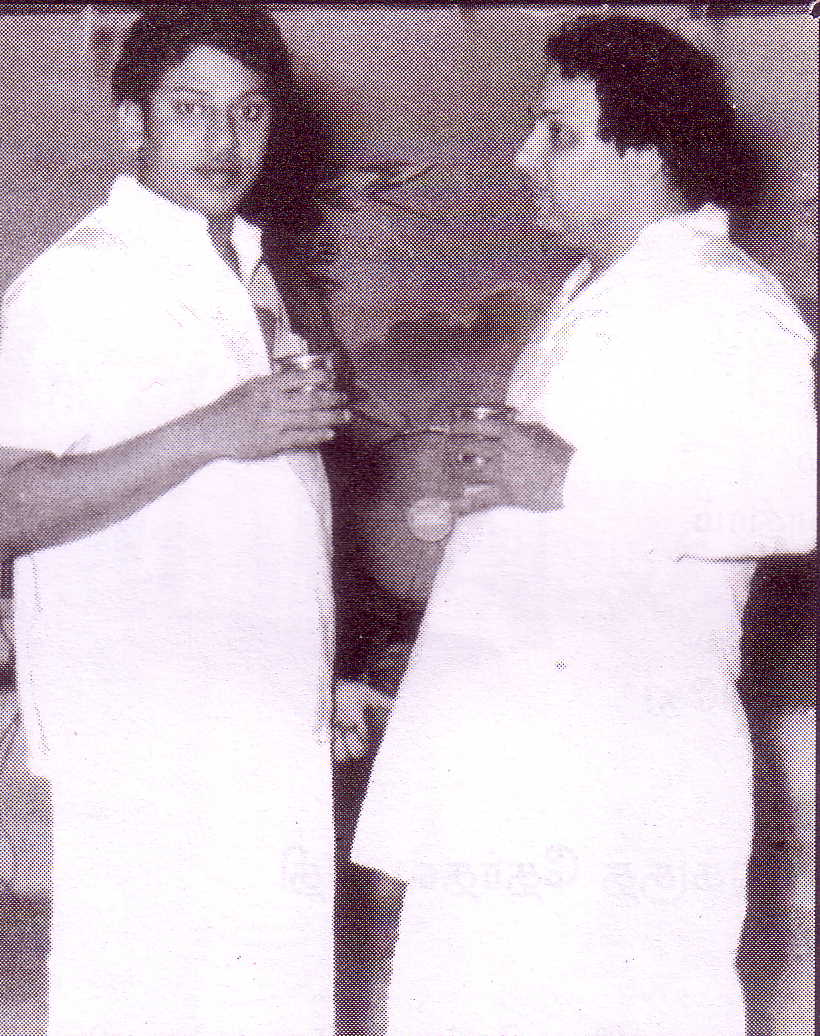 SSR (lt) and MGR (rt) in their salad days
Charlie Chaplin had charisma, but W.C. Fields didn’t have it. John Wayne had charisma, but Lee Van Cleef didn’t have it. Marlon Brando had charisma, but Rod Steiger didn’t have it. Katharine Hepburn had charisma, but Ava Gardner didn’t have it. Ingrid Bergman had charisma, but Shelley Winters didn’t have it. MGR had charisma, but his early rival T.R. Ramachandran (TRR) didn’t have it! In fact, in mid-1940s, MGR used a variation of his name, M.G. Ramachandar, to distinguish himself from TRR who had gained early fame as a hero in a 1941 movie Sabapathi. Later, within a time span of 15 years, after MGR had gained a firm foothold as a ranking hero in Tamil movie word, the same TRR played second fiddle to MGR as a comedian in the Bhagdad Thirudan (Baghdad Thief, 1960) movie.
Make no mistake. All the actors whom I have mentioned in the above paragraph were exceptionally talented, and all were professionals of top quality. Why some were blessed with charisma while others were unlucky is not easy to separate. Even those who had charisma did falter occasionally in their personal lives and relationships. They were immortals in their chosen art form, but mortals in their personal lives.
December 11th being the 10th death anniversary of M.S. Subbulakshmi, the renowned Carnatic music diva and actress, it is opportune to mention that MGR did act in a minor role in Subbulakshmi’s last movie Meera (1945). Subbulakshmi was chronologically four months senior to MGR, and she outlived MGR by 17 years. When Meera was released, Subbulakshmi had charisma, but MGR didn’t have it. Though a musician, Subbulakshmi acted in only four Tamil movies, between 1938 and 1945. These were, Sevasadanam (1938), Sakuntalai (1940), Savitri (1941) and Meera (1945). In the Sakuntalai movie, she paired with another super grade Carnatic musician, G.N. Balasubramaniam (GNB, for short). Unfortunately, GNB couldn’t transfer his charisma from musical stage to the movie arena. The same pattern was seen among other reputed Carnatic musicians as well, such as V.V. Sadagopan (about whose talents, MGR was envious in 1939) and Nadaswaram expert T. N. Rajaratnam Pillai.
Here is the translation on what MGR wrote in his autobiography about his ill-luck in losing a movie role to Carnatic musician Veeravanallur Vedantam (V.V.) Sadagopan, who was 2 years chronologically senior to him. “Mr. V.V. Sadagopan had earned fame in acting as a hero in the movie ‘Athirshdam’ [Good Luck, 1939]. When one sees his smiling face, they wouldn’t care to look at any others’ smiles. Poets do praise the teeth as pearls. That applies perfectly to the smile of Mr. Sadagopan. If one looks at his English-style suit and hat, they will ask, who can be this foreign actor. His chisel shaped body, handsome round face, attractive voice, musical skill as well as English knowledge with a B.A. degree. Will any fool reject such a personality like Mr. V.V. Sadagopan, in preference to another guy? How could I yearn for such a role? Couldn’t I comprehend the difference from mountain and valley? After realizing this situation, I returned home that ‘I will never get that role’. At home, I could only talk this disappointment to my mother. To whom else, I can share this? Even now, I find it difficult how she was able to manage this disappointment [of her son].”
Somehow, Lady Luck did smile at MGR seven years later. Sadagopan’s career in Tamil movies folded abysmally, with only four movies, before MGR was offered the hero billing in 1947. Prior to his 1939 movie Athirshdam, Sadagopan had acted in a 1937 movie ‘Nava Yuvan’, for which some shooting was done in London! He did act as a hero in two 1941 movies ‘Madanakamarajan’ (Gemini banner’s first production) and ‘Venuganam’.
SSR (lt) and MGR (rt) in their salad days
Charlie Chaplin had charisma, but W.C. Fields didn’t have it. John Wayne had charisma, but Lee Van Cleef didn’t have it. Marlon Brando had charisma, but Rod Steiger didn’t have it. Katharine Hepburn had charisma, but Ava Gardner didn’t have it. Ingrid Bergman had charisma, but Shelley Winters didn’t have it. MGR had charisma, but his early rival T.R. Ramachandran (TRR) didn’t have it! In fact, in mid-1940s, MGR used a variation of his name, M.G. Ramachandar, to distinguish himself from TRR who had gained early fame as a hero in a 1941 movie Sabapathi. Later, within a time span of 15 years, after MGR had gained a firm foothold as a ranking hero in Tamil movie word, the same TRR played second fiddle to MGR as a comedian in the Bhagdad Thirudan (Baghdad Thief, 1960) movie.
Make no mistake. All the actors whom I have mentioned in the above paragraph were exceptionally talented, and all were professionals of top quality. Why some were blessed with charisma while others were unlucky is not easy to separate. Even those who had charisma did falter occasionally in their personal lives and relationships. They were immortals in their chosen art form, but mortals in their personal lives.
December 11th being the 10th death anniversary of M.S. Subbulakshmi, the renowned Carnatic music diva and actress, it is opportune to mention that MGR did act in a minor role in Subbulakshmi’s last movie Meera (1945). Subbulakshmi was chronologically four months senior to MGR, and she outlived MGR by 17 years. When Meera was released, Subbulakshmi had charisma, but MGR didn’t have it. Though a musician, Subbulakshmi acted in only four Tamil movies, between 1938 and 1945. These were, Sevasadanam (1938), Sakuntalai (1940), Savitri (1941) and Meera (1945). In the Sakuntalai movie, she paired with another super grade Carnatic musician, G.N. Balasubramaniam (GNB, for short). Unfortunately, GNB couldn’t transfer his charisma from musical stage to the movie arena. The same pattern was seen among other reputed Carnatic musicians as well, such as V.V. Sadagopan (about whose talents, MGR was envious in 1939) and Nadaswaram expert T. N. Rajaratnam Pillai.
Here is the translation on what MGR wrote in his autobiography about his ill-luck in losing a movie role to Carnatic musician Veeravanallur Vedantam (V.V.) Sadagopan, who was 2 years chronologically senior to him. “Mr. V.V. Sadagopan had earned fame in acting as a hero in the movie ‘Athirshdam’ [Good Luck, 1939]. When one sees his smiling face, they wouldn’t care to look at any others’ smiles. Poets do praise the teeth as pearls. That applies perfectly to the smile of Mr. Sadagopan. If one looks at his English-style suit and hat, they will ask, who can be this foreign actor. His chisel shaped body, handsome round face, attractive voice, musical skill as well as English knowledge with a B.A. degree. Will any fool reject such a personality like Mr. V.V. Sadagopan, in preference to another guy? How could I yearn for such a role? Couldn’t I comprehend the difference from mountain and valley? After realizing this situation, I returned home that ‘I will never get that role’. At home, I could only talk this disappointment to my mother. To whom else, I can share this? Even now, I find it difficult how she was able to manage this disappointment [of her son].”
Somehow, Lady Luck did smile at MGR seven years later. Sadagopan’s career in Tamil movies folded abysmally, with only four movies, before MGR was offered the hero billing in 1947. Prior to his 1939 movie Athirshdam, Sadagopan had acted in a 1937 movie ‘Nava Yuvan’, for which some shooting was done in London! He did act as a hero in two 1941 movies ‘Madanakamarajan’ (Gemini banner’s first production) and ‘Venuganam’.
Thoughts of Max Weber and Edward Shils
Introduction of the charisma concept, as a sociological phenomenon, was attributed to German sociologist and philosopher Maximilian (Max) Weber (1864-1920). I provide some excerpts of interpretation of Weber’s thoughts by American sociologist Edward Shils (1910-1995). In his 1965 paper, Shils offers the following description.
“Weber did not restrict his usage of ‘charisma’ to refer only to manifestations of divinity. He often used the term to refer to extraordinary individualities, i.e., powerful, ascendant, persistent, effectively expressive personalities who impose themselves on their environment by their exceptional courage, decisiveness, self-confidence, fluency, insight, energy etc., and who do not necessarily believe that they are working under divine inspiration.”
Shils also informs that Weber viewed three patterns related to charisma. These were,
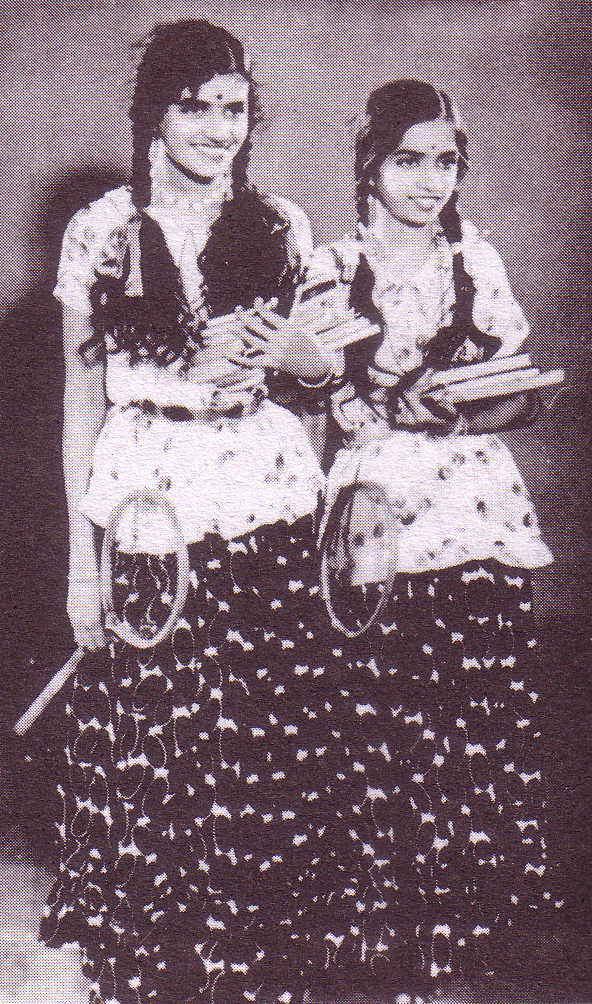 M.S. Subbulakshmi (lt) in ‘Sevasadanam’ (2) movie
‘kinship charisma’ (Gentilcharisma), ‘hereditary charisma (Erbscharisma) and ‘charisma of office’(Amtscharisma). Another interesting thought expressed by Shils is that, “The disposition to attribute charisma is intimately related to the need for order. The attribution of charismatic qualities occurs in the presence of order-creating, order-disclosing, order-discovering power as such; it is a response to great ordering power.” Then, in a foot-note following this sentence, Shils also stresses that ‘Order-destroying power’ itself can earn charisma. This explains, why pioneer freedom fighters gain charisma. Examples include George Washington, Vladimir Lenin, Mahatma Gandhi, Nelson Mandela and V. Prabhakaran. In Shils’s words, “Order-destroying power, great capacity for violence, attracts too, and arouses the charismatic propensity. It does so because it promises in some instance, to provide a new and better order, one more harmonious with the more inclusive and deeper order of existence.”
It is my impression that MGR probably earned charisma in Tamil movies, by destroying the then prevailing order! I offer four reasons. First, until early 1950s, heroines were paid a higher salary in South Indian cinema in comparison to that of heroes. Even MGR had written in his autobiography, that his then love interest and later to become 3rd wife (V.N. Janaki) was earning higher salary than him. Powerful performances by MGR and Sivaji Ganesan in 1952, reversed this salary disparity between heroes and heroines. Secondly, MGR facilitated the abandoning of singer-heroes generation in Tamil movies. His mentor in stage, P.U. Chinnappa died prematurely in 1951. Chinnappa’s co-equal hero M.K. Thyagaraja Bhagavathar lost his glamor after serving a prison sentence in the second half of 1940s, and showed aging. The third singer-hero of Tamil movies, T.R. Mahalingam, self-destructed himself in attempting to become a producer. Thirdly, preaching self-reliance for social uplift via meaningful songs became MGR’s primary mode of teaching. Fourthly, even in choosing ‘politically correct’ titles of his movies, MGR had his last word. He wouldn’t want to have a title which splashes arrogance, or on socially ill-respected themes or characters. His movie titles had to be positively clean. Ravindar, who was one of MGR’s script writers, mentions an anecdote about a movie title. ‘The Man Who Knew too Much’ was a well-known Alfred Hitchcock vehicle, produced twice in 1934 and 1956. When the plot of this movie was adopted for an MGR movie, Ravindar mentions that to fit the original story, they titled it as ‘Ellam Arintha Manithan (All Knowing Man)’. MGR over-ruled this title as “too pompous. We don’t need such a big name. Why not change it to, Aasai Muham (Lovely Face)”.
M.S. Subbulakshmi (lt) in ‘Sevasadanam’ (2) movie
‘kinship charisma’ (Gentilcharisma), ‘hereditary charisma (Erbscharisma) and ‘charisma of office’(Amtscharisma). Another interesting thought expressed by Shils is that, “The disposition to attribute charisma is intimately related to the need for order. The attribution of charismatic qualities occurs in the presence of order-creating, order-disclosing, order-discovering power as such; it is a response to great ordering power.” Then, in a foot-note following this sentence, Shils also stresses that ‘Order-destroying power’ itself can earn charisma. This explains, why pioneer freedom fighters gain charisma. Examples include George Washington, Vladimir Lenin, Mahatma Gandhi, Nelson Mandela and V. Prabhakaran. In Shils’s words, “Order-destroying power, great capacity for violence, attracts too, and arouses the charismatic propensity. It does so because it promises in some instance, to provide a new and better order, one more harmonious with the more inclusive and deeper order of existence.”
It is my impression that MGR probably earned charisma in Tamil movies, by destroying the then prevailing order! I offer four reasons. First, until early 1950s, heroines were paid a higher salary in South Indian cinema in comparison to that of heroes. Even MGR had written in his autobiography, that his then love interest and later to become 3rd wife (V.N. Janaki) was earning higher salary than him. Powerful performances by MGR and Sivaji Ganesan in 1952, reversed this salary disparity between heroes and heroines. Secondly, MGR facilitated the abandoning of singer-heroes generation in Tamil movies. His mentor in stage, P.U. Chinnappa died prematurely in 1951. Chinnappa’s co-equal hero M.K. Thyagaraja Bhagavathar lost his glamor after serving a prison sentence in the second half of 1940s, and showed aging. The third singer-hero of Tamil movies, T.R. Mahalingam, self-destructed himself in attempting to become a producer. Thirdly, preaching self-reliance for social uplift via meaningful songs became MGR’s primary mode of teaching. Fourthly, even in choosing ‘politically correct’ titles of his movies, MGR had his last word. He wouldn’t want to have a title which splashes arrogance, or on socially ill-respected themes or characters. His movie titles had to be positively clean. Ravindar, who was one of MGR’s script writers, mentions an anecdote about a movie title. ‘The Man Who Knew too Much’ was a well-known Alfred Hitchcock vehicle, produced twice in 1934 and 1956. When the plot of this movie was adopted for an MGR movie, Ravindar mentions that to fit the original story, they titled it as ‘Ellam Arintha Manithan (All Knowing Man)’. MGR over-ruled this title as “too pompous. We don’t need such a big name. Why not change it to, Aasai Muham (Lovely Face)”.
Taxonomy of Charisma
Why is it, charisma couldn’t be transferred from one area to another, like the Tamil musicians I’ve cited above. This applies to MGR’s illustrious contemporary in stage-movie and political arenas, Sivaji Ganesan (aka V.C. Ganesan) too. Sivaji Ganesan was blessed with charisma in cinema, but he couldn’t transfer such charisma to politics. MGR seems to be the only actor-politician who was able to transfer his charisma from movies to politics. Compare MGR’s case with that of Hollywood actor-politician, President Ronald Reagan. The 40th President of USA was not at all a charismatic actor, compared to his contemporaries like Humphrey Bogart, Jimmy Stewart and Marlon Brando. But, in politics, Reagan did gain charisma.
To the best of my knowledge, there is no taxonomy of charisma in the sociological literature. To confirm this fact, today (Dec.11, 2014), I checked the Web of Science database (http://apps.webofknowledge.com/), with keyword ‘charisma’. There were 1,808 entries. When, I linked keywords ‘charisma’ and ‘taxonomy’, only 5 research papers turned up. I was able to read the complete text of 4 of these. Even among these five, 2 were focused on orchids and mammals, but not on humans! In the absence of such a charisma taxonomy, I offer below my thoughts.
- Fair, Transferable charisma (from one field to another field). MGR and his mentor Anna were good examples, in transferring their charisma from movies to politics (MGR) and politics to movies (Anna). M.S. Subbulakshmi was adept in transferring her charisma from music to movies.
- Fair, Un-transferable charisma (charisma limited to one field of expertise). Sivaji Ganesan couldn’t transfer his charisma from movies to politics. The same with poet Kannadasan too.
- Reflective charisma (charisma gained by association with a charismatic person). Jayalalitha (in association with MGR) and Karunanidhi (in association with Anna) are good examples. Karunanidhi-brand charisma is pitiable. He did earn charisma in the drama-cinema field as a stylist of his own. But, in politics, he lost most of it due to his vainglorious character.
- Belatedly recognized charisma. This could be separated into two types. Type 1: Sunset of life charisma (Nelson Mandela was a good example. Until he was released from prison in 1990, none considered him as charismatic.) Type 2: Posthumous charisma – attained after death. (Jesus Christ, Alfred Nobel, artist Vincent van Gogh, computer scientist Alan Turing and Tamil poet Subramanya Bharathi are good examples.)
- Foul charisma: a loathsome charisma offensive to the senses majority of humans. Many examples abound. Adolf Hitler, Winston Churchill, Al Capone, Hugh Hefner, Madonna (pop icon).
- Epsilon charisma (or Ephemeral charisma): bare charisma or literally lasting only for a day or few days. I’d identify betrayers of benefactors in this category, beginning from Brutus, Cassius and Judas Iscariot. They do satisfy one trait of charisma holders – that of originality in a deed.
- Pseudo-charisma (or Hyped charisma); Many contemporary politicians, like President Bill Clinton, are tagged by favor-seeking journalists as charismatic. One wonders, what did Mr. Clinton achieve (other than winning two presidential elections) either politically or intellectually to become charismatic?
- Non-charisma: Examples abound among politicians. Some of my favorites are, Richard Nixon, Morarji Desai, Junius Jayewardene, Subramanian Swamy, Palaniappan Chidambaram.
I have observed that all the UN Secretary Generals elected by the General Assembly (8, since 1946) are non-charismatic. These are, Trygve Lie, Dag Hammarskjold, U Thant, Kurt Waldheim, Javier Perez de Cuellar, Boutros-Ghali, Kofi Annan and Ban Ki-Moon. Why is it so? These guys don’t have any original thinking on their own. They merely act as a super grade peon of Super Powers.
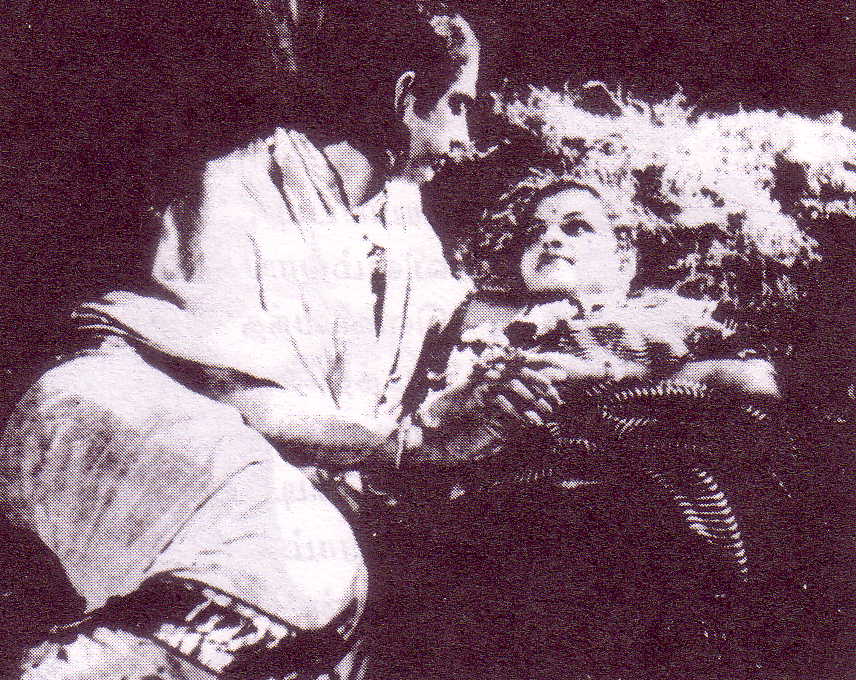 M.S. Subbulakshmi (rt) in ‘Sakuntalai’ (2) movie
Primary Traits of Charismatic Persons
Charismatic persons can be identified with following primary traits. (1) Originality in deeds, (2) humility in action, (3) Apportioning due credit to fellow associates, and (4) risk taking attitude. SSR, in his autobiography, includes two sample episodes about his interaction with MGR, which attest to the latter’s humility. I translate them here.
Episode 1: “On January 1958, when Prime Minister Nehru chided the actions of Periyar (E.V. Ramasamy Naiker) and other Tamilnadu leaders as ‘nonsense’, Anna, as the leader of Kazhagam, demanded that we should make protest to Nehru by showing black flags. Anna solicited the help of all Kazhagam enthusiasts to gather at the Chennai airport, so that when Nehru landed, he should see only the black flags. In those days, Kazhagam didn’t have much finance. During such protest situations, annan MGR and I are the ones who took major responsibility. MGR Pictures and SSR Pictures owned by us owned sewing machines. Therefore, day and night, [we] prepared many black flags and other protest-related minutiae….We were taken to Central Jail, and lodged in First Floor, First class room. It was First class room only in name; but it was very small. There was a dirty mattress full of lice to sleep. We used our own hands pillows and slept in the floor.
Next day, at noon, we were offered food. I found it difficult to eat what was served as rice in a small aluminum plate. I looked at MGR. He wasn’t bothered at all. He quipped, ‘In my young days, I had eaten food like this. So, this is not at all new for me.’ A mud pot was also placed. And next to it, there was a tin can, for drinking water. Adjacent to these, there were two additional mud pots too. I asked him, ‘What are these for?’ He said, ‘Those are for our excretory functions.’ I felt so uncomfortable, and asked him, ‘How can we use these?’ His nonchalant response was, ‘Like this, in the same room there are five or six convicts spending time. Think about their situation!’…
Before we left the jail room, annan MGR told, ‘We should keep in mind the real situation we experienced here. Until now, in the cinema, we had depicted the jails as comfortable places. Hereafter, in our movies, we had to present the reality. Then only, people will realize the ugliness of jail.’ ”
Episode 2: “During the 1980 Legislative Assembly election for Tamil Nadu, annan MGR asked me to contest a constituency. I responded, ‘I don’t think so, anne! I’ll take part in the election propaganda meetings. For this, his response was, ‘Suppose, in case our party couldn’t win enough to become a ruling party, we need a responsible person in the Opposition benches to speak louder.’ I thought – that was his strength. If we believe that, we will win, we will not actively work for it. In case, if we doubt that we may lose, then our Anna DMK supporters will contribute their efforts day and night even on the verge of starving and will bring victory for our party, was his firm believe, I sensed.”
M.S. Subbulakshmi (rt) in ‘Sakuntalai’ (2) movie
Primary Traits of Charismatic Persons
Charismatic persons can be identified with following primary traits. (1) Originality in deeds, (2) humility in action, (3) Apportioning due credit to fellow associates, and (4) risk taking attitude. SSR, in his autobiography, includes two sample episodes about his interaction with MGR, which attest to the latter’s humility. I translate them here.
Episode 1: “On January 1958, when Prime Minister Nehru chided the actions of Periyar (E.V. Ramasamy Naiker) and other Tamilnadu leaders as ‘nonsense’, Anna, as the leader of Kazhagam, demanded that we should make protest to Nehru by showing black flags. Anna solicited the help of all Kazhagam enthusiasts to gather at the Chennai airport, so that when Nehru landed, he should see only the black flags. In those days, Kazhagam didn’t have much finance. During such protest situations, annan MGR and I are the ones who took major responsibility. MGR Pictures and SSR Pictures owned by us owned sewing machines. Therefore, day and night, [we] prepared many black flags and other protest-related minutiae….We were taken to Central Jail, and lodged in First Floor, First class room. It was First class room only in name; but it was very small. There was a dirty mattress full of lice to sleep. We used our own hands pillows and slept in the floor.
Next day, at noon, we were offered food. I found it difficult to eat what was served as rice in a small aluminum plate. I looked at MGR. He wasn’t bothered at all. He quipped, ‘In my young days, I had eaten food like this. So, this is not at all new for me.’ A mud pot was also placed. And next to it, there was a tin can, for drinking water. Adjacent to these, there were two additional mud pots too. I asked him, ‘What are these for?’ He said, ‘Those are for our excretory functions.’ I felt so uncomfortable, and asked him, ‘How can we use these?’ His nonchalant response was, ‘Like this, in the same room there are five or six convicts spending time. Think about their situation!’…
Before we left the jail room, annan MGR told, ‘We should keep in mind the real situation we experienced here. Until now, in the cinema, we had depicted the jails as comfortable places. Hereafter, in our movies, we had to present the reality. Then only, people will realize the ugliness of jail.’ ”
Episode 2: “During the 1980 Legislative Assembly election for Tamil Nadu, annan MGR asked me to contest a constituency. I responded, ‘I don’t think so, anne! I’ll take part in the election propaganda meetings. For this, his response was, ‘Suppose, in case our party couldn’t win enough to become a ruling party, we need a responsible person in the Opposition benches to speak louder.’ I thought – that was his strength. If we believe that, we will win, we will not actively work for it. In case, if we doubt that we may lose, then our Anna DMK supporters will contribute their efforts day and night even on the verge of starving and will bring victory for our party, was his firm believe, I sensed.”
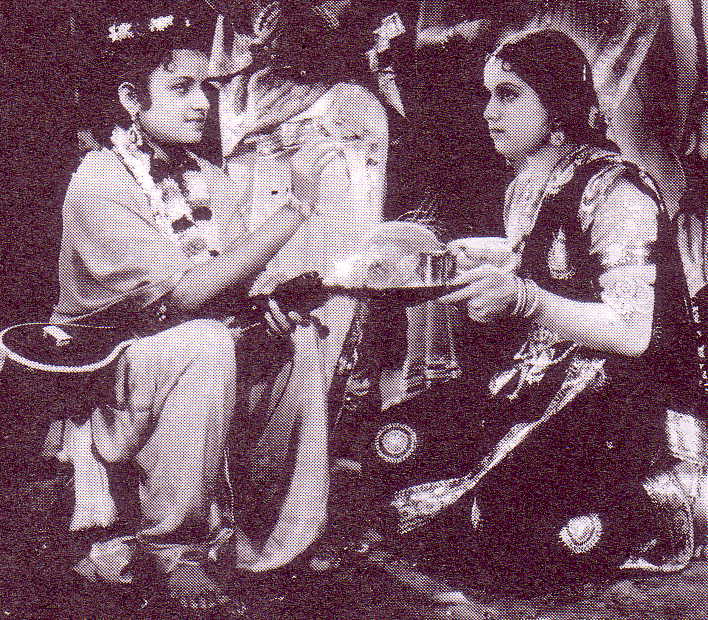 M.S. Subbulakshmi (lt) in ‘Savitri’ (2) movie
M.S. S. Pandian, one of MGR’s early biographers, died last month (Nov. 10), at the age of 57. Though he had been eulogized as “an eminent social scientist who wrote extensively on the Dravidian Movement, south Indian politics, cinema…” in the Indian media, I had felt that his study of MGR’s career is utterly biased. In reviewing Pandian’s work, another MGR observer Robert Hardgrave Jr. made the following perceptive comments:
“With the Marxian perspective of Gramsci and in the language of post-modernism, Pandian examines various elements of the cinematic image of MGR and its ‘embeddedness’ in the cultural idioms of Tamilnadu; how this screen image was transferred to politics through the ‘constructed biographies’ of MGR; and, less successfully, the relationship of the material condition of the subaltern classes to the rise of the MGR phenomenon. Pandian’s use of Gransci’s concept of ‘common sense’ is neither illuminating nor successful in explaining how MGR produced ‘consent among the subaltern classes,’ but Pandian nevertheless provides a fascinating and revealing analysis of MGR in film and the ‘filmy politics’ in Tamilnadu.”
Even the TamilNet website provided an obituary note about Professor Pandian, mentioning that he was an enthusiast for separate state Eelam. But, to many Eelam Tamils’ dismay, Pandian never bothered to write an appreciative sentence on MGR’s strong support for Eelam campaign, in his biased tract on MGR. That tells something about the scholastic attitude of Marxist scholars!
Bertrand Russell, in his sociological analysis of power, infers the following.
“If I had to select four men who have had more power than any others, I should mention Buddha and Christ, Pythagoras and Galileo. No one of these four had the support of the State until after his propaganda had achieved a great measure of success. No one of the four had much success in his own life time. No one of the four would have affected human life as he has done if power had been his primary object. (Italics, as in the original.)
Though Russell don’t use charisma word, it is indirectly implied that the four individuals (Pythagoras, 571 BC- 495 BC; Buddha, 563 BC-483 BC; Jesus Christ, 7-4 BC – AD 30-33; and Galilei Galileo,1564-1642) he mentioned exuded posthumous charisma, in exercising their power over the illiterate masses. But, one should not forget, that all four individuals lived in an era where mass media was not a factor of influence in daily lives. Of course, there was no camera to portray their physical features. Also, in the times of these four charismatic individuals, long distance travel was unthinkable. While they were living, their perceived influence on followers were marginal at best, or negligible at worst. Compared to these four, MGR living in the 20th century, had ample mass media coverage and did exercise his power/influence over 50 million individuals for nearly three decades.
M.S. Subbulakshmi (lt) in ‘Savitri’ (2) movie
M.S. S. Pandian, one of MGR’s early biographers, died last month (Nov. 10), at the age of 57. Though he had been eulogized as “an eminent social scientist who wrote extensively on the Dravidian Movement, south Indian politics, cinema…” in the Indian media, I had felt that his study of MGR’s career is utterly biased. In reviewing Pandian’s work, another MGR observer Robert Hardgrave Jr. made the following perceptive comments:
“With the Marxian perspective of Gramsci and in the language of post-modernism, Pandian examines various elements of the cinematic image of MGR and its ‘embeddedness’ in the cultural idioms of Tamilnadu; how this screen image was transferred to politics through the ‘constructed biographies’ of MGR; and, less successfully, the relationship of the material condition of the subaltern classes to the rise of the MGR phenomenon. Pandian’s use of Gransci’s concept of ‘common sense’ is neither illuminating nor successful in explaining how MGR produced ‘consent among the subaltern classes,’ but Pandian nevertheless provides a fascinating and revealing analysis of MGR in film and the ‘filmy politics’ in Tamilnadu.”
Even the TamilNet website provided an obituary note about Professor Pandian, mentioning that he was an enthusiast for separate state Eelam. But, to many Eelam Tamils’ dismay, Pandian never bothered to write an appreciative sentence on MGR’s strong support for Eelam campaign, in his biased tract on MGR. That tells something about the scholastic attitude of Marxist scholars!
Bertrand Russell, in his sociological analysis of power, infers the following.
“If I had to select four men who have had more power than any others, I should mention Buddha and Christ, Pythagoras and Galileo. No one of these four had the support of the State until after his propaganda had achieved a great measure of success. No one of the four had much success in his own life time. No one of the four would have affected human life as he has done if power had been his primary object. (Italics, as in the original.)
Though Russell don’t use charisma word, it is indirectly implied that the four individuals (Pythagoras, 571 BC- 495 BC; Buddha, 563 BC-483 BC; Jesus Christ, 7-4 BC – AD 30-33; and Galilei Galileo,1564-1642) he mentioned exuded posthumous charisma, in exercising their power over the illiterate masses. But, one should not forget, that all four individuals lived in an era where mass media was not a factor of influence in daily lives. Of course, there was no camera to portray their physical features. Also, in the times of these four charismatic individuals, long distance travel was unthinkable. While they were living, their perceived influence on followers were marginal at best, or negligible at worst. Compared to these four, MGR living in the 20th century, had ample mass media coverage and did exercise his power/influence over 50 million individuals for nearly three decades.
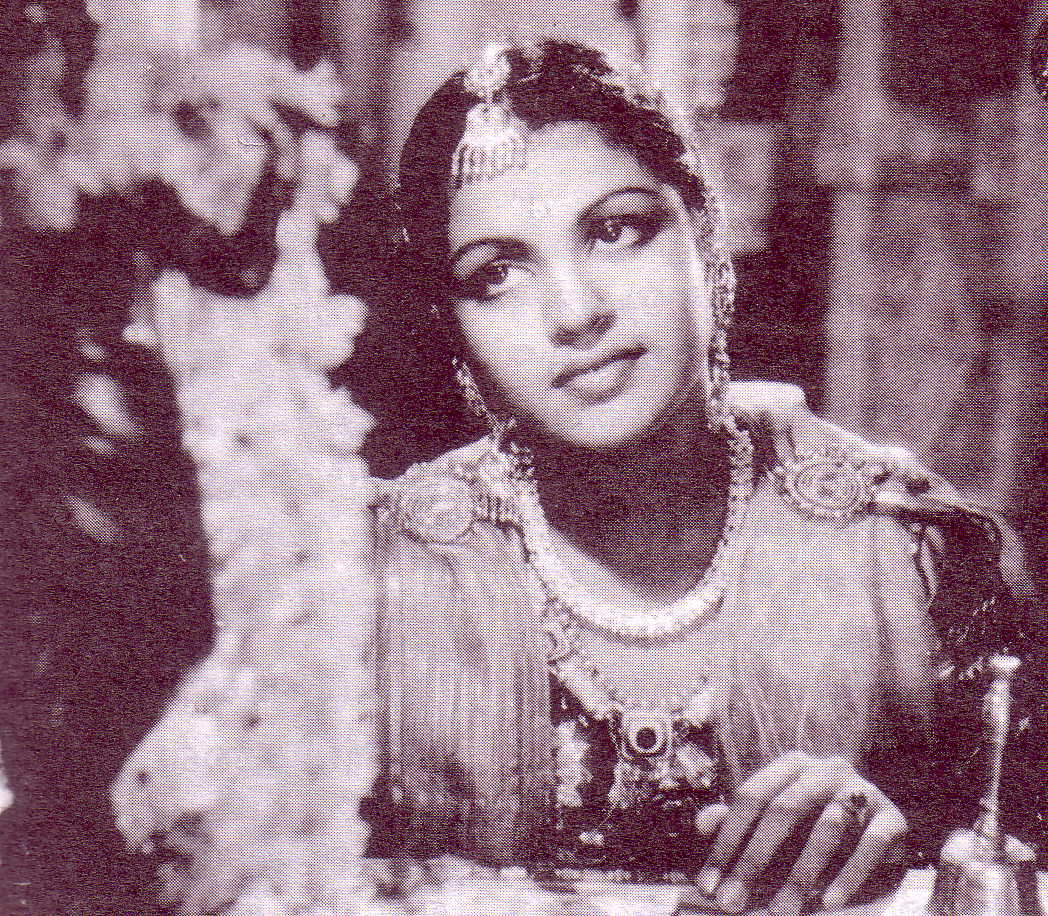 M.S. Subbulakshmi in ‘Meera'(2) movie
Cited Sources
‘Film News’ Anandan: Sadhanaigal Padaitha Thamizh thiraipada Varalaru (Tamil Film History and its Achievements), Sivagami Publications, Chennai, 2004.
Robert L. Hardgrave Jr.: review of ‘The Image Trap: M.G.Ramachandran in Film and Politics’, by M.S.S. Pandian. Pacific Affairs, summer 1993; 66(2): 292-293.
M.S. Subbulakshmi in ‘Meera'(2) movie
Cited Sources
‘Film News’ Anandan: Sadhanaigal Padaitha Thamizh thiraipada Varalaru (Tamil Film History and its Achievements), Sivagami Publications, Chennai, 2004.
Robert L. Hardgrave Jr.: review of ‘The Image Trap: M.G.Ramachandran in Film and Politics’, by M.S.S. Pandian. Pacific Affairs, summer 1993; 66(2): 292-293.
- Mohandas: MGR: The Man and the Myth, Panther Publishers, Bangalore, 1992.
Oxford English Dictionary (The Compact Edition), vol.I (A-), Oxford University Press, Oxford, 28th printing, 1989, p.382.
M.S. S. Pandian: The Image Trap – M.G. Ramachandran in Film and Politics, Sage Publications, New Delhi, 1992.
S.S. Rajendran: Naan Vantha Pathai [The Path I Trod], Akani Veliyeedu, Vandavasi, 2014. (in Tamil)
MGR: Naan Yean Piranthen? [Why I was Born?] – Part 2, Kannadhasan Pathippagam, Chennai, 2014, p. 935.
- Ravindar: Pon Mana Chemmal MGR, Vijaya Publications, Chennai, 2009. (in Tamil)
Bertrand Russell: Power – A New Social Analysis, Unwin Paperbacks, London, 1985 (originally published, 1938), p. 185.
Edward Shils: Charisma, order and status. American Sociological Review, Apr. 1965; 30(2): 199-213.
S.N.Vijetha: Social scientist Pandian dead. The Hindu (Chennai), Nov.11, 2014.
by Sachi Sri-Kantha, December 10, 2014
MGR and SSR with K.R.Ramasamy after release from detention
Here is the comment, which I received from fellow MGR biographer and friend R. Kannan, for Part 22, on November 5th.
“Hello Sachi: I just finished part 22. Nicely done. You might have wished to record SSR and MGR showing up at the Vellore General Council meeting [of DMK] together from an adjacent room when Sampath gets into a situation. You may have wished to also mention that SSR did ‘Thanga rathnam’ as a propaganda film for the DMK in the 1969 polls. Also that SSR was one of Anna’s closest and had criticized MGR for his talk ‘Anna is my guide’ [delivered at a function, felicitating Kamarajar’s birthday].
I am trying to get hold of SSR’s autobio. I shall try to get two copies and send you one if possible…”
In the previous chapter, I noted the death of Sedapati Suryanarayana Thevar (SS) Rajendran (affectionately addressed as SSR by Tamilians all over) on October 24 at the age of 86. I also mentioned that “one can rely on the autobiographies of four principals – Kannadasan, MGR, Karunanidhi and Sivaji Ganesan – to learn about the inner currents which prevailed then” in DMK party. Now one can add that, we also have SSR’s ‘incomplete’ autobiography, Naan Vantha Pathai [The Path I had Trod, 2014] in Tamil, published just before his death. I plan to write a review of this book separately. I appreciate Kannan for his help in getting a copy of this book in time. Here, I include only two episodes SSR had described about MGR at the end.
The Quality called Charisma
In recent times, like other respectable words such as genius, legend and superstar, charisma (or charismatic) word also has received depreciation when journalist hacks began using it as an adjective indiscriminately to politicians. The Oxford English Dictionary defines charisma as, “Theol. Favour given, gift of grace. A free gift or favour specially vouchsafed by God; a grace, a talent”. It lists that one of the earliest use of this word in English was by John Bulwer (1606-1656), an English physician and natural philosopher. In Bulwer’s 1644 book, ‘Chirologia and Chironomia’, it appears as, “is used in the conveyance of that charisma or miraculous gift of healing.” In its original sense of meaning, charismatic persons are understood to possess ‘healing powers’.
In this chapter, I provide some thoughts on MGR and charisma. Even MGR’s detractors and strong critics will agree that MGR had charisma in abundance. My focus was, when did he acquire such charisma? None of previous MGR’s biographers (especially M.S. S. Pandian, in his snobbish criticism of MGR’s movie and political career) had tackled this theme. Mohandas had occasionally springled the charisma word, in his portrayal of MGR. But, Mohandas’s focus was mainly on MGR’s last decade of his life, after MGR’s ascension as the chief minister of Tamil Nadu state. To delve into charisma theme, one should study his contemporaries in Hollywood and India.
All were contemporaries of MGR. I have titled this chapter as ‘camera lens and charisma’. The popular belief maybe that all movie stars were blessed with charisma, because camera lens blows up their physical features, in multiple angles and close-up shots of face. But, this need not be so. Thousands of actors have thrilled the cinema fans for nearly one hundred years. But, only a fraction of them exuded charisma. As a subjective exercise, to distinguish movie stars who had charisma and who didn’t have charisma, I provide a select list who excelled themselves in Hollywood and in India.
SSR (lt) and MGR (rt) in their salad days
Charlie Chaplin had charisma, but W.C. Fields didn’t have it. John Wayne had charisma, but Lee Van Cleef didn’t have it. Marlon Brando had charisma, but Rod Steiger didn’t have it. Katharine Hepburn had charisma, but Ava Gardner didn’t have it. Ingrid Bergman had charisma, but Shelley Winters didn’t have it. MGR had charisma, but his early rival T.R. Ramachandran (TRR) didn’t have it! In fact, in mid-1940s, MGR used a variation of his name, M.G. Ramachandar, to distinguish himself from TRR who had gained early fame as a hero in a 1941 movie Sabapathi. Later, within a time span of 15 years, after MGR had gained a firm foothold as a ranking hero in Tamil movie word, the same TRR played second fiddle to MGR as a comedian in the Bhagdad Thirudan (Baghdad Thief, 1960) movie.
Make no mistake. All the actors whom I have mentioned in the above paragraph were exceptionally talented, and all were professionals of top quality. Why some were blessed with charisma while others were unlucky is not easy to separate. Even those who had charisma did falter occasionally in their personal lives and relationships. They were immortals in their chosen art form, but mortals in their personal lives.
December 11th being the 10th death anniversary of M.S. Subbulakshmi, the renowned Carnatic music diva and actress, it is opportune to mention that MGR did act in a minor role in Subbulakshmi’s last movie Meera (1945). Subbulakshmi was chronologically four months senior to MGR, and she outlived MGR by 17 years. When Meera was released, Subbulakshmi had charisma, but MGR didn’t have it. Though a musician, Subbulakshmi acted in only four Tamil movies, between 1938 and 1945. These were, Sevasadanam (1938), Sakuntalai (1940), Savitri (1941) and Meera (1945). In the Sakuntalai movie, she paired with another super grade Carnatic musician, G.N. Balasubramaniam (GNB, for short). Unfortunately, GNB couldn’t transfer his charisma from musical stage to the movie arena. The same pattern was seen among other reputed Carnatic musicians as well, such as V.V. Sadagopan (about whose talents, MGR was envious in 1939) and Nadaswaram expert T. N. Rajaratnam Pillai.
Here is the translation on what MGR wrote in his autobiography about his ill-luck in losing a movie role to Carnatic musician Veeravanallur Vedantam (V.V.) Sadagopan, who was 2 years chronologically senior to him. “Mr. V.V. Sadagopan had earned fame in acting as a hero in the movie ‘Athirshdam’ [Good Luck, 1939]. When one sees his smiling face, they wouldn’t care to look at any others’ smiles. Poets do praise the teeth as pearls. That applies perfectly to the smile of Mr. Sadagopan. If one looks at his English-style suit and hat, they will ask, who can be this foreign actor. His chisel shaped body, handsome round face, attractive voice, musical skill as well as English knowledge with a B.A. degree. Will any fool reject such a personality like Mr. V.V. Sadagopan, in preference to another guy? How could I yearn for such a role? Couldn’t I comprehend the difference from mountain and valley? After realizing this situation, I returned home that ‘I will never get that role’. At home, I could only talk this disappointment to my mother. To whom else, I can share this? Even now, I find it difficult how she was able to manage this disappointment [of her son].”
Somehow, Lady Luck did smile at MGR seven years later. Sadagopan’s career in Tamil movies folded abysmally, with only four movies, before MGR was offered the hero billing in 1947. Prior to his 1939 movie Athirshdam, Sadagopan had acted in a 1937 movie ‘Nava Yuvan’, for which some shooting was done in London! He did act as a hero in two 1941 movies ‘Madanakamarajan’ (Gemini banner’s first production) and ‘Venuganam’.
Thoughts of Max Weber and Edward Shils
Introduction of the charisma concept, as a sociological phenomenon, was attributed to German sociologist and philosopher Maximilian (Max) Weber (1864-1920). I provide some excerpts of interpretation of Weber’s thoughts by American sociologist Edward Shils (1910-1995). In his 1965 paper, Shils offers the following description.
“Weber did not restrict his usage of ‘charisma’ to refer only to manifestations of divinity. He often used the term to refer to extraordinary individualities, i.e., powerful, ascendant, persistent, effectively expressive personalities who impose themselves on their environment by their exceptional courage, decisiveness, self-confidence, fluency, insight, energy etc., and who do not necessarily believe that they are working under divine inspiration.”
Shils also informs that Weber viewed three patterns related to charisma. These were,
M.S. Subbulakshmi (lt) in ‘Sevasadanam’ (2) movie
‘kinship charisma’ (Gentilcharisma), ‘hereditary charisma (Erbscharisma) and ‘charisma of office’(Amtscharisma). Another interesting thought expressed by Shils is that, “The disposition to attribute charisma is intimately related to the need for order. The attribution of charismatic qualities occurs in the presence of order-creating, order-disclosing, order-discovering power as such; it is a response to great ordering power.” Then, in a foot-note following this sentence, Shils also stresses that ‘Order-destroying power’ itself can earn charisma. This explains, why pioneer freedom fighters gain charisma. Examples include George Washington, Vladimir Lenin, Mahatma Gandhi, Nelson Mandela and V. Prabhakaran. In Shils’s words, “Order-destroying power, great capacity for violence, attracts too, and arouses the charismatic propensity. It does so because it promises in some instance, to provide a new and better order, one more harmonious with the more inclusive and deeper order of existence.”
It is my impression that MGR probably earned charisma in Tamil movies, by destroying the then prevailing order! I offer four reasons. First, until early 1950s, heroines were paid a higher salary in South Indian cinema in comparison to that of heroes. Even MGR had written in his autobiography, that his then love interest and later to become 3rd wife (V.N. Janaki) was earning higher salary than him. Powerful performances by MGR and Sivaji Ganesan in 1952, reversed this salary disparity between heroes and heroines. Secondly, MGR facilitated the abandoning of singer-heroes generation in Tamil movies. His mentor in stage, P.U. Chinnappa died prematurely in 1951. Chinnappa’s co-equal hero M.K. Thyagaraja Bhagavathar lost his glamor after serving a prison sentence in the second half of 1940s, and showed aging. The third singer-hero of Tamil movies, T.R. Mahalingam, self-destructed himself in attempting to become a producer. Thirdly, preaching self-reliance for social uplift via meaningful songs became MGR’s primary mode of teaching. Fourthly, even in choosing ‘politically correct’ titles of his movies, MGR had his last word. He wouldn’t want to have a title which splashes arrogance, or on socially ill-respected themes or characters. His movie titles had to be positively clean. Ravindar, who was one of MGR’s script writers, mentions an anecdote about a movie title. ‘The Man Who Knew too Much’ was a well-known Alfred Hitchcock vehicle, produced twice in 1934 and 1956. When the plot of this movie was adopted for an MGR movie, Ravindar mentions that to fit the original story, they titled it as ‘Ellam Arintha Manithan (All Knowing Man)’. MGR over-ruled this title as “too pompous. We don’t need such a big name. Why not change it to, Aasai Muham (Lovely Face)”.
Taxonomy of Charisma
Why is it, charisma couldn’t be transferred from one area to another, like the Tamil musicians I’ve cited above. This applies to MGR’s illustrious contemporary in stage-movie and political arenas, Sivaji Ganesan (aka V.C. Ganesan) too. Sivaji Ganesan was blessed with charisma in cinema, but he couldn’t transfer such charisma to politics. MGR seems to be the only actor-politician who was able to transfer his charisma from movies to politics. Compare MGR’s case with that of Hollywood actor-politician, President Ronald Reagan. The 40th President of USA was not at all a charismatic actor, compared to his contemporaries like Humphrey Bogart, Jimmy Stewart and Marlon Brando. But, in politics, Reagan did gain charisma.
To the best of my knowledge, there is no taxonomy of charisma in the sociological literature. To confirm this fact, today (Dec.11, 2014), I checked the Web of Science database (http://apps.webofknowledge.com/), with keyword ‘charisma’. There were 1,808 entries. When, I linked keywords ‘charisma’ and ‘taxonomy’, only 5 research papers turned up. I was able to read the complete text of 4 of these. Even among these five, 2 were focused on orchids and mammals, but not on humans! In the absence of such a charisma taxonomy, I offer below my thoughts.
- Fair, Transferable charisma (from one field to another field). MGR and his mentor Anna were good examples, in transferring their charisma from movies to politics (MGR) and politics to movies (Anna). M.S. Subbulakshmi was adept in transferring her charisma from music to movies.
- Fair, Un-transferable charisma (charisma limited to one field of expertise). Sivaji Ganesan couldn’t transfer his charisma from movies to politics. The same with poet Kannadasan too.
- Reflective charisma (charisma gained by association with a charismatic person). Jayalalitha (in association with MGR) and Karunanidhi (in association with Anna) are good examples. Karunanidhi-brand charisma is pitiable. He did earn charisma in the drama-cinema field as a stylist of his own. But, in politics, he lost most of it due to his vainglorious character.
- Belatedly recognized charisma. This could be separated into two types. Type 1: Sunset of life charisma (Nelson Mandela was a good example. Until he was released from prison in 1990, none considered him as charismatic.) Type 2: Posthumous charisma – attained after death. (Jesus Christ, Alfred Nobel, artist Vincent van Gogh, computer scientist Alan Turing and Tamil poet Subramanya Bharathi are good examples.)
- Foul charisma: a loathsome charisma offensive to the senses majority of humans. Many examples abound. Adolf Hitler, Winston Churchill, Al Capone, Hugh Hefner, Madonna (pop icon).
- Epsilon charisma (or Ephemeral charisma): bare charisma or literally lasting only for a day or few days. I’d identify betrayers of benefactors in this category, beginning from Brutus, Cassius and Judas Iscariot. They do satisfy one trait of charisma holders – that of originality in a deed.
- Pseudo-charisma (or Hyped charisma); Many contemporary politicians, like President Bill Clinton, are tagged by favor-seeking journalists as charismatic. One wonders, what did Mr. Clinton achieve (other than winning two presidential elections) either politically or intellectually to become charismatic?
- Non-charisma: Examples abound among politicians. Some of my favorites are, Richard Nixon, Morarji Desai, Junius Jayewardene, Subramanian Swamy, Palaniappan Chidambaram.
I have observed that all the UN Secretary Generals elected by the General Assembly (8, since 1946) are non-charismatic. These are, Trygve Lie, Dag Hammarskjold, U Thant, Kurt Waldheim, Javier Perez de Cuellar, Boutros-Ghali, Kofi Annan and Ban Ki-Moon. Why is it so? These guys don’t have any original thinking on their own. They merely act as a super grade peon of Super Powers.
M.S. Subbulakshmi (rt) in ‘Sakuntalai’ (2) movie
Primary Traits of Charismatic Persons
Charismatic persons can be identified with following primary traits. (1) Originality in deeds, (2) humility in action, (3) Apportioning due credit to fellow associates, and (4) risk taking attitude. SSR, in his autobiography, includes two sample episodes about his interaction with MGR, which attest to the latter’s humility. I translate them here.
Episode 1: “On January 1958, when Prime Minister Nehru chided the actions of Periyar (E.V. Ramasamy Naiker) and other Tamilnadu leaders as ‘nonsense’, Anna, as the leader of Kazhagam, demanded that we should make protest to Nehru by showing black flags. Anna solicited the help of all Kazhagam enthusiasts to gather at the Chennai airport, so that when Nehru landed, he should see only the black flags. In those days, Kazhagam didn’t have much finance. During such protest situations, annan MGR and I are the ones who took major responsibility. MGR Pictures and SSR Pictures owned by us owned sewing machines. Therefore, day and night, [we] prepared many black flags and other protest-related minutiae….We were taken to Central Jail, and lodged in First Floor, First class room. It was First class room only in name; but it was very small. There was a dirty mattress full of lice to sleep. We used our own hands pillows and slept in the floor.
Next day, at noon, we were offered food. I found it difficult to eat what was served as rice in a small aluminum plate. I looked at MGR. He wasn’t bothered at all. He quipped, ‘In my young days, I had eaten food like this. So, this is not at all new for me.’ A mud pot was also placed. And next to it, there was a tin can, for drinking water. Adjacent to these, there were two additional mud pots too. I asked him, ‘What are these for?’ He said, ‘Those are for our excretory functions.’ I felt so uncomfortable, and asked him, ‘How can we use these?’ His nonchalant response was, ‘Like this, in the same room there are five or six convicts spending time. Think about their situation!’…
Before we left the jail room, annan MGR told, ‘We should keep in mind the real situation we experienced here. Until now, in the cinema, we had depicted the jails as comfortable places. Hereafter, in our movies, we had to present the reality. Then only, people will realize the ugliness of jail.’ ”
Episode 2: “During the 1980 Legislative Assembly election for Tamil Nadu, annan MGR asked me to contest a constituency. I responded, ‘I don’t think so, anne! I’ll take part in the election propaganda meetings. For this, his response was, ‘Suppose, in case our party couldn’t win enough to become a ruling party, we need a responsible person in the Opposition benches to speak louder.’ I thought – that was his strength. If we believe that, we will win, we will not actively work for it. In case, if we doubt that we may lose, then our Anna DMK supporters will contribute their efforts day and night even on the verge of starving and will bring victory for our party, was his firm believe, I sensed.”
M.S. Subbulakshmi (lt) in ‘Savitri’ (2) movie
M.S. S. Pandian, one of MGR’s early biographers, died last month (Nov. 10), at the age of 57. Though he had been eulogized as “an eminent social scientist who wrote extensively on the Dravidian Movement, south Indian politics, cinema…” in the Indian media, I had felt that his study of MGR’s career is utterly biased. In reviewing Pandian’s work, another MGR observer Robert Hardgrave Jr. made the following perceptive comments:
“With the Marxian perspective of Gramsci and in the language of post-modernism, Pandian examines various elements of the cinematic image of MGR and its ‘embeddedness’ in the cultural idioms of Tamilnadu; how this screen image was transferred to politics through the ‘constructed biographies’ of MGR; and, less successfully, the relationship of the material condition of the subaltern classes to the rise of the MGR phenomenon. Pandian’s use of Gransci’s concept of ‘common sense’ is neither illuminating nor successful in explaining how MGR produced ‘consent among the subaltern classes,’ but Pandian nevertheless provides a fascinating and revealing analysis of MGR in film and the ‘filmy politics’ in Tamilnadu.”
Even the TamilNet website provided an obituary note about Professor Pandian, mentioning that he was an enthusiast for separate state Eelam. But, to many Eelam Tamils’ dismay, Pandian never bothered to write an appreciative sentence on MGR’s strong support for Eelam campaign, in his biased tract on MGR. That tells something about the scholastic attitude of Marxist scholars!
Bertrand Russell, in his sociological analysis of power, infers the following.
“If I had to select four men who have had more power than any others, I should mention Buddha and Christ, Pythagoras and Galileo. No one of these four had the support of the State until after his propaganda had achieved a great measure of success. No one of the four had much success in his own life time. No one of the four would have affected human life as he has done if power had been his primary object. (Italics, as in the original.)
Though Russell don’t use charisma word, it is indirectly implied that the four individuals (Pythagoras, 571 BC- 495 BC; Buddha, 563 BC-483 BC; Jesus Christ, 7-4 BC – AD 30-33; and Galilei Galileo,1564-1642) he mentioned exuded posthumous charisma, in exercising their power over the illiterate masses. But, one should not forget, that all four individuals lived in an era where mass media was not a factor of influence in daily lives. Of course, there was no camera to portray their physical features. Also, in the times of these four charismatic individuals, long distance travel was unthinkable. While they were living, their perceived influence on followers were marginal at best, or negligible at worst. Compared to these four, MGR living in the 20th century, had ample mass media coverage and did exercise his power/influence over 50 million individuals for nearly three decades.
M.S. Subbulakshmi in ‘Meera'(2) movie
Cited Sources
‘Film News’ Anandan: Sadhanaigal Padaitha Thamizh thiraipada Varalaru (Tamil Film History and its Achievements), Sivagami Publications, Chennai, 2004.
Robert L. Hardgrave Jr.: review of ‘The Image Trap: M.G.Ramachandran in Film and Politics’, by M.S.S. Pandian. Pacific Affairs, summer 1993; 66(2): 292-293.
- Mohandas: MGR: The Man and the Myth, Panther Publishers, Bangalore, 1992.
Oxford English Dictionary (The Compact Edition), vol.I (A-), Oxford University Press, Oxford, 28th printing, 1989, p.382.
M.S. S. Pandian: The Image Trap – M.G. Ramachandran in Film and Politics, Sage Publications, New Delhi, 1992.
S.S. Rajendran: Naan Vantha Pathai [The Path I Trod], Akani Veliyeedu, Vandavasi, 2014. (in Tamil)
MGR: Naan Yean Piranthen? [Why I was Born?] – Part 2, Kannadhasan Pathippagam, Chennai, 2014, p. 935.
- Ravindar: Pon Mana Chemmal MGR, Vijaya Publications, Chennai, 2009. (in Tamil)
Bertrand Russell: Power – A New Social Analysis, Unwin Paperbacks, London, 1985 (originally published, 1938), p. 185.
Edward Shils: Charisma, order and status. American Sociological Review, Apr. 1965; 30(2): 199-213.
S.N.Vijetha: Social scientist Pandian dead. The Hindu (Chennai), Nov.11, 2014.
MGR Remembered – Part 24
Secured and Damaged Charisma
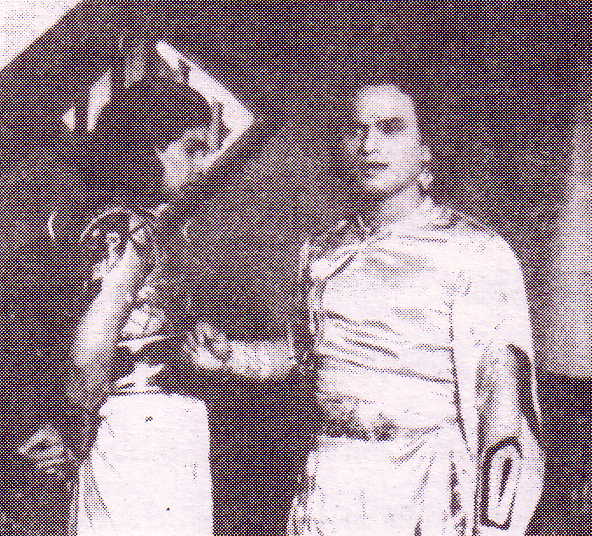 MGR (lt) and Bhagavathar (rt) in ‘Ashok Kumar’ movie
In the previous chapter, I had observed that charismatic persons can be identified with following primary traits. (1) Originality in deeds, (2) humility in action, (3) Apportioning due credit to fellow associates, and (4) risk taking attitude. Subsequently, I located an interesting article by Ken Rea in the New Theatre Quarterly journal, published recently in August 2014. What he had reported and inferred are of some relevance for this MGR biography. I’ll provide a synopsis of this study on aspiring British stage actors, at the end of this chapter.
Also, in Part 11 of this series, I had compared MGR’s record in Tamil movies to that of his Hollywood contemporary John Wayne. Both were charismatic action-movie stars of their generation. Apart from this, in this chapter, I look for a comparison nearer home. I compare MGR’s record in Tamil movies to that of his senior contemporary M.K.Thyagarajah Bhagavathar (1910-1959), anointed as the first super star of Tamil cinema. For convenience, I refer to him simply as ‘Bhagavathar’ as he was called by his fans and media folks of his times. Though, Bhagavathar and MGR had charisma, why the former lost it in mid 1940s and died without retrieving it until his death, and why the latter never lost his charisma and secured it safely until his death is the focus of this chapter. Thus I have titled it as, ‘Secured and Damaged Charisma’. ‘Damaged charisma’ theme also is equally relevant to the stage-movie-political career of M. Karunanidhi, MGR’s friend turned foe.
MGR (lt) and Bhagavathar (rt) in ‘Ashok Kumar’ movie
In the previous chapter, I had observed that charismatic persons can be identified with following primary traits. (1) Originality in deeds, (2) humility in action, (3) Apportioning due credit to fellow associates, and (4) risk taking attitude. Subsequently, I located an interesting article by Ken Rea in the New Theatre Quarterly journal, published recently in August 2014. What he had reported and inferred are of some relevance for this MGR biography. I’ll provide a synopsis of this study on aspiring British stage actors, at the end of this chapter.
Also, in Part 11 of this series, I had compared MGR’s record in Tamil movies to that of his Hollywood contemporary John Wayne. Both were charismatic action-movie stars of their generation. Apart from this, in this chapter, I look for a comparison nearer home. I compare MGR’s record in Tamil movies to that of his senior contemporary M.K.Thyagarajah Bhagavathar (1910-1959), anointed as the first super star of Tamil cinema. For convenience, I refer to him simply as ‘Bhagavathar’ as he was called by his fans and media folks of his times. Though, Bhagavathar and MGR had charisma, why the former lost it in mid 1940s and died without retrieving it until his death, and why the latter never lost his charisma and secured it safely until his death is the focus of this chapter. Thus I have titled it as, ‘Secured and Damaged Charisma’. ‘Damaged charisma’ theme also is equally relevant to the stage-movie-political career of M. Karunanidhi, MGR’s friend turned foe.
Synopsis Bhagavathar’s movie career
I provide a specially compiled table nearby, which compares the film careers of Bhagavathar and MGR. A synopsis on Bhagavathar’s career which appears in the Encyclopedia of Indian Cinema (1998) is offered below.
“One of the first major Tamil singing stars, introduced in K. Subramanyam’s mythological Pavalakkodi (as Arjuna). Born into a family of goldsmiths in Tiruchi; joined the theatre as a child in F.G. Natesa Iyer’s troupe and went on to become the biggest Tamil stage star, sporting shoulder-length hair, diamond ear-rings and kohl around his eyes. After a successful film debut, became briefly the highest-paid actor in South India, despite appearing in only 11 films, with classic performances in Duncan’s Ambikapathy, Y.V. Rao’s Chintamani and Raja Chandrasekhar’s Ashok Kumar, and the folk legend of the reformed saint Haridas, a major commercial hit. Helped launch the mainstream Newtone Studio (1937). As a musician, he adhered to the Tamilisai movement, emphasizing Tamil traditions as opposed to the Carnatic idiom dominated by Telugu, Kannada and Sanskrit. Arrested with N.S. Krishnan and jailed in 1945 for two years for the infamous Lakshmikantan murder (in which the two stars allegedly had a film gossip columnist C.N. Lakshmikantan, killed). Made a high profile comeback with two of his own productions: Chandrasekhar’s Raja Mukthi, failed but is remembered as a debut of playback singer M.L. Vasanthakumari. Turned to direction with his last film, Pudhu Vazhvu.”
There is a factual error in this synopsis. Bhagavathar’s oeuvre consists of a total of 14 movies. His first 9 movies until 1944 were grand hits, among which two (Sathyaseelan, 1936 and Thiruneelakantar, 1939) were his own productions. But the last 5 movies released after his jail term (from 1948 to 1960, including Pudhu Vazhvu – 1957 which he produced and directed) were flops in box office. His final movie Sivakami (1960) was released posthumously. Why Bhagavathar’s charisma became damaged is an interesting question.
Apathy of Bhagavathar and his wife Kamalam
It may be arrogance, or a case of lack of empathy to a fellow actor, not favored by Lady Luck. In Part 3 of this series, I had translated an anecdote from Kaja Muhaideen’s (pen name K.Ravindar) book. He worked for MGR until latter’s death as a script writer. I reproduce it again here for its relevance as well as humility and helping trait of MGR, to those who had been rude to him when he was an out-of-luck actor yearning for chances. Two short and sanitized biographies on Bhagavathar’s life had appeared in Tamil, by Vindhan and Malathi Balan. But, the episode described by Ravindar do not appear in them. As Bhagavathar had died in 1959, this episode relates to Mrs. Kamalam Bhagavathar. The setting was post 1977, after MGR had become the Chief Minister of Tamil Nadu. ‘Hero’/‘He’/‘him’ in the translated text refers to MGR.
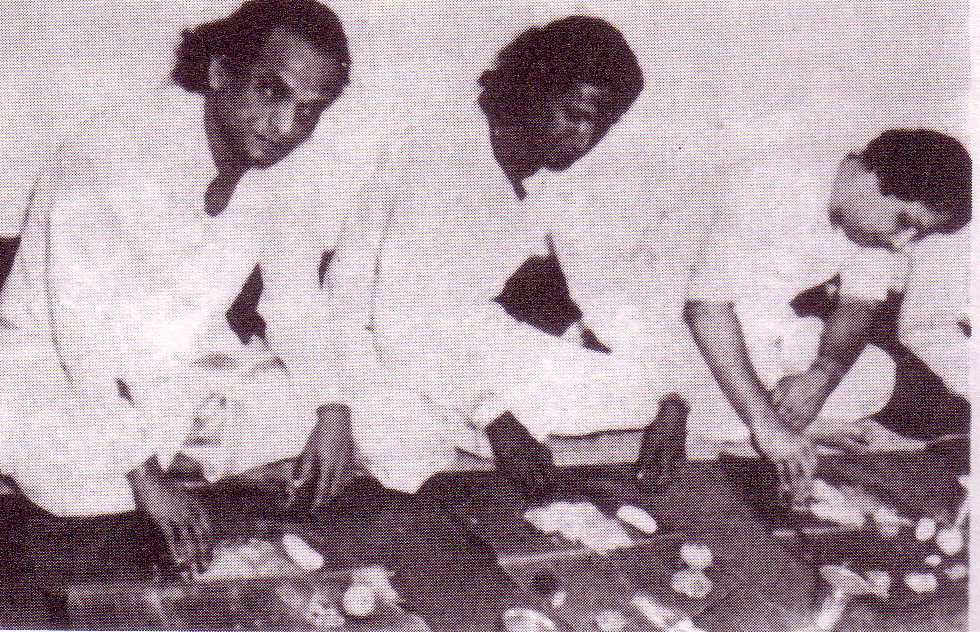 Bhagavathar (lt) and MGR (3rd from lt) sharing a meal
“If it’s evening, I go to Arkadu Mudali Road. For two days an old lady was waiting at Arkadu Mudali road. On the first day, I couldn’t identify her. On the second day, she asked, ‘Are you the Nagore boy, who was in N.P. Abdul Kadar house?’ I watched her face curiously and was dumbfounded. Before that, she herself introduced her; ‘I’m the wife of Bagavathar’. My eyes teared. In those days she was full of beauty with gem stones dangling in her body. Now, her skin had darkened and lifeless. I felt pity. ‘Amma, why you are here?’ I asked.
‘Thambi, I wanted to see MGR. No one listens to me. If you could tell him, please let him know. I’m standing here for two days with pain.’
It was not my job to notice who were standing at the entrance, who leaves. On that day, I reluctantly put that message to him. He asked, ‘Do you know her?’
I said, ‘Yes, It was N.P. Abdul Kadar who introduced me to M.K. Radha elder; he was the one who brought me to the cinema world. During that time, when I was idling, I stand in the Thanam and Co. wrist-watch shop owned by Kadar elder. Then, both Bagavathar and this lady do visit the shop. Even now, she was the one who identified me.’
He said, ‘Yes, for one reason I have made her stand there. You go and do your job.’
Within one week, I learnt from newspaper that one lakh (100,000) rupees were offered from personal funds to Bagavathar family, and the road in which Bagavathar’s house was located and an art theater was named after Bagavathar. Hero was the one who had done this. There was a photo in which hero was featured with Bagavathar family. As it was his habit in doing something without announcement, I didn’t feel this was such a big matter. After hero arrived, I went to see him.
‘Howdy? Did you read the paper? Did you see the story about Bagavathar?’ he asked.
‘Yes’, I quipped.
‘Are you satisfied now?’ he asked.
When I replied, ‘What’s here about my satisfaction?’, he responded.
‘Ravindar, I wanted that lady to realize how times change. She stood only for two days. Even for that, she felt so hurt. Do you know, how many days I had stood in their house compound? In that Askok Kumar movie, the role of me playing Bagavathar’s friend was strongly opposed Bagavathar and his wife who complained to Rajah Chandrasekhar. Even then there were Elder and Younger siblings. Chandrasekhar was the elder, and T.R. Ragunath was the younger. Because of the kind heartedness of those two, I got to play that role! Just because you are on top now, one shouldn’t undermine others’ opportunities’, he said.” [Words in bold font, as in the original.]
As MGR had implied, lack of empathy when their luck was in ascension on the part of Bhagavathar and his wife Kamalam could have been one of the reasons for damaged charisma of the singer-actor. The two sanitized biographies on Bhagavathar do not provide adequate details of the sensational gossip journalist C.N. Lakshmikanthan murder case of 1944, for which he was arrested, (charged as the 3rd accused with abetment as well as with conspiracy to the murder) and sentenced to life imprisonment.
Bhagavathar (lt) and MGR (3rd from lt) sharing a meal
“If it’s evening, I go to Arkadu Mudali Road. For two days an old lady was waiting at Arkadu Mudali road. On the first day, I couldn’t identify her. On the second day, she asked, ‘Are you the Nagore boy, who was in N.P. Abdul Kadar house?’ I watched her face curiously and was dumbfounded. Before that, she herself introduced her; ‘I’m the wife of Bagavathar’. My eyes teared. In those days she was full of beauty with gem stones dangling in her body. Now, her skin had darkened and lifeless. I felt pity. ‘Amma, why you are here?’ I asked.
‘Thambi, I wanted to see MGR. No one listens to me. If you could tell him, please let him know. I’m standing here for two days with pain.’
It was not my job to notice who were standing at the entrance, who leaves. On that day, I reluctantly put that message to him. He asked, ‘Do you know her?’
I said, ‘Yes, It was N.P. Abdul Kadar who introduced me to M.K. Radha elder; he was the one who brought me to the cinema world. During that time, when I was idling, I stand in the Thanam and Co. wrist-watch shop owned by Kadar elder. Then, both Bagavathar and this lady do visit the shop. Even now, she was the one who identified me.’
He said, ‘Yes, for one reason I have made her stand there. You go and do your job.’
Within one week, I learnt from newspaper that one lakh (100,000) rupees were offered from personal funds to Bagavathar family, and the road in which Bagavathar’s house was located and an art theater was named after Bagavathar. Hero was the one who had done this. There was a photo in which hero was featured with Bagavathar family. As it was his habit in doing something without announcement, I didn’t feel this was such a big matter. After hero arrived, I went to see him.
‘Howdy? Did you read the paper? Did you see the story about Bagavathar?’ he asked.
‘Yes’, I quipped.
‘Are you satisfied now?’ he asked.
When I replied, ‘What’s here about my satisfaction?’, he responded.
‘Ravindar, I wanted that lady to realize how times change. She stood only for two days. Even for that, she felt so hurt. Do you know, how many days I had stood in their house compound? In that Askok Kumar movie, the role of me playing Bagavathar’s friend was strongly opposed Bagavathar and his wife who complained to Rajah Chandrasekhar. Even then there were Elder and Younger siblings. Chandrasekhar was the elder, and T.R. Ragunath was the younger. Because of the kind heartedness of those two, I got to play that role! Just because you are on top now, one shouldn’t undermine others’ opportunities’, he said.” [Words in bold font, as in the original.]
As MGR had implied, lack of empathy when their luck was in ascension on the part of Bhagavathar and his wife Kamalam could have been one of the reasons for damaged charisma of the singer-actor. The two sanitized biographies on Bhagavathar do not provide adequate details of the sensational gossip journalist C.N. Lakshmikanthan murder case of 1944, for which he was arrested, (charged as the 3rd accused with abetment as well as with conspiracy to the murder) and sentenced to life imprisonment.
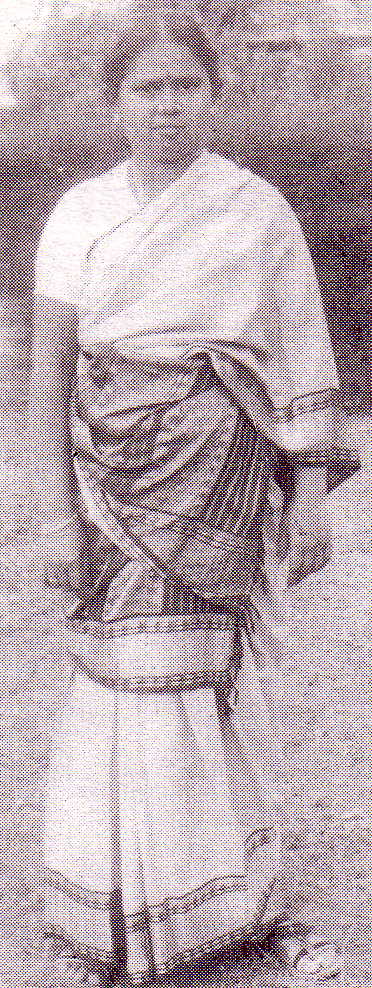 Kamalam, wife of M.K.T. Bhagavathar
Few Comparisons between the careers of Bhagavathar and MGR
First, it is somewhat a coincidence that both Bhagavathar and MGR lost their fathers in Ceylon. Gopalamenon, MGR’s father, probably died in 1919 after he moved himself and his family to Kandy from Kerala. Krishnamurthy, Bhagavathar’s father, died in Colombo, while accompanying the drama troupe (in which his son was the lead performer) in its second trip to Ceylon. Though the exact year in which Krishnamurthy died is not mentioned by Bhagavathar’s biographer Vindhan, I presume it should have been in early or mid-1930s. Through the courtesy of Mr. Kathiresan (an influential figure in Colombo of that era and father of actress Thavamanidevi), Bhagavathar was able to transport the remains of his father to Tiruchi.
Secondly, for his 1934 movie debut as a hero, Bhagavathar (at the age of 24) received only 1,000 rupees. The heroine of Pavalakkodi movie, S. D. Subbulakshmi was offered 2,000 rupees. In his autobiography, MGR mentions with humility that for his 1936 Sathi Leelavathi movie debut in the role of a police inspector (at the age of 19), for the first time in his life, he saw the 100 rupee note, as an advance received from producer Maruthachalam Chettiar. Then, for his 1942 Thamizhariyum Perumal movie, for a small role, he received a salary of 300 rupees. Between these two movies, MGR had acted in a small role in Bhagavathar’s hit movie Ashok Kumar (1941). But, he had omitted this experience in his autobiography. Finally, for his 1947 Rajakumari movie as a hero (at the age of 30), MGR was offered a cumulative sum of 2,500 rupees.
Thirdly, both Bhagavathar and MGR had to face a criminal lawsuit. For Bhagavathar, it was in 1944, when he was aged 34. For MGR, it was in 1967, when he was 50. Bhagavathar was an accused in his lawsuit; but MGR was a plaintiff in which his fellow actor M.R. Radha was the accused in attempting to murder him. More details on MGR’s case against M.R. Radha will follow later. Whether the status of being an accused or a plaintiff in a murder trial affect the charisma status of a movie superstar is a moot question.
Kamalam, wife of M.K.T. Bhagavathar
Few Comparisons between the careers of Bhagavathar and MGR
First, it is somewhat a coincidence that both Bhagavathar and MGR lost their fathers in Ceylon. Gopalamenon, MGR’s father, probably died in 1919 after he moved himself and his family to Kandy from Kerala. Krishnamurthy, Bhagavathar’s father, died in Colombo, while accompanying the drama troupe (in which his son was the lead performer) in its second trip to Ceylon. Though the exact year in which Krishnamurthy died is not mentioned by Bhagavathar’s biographer Vindhan, I presume it should have been in early or mid-1930s. Through the courtesy of Mr. Kathiresan (an influential figure in Colombo of that era and father of actress Thavamanidevi), Bhagavathar was able to transport the remains of his father to Tiruchi.
Secondly, for his 1934 movie debut as a hero, Bhagavathar (at the age of 24) received only 1,000 rupees. The heroine of Pavalakkodi movie, S. D. Subbulakshmi was offered 2,000 rupees. In his autobiography, MGR mentions with humility that for his 1936 Sathi Leelavathi movie debut in the role of a police inspector (at the age of 19), for the first time in his life, he saw the 100 rupee note, as an advance received from producer Maruthachalam Chettiar. Then, for his 1942 Thamizhariyum Perumal movie, for a small role, he received a salary of 300 rupees. Between these two movies, MGR had acted in a small role in Bhagavathar’s hit movie Ashok Kumar (1941). But, he had omitted this experience in his autobiography. Finally, for his 1947 Rajakumari movie as a hero (at the age of 30), MGR was offered a cumulative sum of 2,500 rupees.
Thirdly, both Bhagavathar and MGR had to face a criminal lawsuit. For Bhagavathar, it was in 1944, when he was aged 34. For MGR, it was in 1967, when he was 50. Bhagavathar was an accused in his lawsuit; but MGR was a plaintiff in which his fellow actor M.R. Radha was the accused in attempting to murder him. More details on MGR’s case against M.R. Radha will follow later. Whether the status of being an accused or a plaintiff in a murder trial affect the charisma status of a movie superstar is a moot question.
Few offers to Bhagavathar for retrieving his charisma
Bhagavathar’s biographers mention at least two chances offered by his well-wishers to retrieve his popularity and charisma. First was by DMK leader C. Annadurai (Anna). He had scripted a movie story named Sorga Vasal ( Gate of Heaven, 1954) especially for Bhagavathar, and wished the latter to play the hero role. But Bhagavathar, unsatisfied by the atheist sentiments expressed in the script stood by his conviction, and rejected the offer outrightly. Thus, Anna had to settle with K.R. Ramasamy (a junior colleague of his party, with an established reputation as a singer-actor) for the lead role in his movie.
The second offer was made by the producer A.L. Srinivasan (an elder sibling of poet Kannadasan) who wanted Bhagavathar to play the role of poet Kambar, the father of the hero Ambikapathi in his 1957 production. The doomed love story of Ambikapathi- Amaravathi couple is to Tamils, what the doomed love of Romeo-Juliet is to English-speaking audience. Bhagavathar himself had essayed the hero Ambikapathi role in his 1937 movie, directed by Ellis Dungan. In the 1957 version, Sivaji Ganesan played the hero Ambikapathi role. Considering his seniority, producer Srinivasan was willing to offer 10,000 rupees higher than the amount offered to Sivaji Ganesan, the hero. But, Bhagavathar had flatly rejected this offer, with a flawed reasoning that his fans who had seen him play Ambikapathi in 1937, would be dismayed if he had to play the role of Kambar (father of hero Ambikapathi). That his reason was flawed based on delusion is a fact. He had lost his fans by 1948 itself. Had he taken up this offer, Bhagavathar might have gained fame in Tamil movie history as playing the role of both, a young Ambikapathi (son) in 1937 and an older Kambar (father) in 1957.
Call it excess pride in his virility or was it unabashed timidity that had clouded Bhagavathar’s thinking then. He simply failed to read the air of changed surroundings – a failed case of mastery of audience. Some of his admirers do mention that after his release from prison in 1947, Bhagavathar had turned philosophical and more religious. If this was the case, then he would have opted to retire from movies, once and for all, and focused only on performing in music concerts. This he failed to do. He did act in 4 movies until 1957, which indicates that Bhagavathar was more than willing to play the dice for recapturing the old fame.
This brings me to the study of Ken Rea, published last year. Ken Rea is a senior acting tutor at the Guildhall School of Music and Drama, London. For the past 14 years, he had gathered information from his students (a total of over 350 actors) answer to the question, ‘What makes an exciting actor (or an outstanding actor)?’ This sample had identified 12 traits, as follows:
- Danger: unpredictable, risk-taking, daring, bold choices, courage, ability to surprise.
- Presence: magnetism, focus, compelling, limitless projection of energy, confidence.
- Warmth: incandescent generosity, without ego, a twinkle in the eye, joy, openness.
- Effortless spontaneity: abandon, freedom, relaxation, openness, playfulness.
- Individuality: freshness of approach, boldness, maverick, going against the obvious, ownership.
- Intensity of focus: totally connected and concentrated, total commitment, transports us.
- Specificity: precision, detail, virtuosity, accuracy, acute perception of behavior.
- Mastery of the audience: rapport, conducting their imagination, letting them in.
- Grace: ease and relaxation, aesthetically pleasing, inner calm.
- Charisma: magnetism, animation, originality of imagination, unique personality.
- Passion: hunger, drive, motivation, relish, vulnerability, enthusiasm.
- Sexual charisma: animal quality, at ease in your body, uninhibited sensuousness.
Charisma appears twice (10th and 12th) among these 12 traits. Tamil movie goers have no doubt that both Bhagavathar and MGR exuded charisma as well as sexual charisma. Bhagavathar oozed sexual charisma in his hero role of 1937 movie Ambikapathi, aided by Ellis Dungan’s direction. MGR’s sexual charisma is distinctly visible in all his 1950s movies, when he was aged 33 to 42.
From these answers of his students, and aided by experts associated with the field (agent or casting director, director, actor and critic), Ken Rea distilled the essence of being an outstanding actor to 7 values (consisting of identifiable cluster traits). These are,
- Warmth: vulnerability, passion and openness
- Generosity: extroversion, love and openness
- Enthusiasm: drive, curiosity, enjoyment, exuberance, optimism, passion and motivation
- Danger: unpredictability, individuality, imagination, agility, courage and risk-taking
- Grit: resilience, perseverance, enthusiasm and optimism
- Presence: attraction, relaxation and magnetism
- Charisma: (the most important of all – the ability to stand out) confidence, presence, passion, authenticity and virtuosity.
In hindsight, one may infer that Bhagavathar was few notches lower than MGR, in the above identified 7 values. I could identify, generosity and danger (courage and risk-taking) as two values which deprived Bhagavathar in retrieving his charisma in the post-1947 period. As the MGR anecdote mentioned above by Ravindar indicates, in comparison to MGR’s recorded life, Bhagavathar was less forthcoming in the generosity component. Secondly, he could have had the courage and risk-taking attitude to accept the two offers made to him by Anna and A.L. Srinivasan to help him in 1950s. Particularly, had he accepted to play the role of Kambar, in the 1957 production, his fans as well as others would have been delighted in seeing how Bhagavathar essayed both vital roles of the Ambikapathi-Amaravathi story in a 20 year span, and compared his performance to that of 1937 Kambar role played by Serukulathur Sama. But, it was not to be.
To find an answer to the question (When did MGR gained charisma?) which I had asked on this charisma theme, I could depend on MGR’s thoughts. In chapter 111 of his autobiography, beginning from 1947 to 1971, he had listed 14 ‘turns’ of his movie career. I find that his list of first four ‘turns’ very helpful. These are,
1st turn: ‘Rajakumari’ (The Princess, 1947): ‘I was contracted as a hero’.
2nd turn: ‘Marutha Naatu Ilavarasi’ (The Princess of the Maruta Land, 1950): ‘It was helpful for producers to decide that I was a ‘hero material’.
3rd turn: ‘Marma Yogi’(Secret Mystic, 1951): ‘When fans were confused about where I belonged – in the 2nd row or 1st row among the heroes, this movie placed me in the 1st row.’
4th turn: ‘Malai Kallan’ (Mountain Thief, 1954): ‘To the question, which position in the first row he deserves, this movie placed me that frequently he deserves the top spot.’
Thus, without much confusion, one can assign that MGR was handed the charismatic crown in 1954 with the popular hit ‘Malai Kallan’ movie.
In contrast to Bhagavathar, after securing his charisma in 1954 in movies, not only MGR was able to transfer that charisma successfully to politics (an exceptional feat among his Indian actor contemporaries), he never permitted his charisma to vanish until his death. This does not mean that he was always right in his decisions. He did err occasionally. But, he was able to overcome his deficits by his endowed warmth and generosity values (the first two values), identified by Ken Rea for an outstanding actor.
Though he had acted in two of Bhagavathar’s movies in subsidiary roles, it is rather unusual that Bhagavathar hardly receives any mention in MGR’s autobiography. Among the cumulative total of 1480 pages, Bhagavathar’s name is mentioned passingly only on two occasions. Relatively, activities of Bhagavathar’s contemporaries like P.U. Chinnappa, N.S. Krishnan and other senior actors of Tamil stage and cinema receive numerous mentions in MGR’s reminiscences.
In the next chapter, I cover MGR’s first production Nadodi Mannan (Vagabond King, 1958), for which he had attributed his 5th turn.
Cited Sources
‘Film News’ Anandan: Sadhanaigal Padaitha Thamizh thiraipada Varalaru (Tamil Film History and its Achievements), Sivagami Publications, Chennai, 2004.
Malathi Balan: ‘Elisai Mannar’ M.K. Thyagarajah Bhagavathar Life Story, Books India, Chennai, 2003. (in Tamil)
Randor Guy: Starlight, Starbright, 1. The Early Tamil Cinema, Amra Publishers, Chennai, 1997.
Ashish Rajadhyaksha and Paul Willemen: Encyclopedia of Indian Cinema, New Revised ed., Oxford University Press, New Delhi, 1999.
MGR: Naan Yean Piranthen? (Why I was Born?), 2 volumes, Kannadhasan Pathippagam, Chennai, 2014. (in Tamil)
- Ravindar: Pon Mana Chemmal MGR (Golden-hearted MGR), Vijaya Publications, Chennai, 2009. (in Tamil)
Ken Rea: Nurturing the Outstanding Actor: Lessons from Action Research in a Drama School. New Theatre Quarterly, 2014 Aug; 30(3): 231-242.
Vindhan: M.K.T. Baghavadhar Kadai (Bhagavadhar Story), Arunthathi Nilayam, Chennai, 2nd ed., 2000. (in Tamil)
MGR (lt) and Bhagavathar (rt) in ‘Ashok Kumar’ movie
In the previous chapter, I had observed that charismatic persons can be identified with following primary traits. (1) Originality in deeds, (2) humility in action, (3) Apportioning due credit to fellow associates, and (4) risk taking attitude. Subsequently, I located an interesting article by Ken Rea in the New Theatre Quarterly journal, published recently in August 2014. What he had reported and inferred are of some relevance for this MGR biography. I’ll provide a synopsis of this study on aspiring British stage actors, at the end of this chapter.
Also, in Part 11 of this series, I had compared MGR’s record in Tamil movies to that of his Hollywood contemporary John Wayne. Both were charismatic action-movie stars of their generation. Apart from this, in this chapter, I look for a comparison nearer home. I compare MGR’s record in Tamil movies to that of his senior contemporary M.K.Thyagarajah Bhagavathar (1910-1959), anointed as the first super star of Tamil cinema. For convenience, I refer to him simply as ‘Bhagavathar’ as he was called by his fans and media folks of his times. Though, Bhagavathar and MGR had charisma, why the former lost it in mid 1940s and died without retrieving it until his death, and why the latter never lost his charisma and secured it safely until his death is the focus of this chapter. Thus I have titled it as, ‘Secured and Damaged Charisma’. ‘Damaged charisma’ theme also is equally relevant to the stage-movie-political career of M. Karunanidhi, MGR’s friend turned foe.
Synopsis Bhagavathar’s movie career
I provide a specially compiled table nearby, which compares the film careers of Bhagavathar and MGR. A synopsis on Bhagavathar’s career which appears in the Encyclopedia of Indian Cinema (1998) is offered below.
“One of the first major Tamil singing stars, introduced in K. Subramanyam’s mythological Pavalakkodi (as Arjuna). Born into a family of goldsmiths in Tiruchi; joined the theatre as a child in F.G. Natesa Iyer’s troupe and went on to become the biggest Tamil stage star, sporting shoulder-length hair, diamond ear-rings and kohl around his eyes. After a successful film debut, became briefly the highest-paid actor in South India, despite appearing in only 11 films, with classic performances in Duncan’s Ambikapathy, Y.V. Rao’s Chintamani and Raja Chandrasekhar’s Ashok Kumar, and the folk legend of the reformed saint Haridas, a major commercial hit. Helped launch the mainstream Newtone Studio (1937). As a musician, he adhered to the Tamilisai movement, emphasizing Tamil traditions as opposed to the Carnatic idiom dominated by Telugu, Kannada and Sanskrit. Arrested with N.S. Krishnan and jailed in 1945 for two years for the infamous Lakshmikantan murder (in which the two stars allegedly had a film gossip columnist C.N. Lakshmikantan, killed). Made a high profile comeback with two of his own productions: Chandrasekhar’s Raja Mukthi, failed but is remembered as a debut of playback singer M.L. Vasanthakumari. Turned to direction with his last film, Pudhu Vazhvu.”
There is a factual error in this synopsis. Bhagavathar’s oeuvre consists of a total of 14 movies. His first 9 movies until 1944 were grand hits, among which two (Sathyaseelan, 1936 and Thiruneelakantar, 1939) were his own productions. But the last 5 movies released after his jail term (from 1948 to 1960, including Pudhu Vazhvu – 1957 which he produced and directed) were flops in box office. His final movie Sivakami (1960) was released posthumously. Why Bhagavathar’s charisma became damaged is an interesting question.
Apathy of Bhagavathar and his wife Kamalam
It may be arrogance, or a case of lack of empathy to a fellow actor, not favored by Lady Luck. In Part 3 of this series, I had translated an anecdote from Kaja Muhaideen’s (pen name K.Ravindar) book. He worked for MGR until latter’s death as a script writer. I reproduce it again here for its relevance as well as humility and helping trait of MGR, to those who had been rude to him when he was an out-of-luck actor yearning for chances. Two short and sanitized biographies on Bhagavathar’s life had appeared in Tamil, by Vindhan and Malathi Balan. But, the episode described by Ravindar do not appear in them. As Bhagavathar had died in 1959, this episode relates to Mrs. Kamalam Bhagavathar. The setting was post 1977, after MGR had become the Chief Minister of Tamil Nadu. ‘Hero’/‘He’/‘him’ in the translated text refers to MGR.
Bhagavathar (lt) and MGR (3rd from lt) sharing a meal
“If it’s evening, I go to Arkadu Mudali Road. For two days an old lady was waiting at Arkadu Mudali road. On the first day, I couldn’t identify her. On the second day, she asked, ‘Are you the Nagore boy, who was in N.P. Abdul Kadar house?’ I watched her face curiously and was dumbfounded. Before that, she herself introduced her; ‘I’m the wife of Bagavathar’. My eyes teared. In those days she was full of beauty with gem stones dangling in her body. Now, her skin had darkened and lifeless. I felt pity. ‘Amma, why you are here?’ I asked.
‘Thambi, I wanted to see MGR. No one listens to me. If you could tell him, please let him know. I’m standing here for two days with pain.’
It was not my job to notice who were standing at the entrance, who leaves. On that day, I reluctantly put that message to him. He asked, ‘Do you know her?’
I said, ‘Yes, It was N.P. Abdul Kadar who introduced me to M.K. Radha elder; he was the one who brought me to the cinema world. During that time, when I was idling, I stand in the Thanam and Co. wrist-watch shop owned by Kadar elder. Then, both Bagavathar and this lady do visit the shop. Even now, she was the one who identified me.’
He said, ‘Yes, for one reason I have made her stand there. You go and do your job.’
Within one week, I learnt from newspaper that one lakh (100,000) rupees were offered from personal funds to Bagavathar family, and the road in which Bagavathar’s house was located and an art theater was named after Bagavathar. Hero was the one who had done this. There was a photo in which hero was featured with Bagavathar family. As it was his habit in doing something without announcement, I didn’t feel this was such a big matter. After hero arrived, I went to see him.
‘Howdy? Did you read the paper? Did you see the story about Bagavathar?’ he asked.
‘Yes’, I quipped.
‘Are you satisfied now?’ he asked.
When I replied, ‘What’s here about my satisfaction?’, he responded.
‘Ravindar, I wanted that lady to realize how times change. She stood only for two days. Even for that, she felt so hurt. Do you know, how many days I had stood in their house compound? In that Askok Kumar movie, the role of me playing Bagavathar’s friend was strongly opposed Bagavathar and his wife who complained to Rajah Chandrasekhar. Even then there were Elder and Younger siblings. Chandrasekhar was the elder, and T.R. Ragunath was the younger. Because of the kind heartedness of those two, I got to play that role! Just because you are on top now, one shouldn’t undermine others’ opportunities’, he said.” [Words in bold font, as in the original.]
As MGR had implied, lack of empathy when their luck was in ascension on the part of Bhagavathar and his wife Kamalam could have been one of the reasons for damaged charisma of the singer-actor. The two sanitized biographies on Bhagavathar do not provide adequate details of the sensational gossip journalist C.N. Lakshmikanthan murder case of 1944, for which he was arrested, (charged as the 3rd accused with abetment as well as with conspiracy to the murder) and sentenced to life imprisonment.
Kamalam, wife of M.K.T. Bhagavathar
Few Comparisons between the careers of Bhagavathar and MGR
First, it is somewhat a coincidence that both Bhagavathar and MGR lost their fathers in Ceylon. Gopalamenon, MGR’s father, probably died in 1919 after he moved himself and his family to Kandy from Kerala. Krishnamurthy, Bhagavathar’s father, died in Colombo, while accompanying the drama troupe (in which his son was the lead performer) in its second trip to Ceylon. Though the exact year in which Krishnamurthy died is not mentioned by Bhagavathar’s biographer Vindhan, I presume it should have been in early or mid-1930s. Through the courtesy of Mr. Kathiresan (an influential figure in Colombo of that era and father of actress Thavamanidevi), Bhagavathar was able to transport the remains of his father to Tiruchi.
Secondly, for his 1934 movie debut as a hero, Bhagavathar (at the age of 24) received only 1,000 rupees. The heroine of Pavalakkodi movie, S. D. Subbulakshmi was offered 2,000 rupees. In his autobiography, MGR mentions with humility that for his 1936 Sathi Leelavathi movie debut in the role of a police inspector (at the age of 19), for the first time in his life, he saw the 100 rupee note, as an advance received from producer Maruthachalam Chettiar. Then, for his 1942 Thamizhariyum Perumal movie, for a small role, he received a salary of 300 rupees. Between these two movies, MGR had acted in a small role in Bhagavathar’s hit movie Ashok Kumar (1941). But, he had omitted this experience in his autobiography. Finally, for his 1947 Rajakumari movie as a hero (at the age of 30), MGR was offered a cumulative sum of 2,500 rupees.
Thirdly, both Bhagavathar and MGR had to face a criminal lawsuit. For Bhagavathar, it was in 1944, when he was aged 34. For MGR, it was in 1967, when he was 50. Bhagavathar was an accused in his lawsuit; but MGR was a plaintiff in which his fellow actor M.R. Radha was the accused in attempting to murder him. More details on MGR’s case against M.R. Radha will follow later. Whether the status of being an accused or a plaintiff in a murder trial affect the charisma status of a movie superstar is a moot question.
Few offers to Bhagavathar for retrieving his charisma
Bhagavathar’s biographers mention at least two chances offered by his well-wishers to retrieve his popularity and charisma. First was by DMK leader C. Annadurai (Anna). He had scripted a movie story named Sorga Vasal ( Gate of Heaven, 1954) especially for Bhagavathar, and wished the latter to play the hero role. But Bhagavathar, unsatisfied by the atheist sentiments expressed in the script stood by his conviction, and rejected the offer outrightly. Thus, Anna had to settle with K.R. Ramasamy (a junior colleague of his party, with an established reputation as a singer-actor) for the lead role in his movie.
The second offer was made by the producer A.L. Srinivasan (an elder sibling of poet Kannadasan) who wanted Bhagavathar to play the role of poet Kambar, the father of the hero Ambikapathi in his 1957 production. The doomed love story of Ambikapathi- Amaravathi couple is to Tamils, what the doomed love of Romeo-Juliet is to English-speaking audience. Bhagavathar himself had essayed the hero Ambikapathi role in his 1937 movie, directed by Ellis Dungan. In the 1957 version, Sivaji Ganesan played the hero Ambikapathi role. Considering his seniority, producer Srinivasan was willing to offer 10,000 rupees higher than the amount offered to Sivaji Ganesan, the hero. But, Bhagavathar had flatly rejected this offer, with a flawed reasoning that his fans who had seen him play Ambikapathi in 1937, would be dismayed if he had to play the role of Kambar (father of hero Ambikapathi). That his reason was flawed based on delusion is a fact. He had lost his fans by 1948 itself. Had he taken up this offer, Bhagavathar might have gained fame in Tamil movie history as playing the role of both, a young Ambikapathi (son) in 1937 and an older Kambar (father) in 1957.
Call it excess pride in his virility or was it unabashed timidity that had clouded Bhagavathar’s thinking then. He simply failed to read the air of changed surroundings – a failed case of mastery of audience. Some of his admirers do mention that after his release from prison in 1947, Bhagavathar had turned philosophical and more religious. If this was the case, then he would have opted to retire from movies, once and for all, and focused only on performing in music concerts. This he failed to do. He did act in 4 movies until 1957, which indicates that Bhagavathar was more than willing to play the dice for recapturing the old fame.
This brings me to the study of Ken Rea, published last year. Ken Rea is a senior acting tutor at the Guildhall School of Music and Drama, London. For the past 14 years, he had gathered information from his students (a total of over 350 actors) answer to the question, ‘What makes an exciting actor (or an outstanding actor)?’ This sample had identified 12 traits, as follows:
- Danger: unpredictable, risk-taking, daring, bold choices, courage, ability to surprise.
- Presence: magnetism, focus, compelling, limitless projection of energy, confidence.
- Warmth: incandescent generosity, without ego, a twinkle in the eye, joy, openness.
- Effortless spontaneity: abandon, freedom, relaxation, openness, playfulness.
- Individuality: freshness of approach, boldness, maverick, going against the obvious, ownership.
- Intensity of focus: totally connected and concentrated, total commitment, transports us.
- Specificity: precision, detail, virtuosity, accuracy, acute perception of behavior.
- Mastery of the audience: rapport, conducting their imagination, letting them in.
- Grace: ease and relaxation, aesthetically pleasing, inner calm.
- Charisma: magnetism, animation, originality of imagination, unique personality.
- Passion: hunger, drive, motivation, relish, vulnerability, enthusiasm.
- Sexual charisma: animal quality, at ease in your body, uninhibited sensuousness.
Charisma appears twice (10th and 12th) among these 12 traits. Tamil movie goers have no doubt that both Bhagavathar and MGR exuded charisma as well as sexual charisma. Bhagavathar oozed sexual charisma in his hero role of 1937 movie Ambikapathi, aided by Ellis Dungan’s direction. MGR’s sexual charisma is distinctly visible in all his 1950s movies, when he was aged 33 to 42.
From these answers of his students, and aided by experts associated with the field (agent or casting director, director, actor and critic), Ken Rea distilled the essence of being an outstanding actor to 7 values (consisting of identifiable cluster traits). These are,
- Warmth: vulnerability, passion and openness
- Generosity: extroversion, love and openness
- Enthusiasm: drive, curiosity, enjoyment, exuberance, optimism, passion and motivation
- Danger: unpredictability, individuality, imagination, agility, courage and risk-taking
- Grit: resilience, perseverance, enthusiasm and optimism
- Presence: attraction, relaxation and magnetism
- Charisma: (the most important of all – the ability to stand out) confidence, presence, passion, authenticity and virtuosity.
In hindsight, one may infer that Bhagavathar was few notches lower than MGR, in the above identified 7 values. I could identify, generosity and danger (courage and risk-taking) as two values which deprived Bhagavathar in retrieving his charisma in the post-1947 period. As the MGR anecdote mentioned above by Ravindar indicates, in comparison to MGR’s recorded life, Bhagavathar was less forthcoming in the generosity component. Secondly, he could have had the courage and risk-taking attitude to accept the two offers made to him by Anna and A.L. Srinivasan to help him in 1950s. Particularly, had he accepted to play the role of Kambar, in the 1957 production, his fans as well as others would have been delighted in seeing how Bhagavathar essayed both vital roles of the Ambikapathi-Amaravathi story in a 20 year span, and compared his performance to that of 1937 Kambar role played by Serukulathur Sama. But, it was not to be.
To find an answer to the question (When did MGR gained charisma?) which I had asked on this charisma theme, I could depend on MGR’s thoughts. In chapter 111 of his autobiography, beginning from 1947 to 1971, he had listed 14 ‘turns’ of his movie career. I find that his list of first four ‘turns’ very helpful. These are,
1st turn: ‘Rajakumari’ (The Princess, 1947): ‘I was contracted as a hero’.
2nd turn: ‘Marutha Naatu Ilavarasi’ (The Princess of the Maruta Land, 1950): ‘It was helpful for producers to decide that I was a ‘hero material’.
3rd turn: ‘Marma Yogi’(Secret Mystic, 1951): ‘When fans were confused about where I belonged – in the 2nd row or 1st row among the heroes, this movie placed me in the 1st row.’
4th turn: ‘Malai Kallan’ (Mountain Thief, 1954): ‘To the question, which position in the first row he deserves, this movie placed me that frequently he deserves the top spot.’
Thus, without much confusion, one can assign that MGR was handed the charismatic crown in 1954 with the popular hit ‘Malai Kallan’ movie.
In contrast to Bhagavathar, after securing his charisma in 1954 in movies, not only MGR was able to transfer that charisma successfully to politics (an exceptional feat among his Indian actor contemporaries), he never permitted his charisma to vanish until his death. This does not mean that he was always right in his decisions. He did err occasionally. But, he was able to overcome his deficits by his endowed warmth and generosity values (the first two values), identified by Ken Rea for an outstanding actor.
Though he had acted in two of Bhagavathar’s movies in subsidiary roles, it is rather unusual that Bhagavathar hardly receives any mention in MGR’s autobiography. Among the cumulative total of 1480 pages, Bhagavathar’s name is mentioned passingly only on two occasions. Relatively, activities of Bhagavathar’s contemporaries like P.U. Chinnappa, N.S. Krishnan and other senior actors of Tamil stage and cinema receive numerous mentions in MGR’s reminiscences.
In the next chapter, I cover MGR’s first production Nadodi Mannan (Vagabond King, 1958), for which he had attributed his 5th turn.
Cited Sources
‘Film News’ Anandan: Sadhanaigal Padaitha Thamizh thiraipada Varalaru (Tamil Film History and its Achievements), Sivagami Publications, Chennai, 2004.
Malathi Balan: ‘Elisai Mannar’ M.K. Thyagarajah Bhagavathar Life Story, Books India, Chennai, 2003. (in Tamil)
Randor Guy: Starlight, Starbright, 1. The Early Tamil Cinema, Amra Publishers, Chennai, 1997.
Ashish Rajadhyaksha and Paul Willemen: Encyclopedia of Indian Cinema, New Revised ed., Oxford University Press, New Delhi, 1999.
MGR: Naan Yean Piranthen? (Why I was Born?), 2 volumes, Kannadhasan Pathippagam, Chennai, 2014. (in Tamil)
- Ravindar: Pon Mana Chemmal MGR (Golden-hearted MGR), Vijaya Publications, Chennai, 2009. (in Tamil)
Ken Rea: Nurturing the Outstanding Actor: Lessons from Action Research in a Drama School. New Theatre Quarterly, 2014 Aug; 30(3): 231-242.
Vindhan: M.K.T. Baghavadhar Kadai (Bhagavadhar Story), Arunthathi Nilayam, Chennai, 2nd ed., 2000. (in Tamil)
MGR Remembered – Part 25
Nadodi Mannan aka The Vagabond King
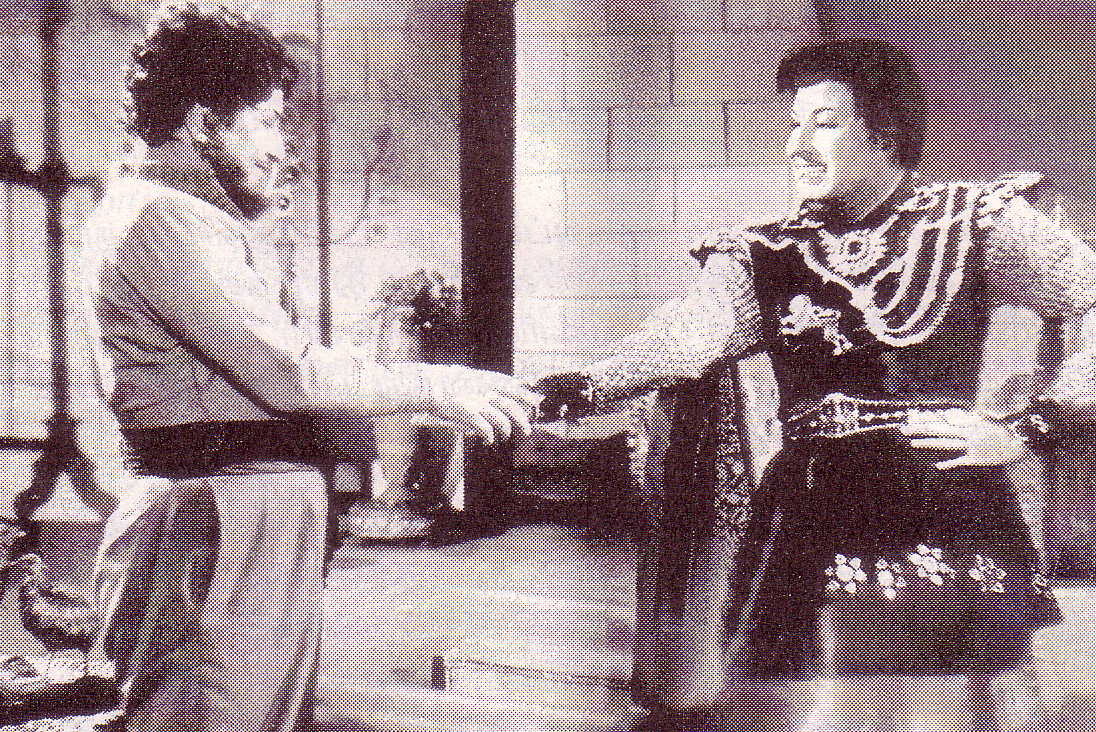 Nadodi Mannan movie – MGR in double roles
by Sachi Sri Kantha, March 6, 2015
I received the following critical comments from fellow MGR biographer and friend R. Kannan, for Part 24 (Secured and Damaged Charisma), on Feb.3rd. Initials MKT refers to M.K. Thiyagarajah Bhagavathar, with whom I have compared MGR’s film career:
“Dear Sachi:
Nadodi Mannan movie – MGR in double roles
by Sachi Sri Kantha, March 6, 2015
I received the following critical comments from fellow MGR biographer and friend R. Kannan, for Part 24 (Secured and Damaged Charisma), on Feb.3rd. Initials MKT refers to M.K. Thiyagarajah Bhagavathar, with whom I have compared MGR’s film career:
“Dear Sachi:
I read your part 24 of the MGR series with great interest and as ever was impressed with your research and efforts. I wish to disagree with you though. If I am not mistaken you cite MKT’s arrogance, condescension, self-serving nature as one of the two reasons for his charisma fading away. Also you mention that he was not known for his philanthropy like MGR.
MGR I believe was equally a human being condescending and even punishing people at times. I am inclined to believe that MGR had gone to the extent of ruining many. I believe that it was in MGR’s nature to be a generous man when it came to money. However, I don’t think these explain his charisma in full. Unlike MKT MGR was an actor- politician who cultivated his image early on. MKT was simply an actor. The DMK carried MGR on its shoulders. True that the party greatly benefitted from MGR’s association.
On the philanthropy I think MKT was a Mariamman devotee and I am assuming he would have donated to such causes. Also MGR’s charisma has been greatly saved by several incidents in his life: the first is the 1969 gunshot wounds; the second is the expulsion from the DMK; the third is his poor health in 1984. In the 1980 parliamentary elections and in the 1986 civic body polls MGR’s charisma was not at play. Also the AIADMK peaked after MGR in the last elections winning a record 150 seats. MGR could not win more than 130+ seats. These are my thoughts for now.”
My response sent on the following day to Mr. Kannan was as follows:
“Dear Kannan,
Thanks for your clear thoughts and analysis on part 24. Sure, you are welcome to disagree with my views. I do appreciate it very much. Can I include your criticism, at the beginning of Part 25?
In fact, about those who were ill-treated by MGR, I plan to write later, in one chapter. I have read, there have been a handful. Kannadasan, Kuladeivam Rajagopal, Chandrababu, T.M. Soundararajan (TMS), later S.A. Asokan and even Jayalalitha (after MGR chose other heroines like Manjula and Latha in 1970s). Karunanidhi had accused that MGR worked against S.S. Rajendran (SSR)’s interest. But, in balance, number of those who have gained from MGR’s munificence outweigh those who were side tracked. Even among the above list, Kannadasan and TMS had kind words later. Jayalalitha returned to MGR.
It’s unfortunate that we don’t have much information about Bhagavathar’s career. Though I didn’t include this in my part 24 chapter, one should also include in this Bhagavathar-
MGR charisma debate, comedian N.S. Krishnan (NSK) as well. NSK also had charisma. He also went to jail with Bhagavathar. But, after his jail term, he was able to retrieve
his lost charisma. His produced movies were not flops. But, why Bhagavathar couldn’t do so?”
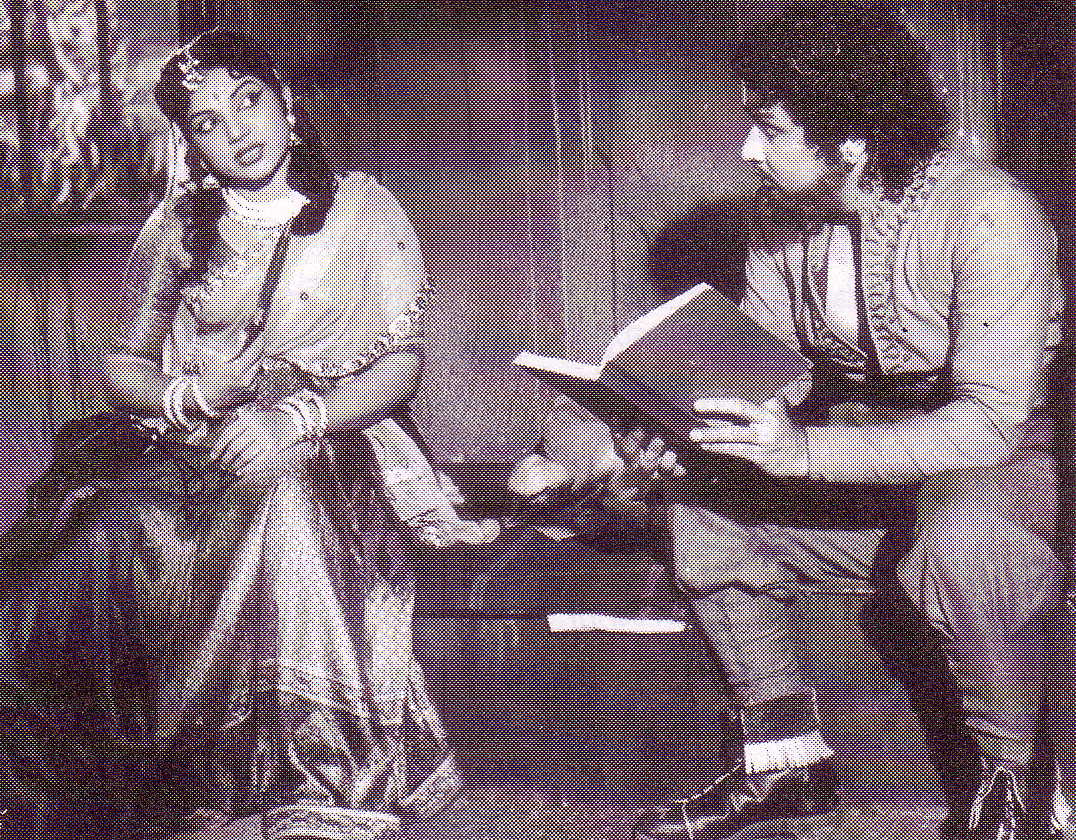 Nadodi Mannan movie – Bhanumathi (lt) with MGR
Motifs in MGR movies
A dictionary on cinematic terms, define a motif as “a recurrent word, phrase, situation, object or idea.” There are many motifs in MGR movies. One prominent motif is a riding scene with an educational (or philosophical) song. The hero character rides a bullock cart or a small scale chariot, while lip-singing this enthralling song. Occasionally, either the heroine or a side-kick (comedian) or an actor in a minor role is nearby. Here are some selected examples.
‘Manusanai manusan saapiduraandhi’ – in Thaaiku Pin Thaaram (Wife after the Mother 1956)
‘Summa irunda nilathai koththi’ – in Nadodi Mannan (The Vagabond King 1958)
‘Uzhaipathila Uzhaipai peruvathila’ – in Nadodi Mannan (The Vagabond King 1958)
‘Achcham enpathu madamaiyada’ – in Mannathi Mannan (King of Kings 1960)
‘Paarappa Palaniappa Pattanamam Pattanamam’ – in Periya Idathu Penn (High Society Woman, 1963)
‘Nenjam undu Nermai undu Oodu raja’ – in En Annan (My Elder Brother 1970)
It has been stated that MGR adopted this strategy of having an educational song, after the success of Malai Kallan (1954) movie, in which he lip synched a time-less song ‘Ethanai Kaalam Thaan Emaruvar intha Naatile?’ (How long these guys will be cheating us?). For this song, the heroine (P. Bhanumathi, 1925-2005) was riding a horse, while MGR character was walking nearby holding the horse rein. Even though the lyricist, the song arranger (aka music director) and the singer were different individuals, in his fans minds, the song has become entrenched as an arch-typical MGR song, for the sole reason that MGR’s imprint is seen there. Almost all such songs in 1950s, and 1960s were sung by T.M. Soundararajan.
Nadodi Mannan (The Vagabond King) was MGR’s grand project of 1956-57, and it was released on August 22, 1958. In addition to acting in double roles, MGR produced and directed it under his newly formed company banner, Em.Gee.Yar Pictures. In these movie, there were two educational songs with a riding scene. One was ‘Summa kidandha nilaththai koththi sombalillamal yer nadathi’ (Digging an unkempt soil and ploughing it earnestly) sung by T.M. Soundararajan and written by Pattukottai Kalyanasundaram, a Communist Party sympathizer. For this song, MGR was riding a bullock cart with heroine P. Bhanumathi. A second song, ‘Uzhaipathila Uzhaipai peruvathila’ (Is their pleasure in labor or in demanding labor) was sung by Sirkali Govindarajan. For this song, written by poet A. Lakshmanadas, MGR was riding a small scale chariot with an actor in a minor role. In addition, MGR also added a still magical educational song Thoongathe thambi thoongathe (Do not idle younger brother and don’t be a listless fellow), sung by T.M. Soundararajan and written by Pattukottai Kalyanasundaram.
Other motifs in MGR’s movies include rising sun symbol of DMK party (until he was expelled from the party in 1972), frequent use of the word Anna (that literally means ‘elder brother’in Tamil, but used as an euphemism to C.N. Annadurai, the founder leader of DMK), and the word Thai (which literally means ‘mother’) in many of his movie titles.
Nadodi Mannan movie – Bhanumathi (lt) with MGR
Motifs in MGR movies
A dictionary on cinematic terms, define a motif as “a recurrent word, phrase, situation, object or idea.” There are many motifs in MGR movies. One prominent motif is a riding scene with an educational (or philosophical) song. The hero character rides a bullock cart or a small scale chariot, while lip-singing this enthralling song. Occasionally, either the heroine or a side-kick (comedian) or an actor in a minor role is nearby. Here are some selected examples.
‘Manusanai manusan saapiduraandhi’ – in Thaaiku Pin Thaaram (Wife after the Mother 1956)
‘Summa irunda nilathai koththi’ – in Nadodi Mannan (The Vagabond King 1958)
‘Uzhaipathila Uzhaipai peruvathila’ – in Nadodi Mannan (The Vagabond King 1958)
‘Achcham enpathu madamaiyada’ – in Mannathi Mannan (King of Kings 1960)
‘Paarappa Palaniappa Pattanamam Pattanamam’ – in Periya Idathu Penn (High Society Woman, 1963)
‘Nenjam undu Nermai undu Oodu raja’ – in En Annan (My Elder Brother 1970)
It has been stated that MGR adopted this strategy of having an educational song, after the success of Malai Kallan (1954) movie, in which he lip synched a time-less song ‘Ethanai Kaalam Thaan Emaruvar intha Naatile?’ (How long these guys will be cheating us?). For this song, the heroine (P. Bhanumathi, 1925-2005) was riding a horse, while MGR character was walking nearby holding the horse rein. Even though the lyricist, the song arranger (aka music director) and the singer were different individuals, in his fans minds, the song has become entrenched as an arch-typical MGR song, for the sole reason that MGR’s imprint is seen there. Almost all such songs in 1950s, and 1960s were sung by T.M. Soundararajan.
Nadodi Mannan (The Vagabond King) was MGR’s grand project of 1956-57, and it was released on August 22, 1958. In addition to acting in double roles, MGR produced and directed it under his newly formed company banner, Em.Gee.Yar Pictures. In these movie, there were two educational songs with a riding scene. One was ‘Summa kidandha nilaththai koththi sombalillamal yer nadathi’ (Digging an unkempt soil and ploughing it earnestly) sung by T.M. Soundararajan and written by Pattukottai Kalyanasundaram, a Communist Party sympathizer. For this song, MGR was riding a bullock cart with heroine P. Bhanumathi. A second song, ‘Uzhaipathila Uzhaipai peruvathila’ (Is their pleasure in labor or in demanding labor) was sung by Sirkali Govindarajan. For this song, written by poet A. Lakshmanadas, MGR was riding a small scale chariot with an actor in a minor role. In addition, MGR also added a still magical educational song Thoongathe thambi thoongathe (Do not idle younger brother and don’t be a listless fellow), sung by T.M. Soundararajan and written by Pattukottai Kalyanasundaram.
Other motifs in MGR’s movies include rising sun symbol of DMK party (until he was expelled from the party in 1972), frequent use of the word Anna (that literally means ‘elder brother’in Tamil, but used as an euphemism to C.N. Annadurai, the founder leader of DMK), and the word Thai (which literally means ‘mother’) in many of his movie titles.
Troubles and Triumph of Nadodi Mannan (The Vagabond King)
A write-up of Nadodi Mannan story plot, as it appeared in the Encyclopedia of Indian Cinema (1999), is as follows:
“MGR’s period adventure fantasy, with 19 songs, and important DMK propaganda film repeating his successful screen pairing with Bhanumathi (Alibabavum Narpatha Thirudargalum 1955 and Madurai Veeran 1956) in a style derived from Gemini’s post-Chandralekha (1948) films. The good king Marthandan (MGR) is dethroned by the Rajguru (Veerappa) and replaced by a double, the commoner Veerangan (MGR again). Nakedly propagandist (e.g. colour sequences showing the red and black DMK flag and its rising sun party symbol), the film presents the good guys as waiting to overthrow the Rajguru’s corrupt rule, a thinly disguised reference to the Congress Party. Inaugurating MGR’s personal political programme with songs like Thoongathe thambi thoongathe (‘Don’t sleep, young brother)…”
Fortunately, we have MGR’s account on why he produced this ‘Nadodi Mannan’ movie, which appeared in a special issue to felicitate its success in 1959. Thus, I provide selected excerpts of his thoughts in translation.
“Why I began this own movie? I could have earned enough for my life from many offers for other movies. Disregarding that route, why I had to make my own movie by spending own money as well as energy? Like this, many questions were asked by my well-wishers as well as those who wanted me to slip. [We] were shareholders in the Mekala Pictures and released the Naam [We] movie. Then, I was keen on making my own movie and we established the Em.Gee.Yar Productions. ‘We’ meaning my elder sibling M.G. Chakrapani and I. For this movie, Kalaignar M. Karunanidhi was supposed to offer the story and write script. It was titled, ‘VidiVeLLi’ and he began to develop the story. For many reasons, there was a delay. Unexpectedly, he was thrown in jail, after he took part in the Kallakudi Agitation. [Note by Sachi: this happened in 1953]. Then, we stopped the Em. Gee.Yar Productions and established the Em.Gee.Yar drama troupe. [However] the idea of producing a movie didn’t leave my mind. I was awaiting for an opportunity.
I did hear many jeers and loose-talk about my sincere effort. One category belonged to, ‘He had earned some fame. But, he couldn’t live within that with respect.’ Another category was, ‘He is going to be a director!…How timid he is?’. [The third criticism was], ‘He is going lose big. We’ll see with our eyes.’ [The fourth criticism was] ‘How is he going to finish the movie, if he spends so much like this?’ [The fifth criticism was] ‘He is shooting many many things. Repeatedly, he does the same. Poor soul! He doesn’t know what to do.’ [The sixth criticism was] ‘Revolution- what revolution? Let his movie return from the Censors. It will be empty!’
I did hear all these talks with my ears. What I could think of these critics was the words of Lord Jesus, ‘They do not know, what they are doing.’ I laughed at them. They also laughed back at me. After the movie was released, and it received plaudits from the press, those who laughed at me, came to cry. Some of them, still continue to cry. Why? I had escaped from burning myself…”
In the same article, MGR had mentioned that he spent 1,800,000 rupees [in 1957-58] for this movie. As has been mentioned previously in this series, this sum was almost 2.5 times higher than the average movie production budget in Chennai for those times. Ravindar, MGR’s assistant in the story department, offers additional supporting details on the cost.”Usually 40-50 days of shooting are adequate for a movie. But, for ‘Nadodi Mannan’, it took 156 days. In those days with minimal technology, the under-water dream scene for the song ‘Kannil vanthu Minnal pool Thoonruthe’ song had 12 days shooting, the final fighting scene at the rope-bridge had 11 days shooting, the folk dance scene with the song ‘Jimpaka jimba’ had 9 days shooting, the sword fight of MGR and villain Nambiar had 7 days shooting, and the appreciated educational song scene ‘Thoongathe thambi Thoongathe’ shot via a long pipe with MGR (in a lower placed prison floor) and heroine Bhanumathi (lodged in different section of the same prison) taking part without each not knowing their faces had 3 days shooting.”
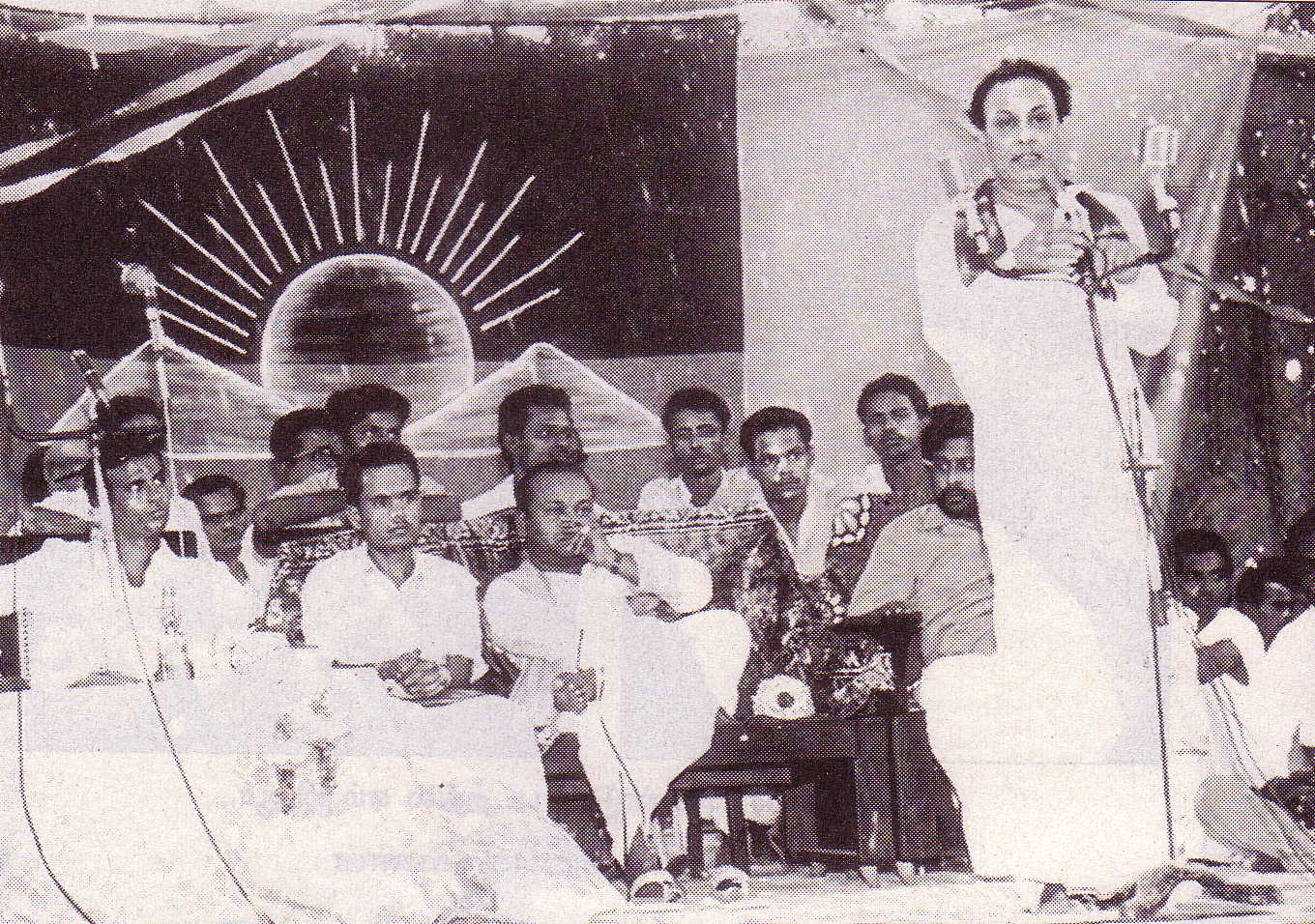 Young MGR in stage with the rising sun motif behind him
While MGR in his account of 1959 offers whole-some praise to the cooperation of heroine Bhanumathi, Ravindar in his 2009 (book) account provides some background details on the friction between MGR and Bhanumathi during the making of the movie. However, Ravindar’s account first appeared in print in Bhommai movie magazine, between 1992 and 1995. As such, while MGR had died in 1987, Bhanumathi was still alive when Ravindar’s account appeared first. I provide below excerpts from Ravindar’s account in translation. Ravindar uses the honorific Tamil word ‘Chemmal’ to MGR. I simply translates it to ‘hero’.
“Nadodi Mannan movie offered lot of troubles to hero. To make it a success, he took care into all aspects of the movie. The first shooting was for the song scene ‘Sammathama – Naan Ungal kooda vara sammathama?’ [Is it OK, Is is OK if I come with you?] sung by heroine Bhanumathi. Elder [sibling Chakrapani] always talks in non-sexual double entendre. They were humorous and thoughtful. Elder quipped, ‘The song begins with a question, ‘Sammathama – Naan Ungal kooda vara sammathama?’ I doubt whether this lady will be with us till the end. Only God should tell.”
Then, Ravindar described the friction between MGR and Bhanumathi as follows:
Bhanumathi was an all-knowing actress. She was indeed honorable to her job. [She] comes late. After arriving, she won’t sit down. She would complete four hour work in one hour and return. ‘Re-take’ was not in her dictionary. To a song scene, ‘Aandavan Enge? Arasandavan Enge?’, the lyricist was Muthukoothan and N.S. Balakrishnan made arrangements for Bhanumathi to sing. Hero would suggest, if the song’s raga is better like this, Bhanumathi would say differing opinion. Then, hero would say, ‘This is not a stage concert. One can change the raga, because the song should touch the ears of viewers.’ For this, Bhanumathi would retort, ‘I know more about music. You just mind your business.’ Hero was upset. Elder [MGR’s sibling Chakrapani] was scared and ask, ‘Can the movie shooting continue like this?’
One day, while at his home in Lloyd’s Road, hero was in upset mood. When I went, he asked, ‘You all are writers. Isn’t it? Can’t you write a story, without a heroine?’ I realized, for what reason, he had asked me that question. Then, I replied, ‘We can write. But, those who see the movie should appreciate it. Tomorrow, I’ll come with a new story.’
This resulted in the introduction of the second heroine in that movie. B. Saroja Devi was introduced as a new face. Ravindar adds, “Hero did prove, that an expert could produce a movie without an actress. After realizing this experience, Bhanumathi returned for a draw. The shooting for the movie was nearly over. Then, one song scene in which Bhanumathi features, ‘Summa irunda nilathai koththi’ (mentioned earlier as one of the riding scene song) was shot and included.” Ravindar provides a sum up as follows: ‘Disaster turned into triumph. The story was revised to have two heroines, and Tamil movie world was served with a solid heroine [in Saroja Devi]. Though the movie was a popular success, hero couldn’t retrieve the money spent, because area distributors had gobbled their shares. Some even had the gall to show ‘loss’ account, which hero took it into stride, as one of human frailities.”
MGR’s 1959 version of his friction with Bhanumathi was as follows. “While I was acting with Mrs. Bhanumathi in the ‘Alibaba’ movie produced by Modern Theatres, the advertisement for Nadodi Mannan appeared as an adoption of the ‘Prisoner of Zenda’ English story. Few days later, another advertisement appeared for Bharani Pictures. On the day, their announcement appeared, Mrs. Bhanumathi told me, “It looks as if, you are making a movie on the same story we are also interested in. Let there be no competition between us. Please change your story. We have spent much for many months and everything is ready.’ I replied, ‘This design, I have been dreaming for many years. I wanted a change in my life and chose this story. In addition, I take control as the director too.’ We continued the discussion. Finally, I told, ‘I’ll keep only the section of a commoner switched to king in the Prisoner of Zenda story. The rest are different. If you are adamant in keeping your story, you can take it. There won’t be any competition. Because, your story is a direct adaptation of Prisoner of Zenda. Mine is different.’
In reality, I was confused too. She also faced the same situation. Few days later, I replied, ‘We had stopped using that story. Without doubt, you can proceed’. I thanked her sincerely. She didn’t realize that she might have an opportunity to act in ‘Nadodi Mannan’. However, the reality was she gave up, and offered us the story written by Mr. A.K. Velan and asked us to use it. I’m one who likes the freedom to work according to my wish. Mrs. Bhanumathi also shares the same trait. Both don’t give up easily. Those who expected that whether my movie will be completed and whether Bhanumathi will feature in it were disappointed by the cooperation she gave to the character Mathana in the movie, in her inimitable style.”
In his essay, MGR does mention that in the very original advertisement for the movie, they themselves added the information that ‘Nadodi Mannan’ was an adoption from Prisoner of Zenda story. However, when the shooting began, the story plot evolved according to the Indian cultural norms, and the Prisoner of Zenda story was jettisoned.
He specifically mentions three changes. While in the original story, the queen moves intimately with the king’s double, in the Nadodi Mannan story, the king’s double rejects the advances of the queen. Once the queen realizes that the double was a stranger, she switches the relationship terms to that of a ‘brother’. Secondly, in the original story, the king’s double was a kin of the king and share the same interests of the king. But, in the Nadodi Mannan story, the double is a commoner (a vagabond) and had opposing interests to that of a king. In the original story, the character of Rajguru and the island component is absent. But in the Nadodi Mannan story, these were plot foils.
MGR had stated that the plot for his movie was formed in his mind twenty years earlier. To quote, “In 1937-38, when I was acting in Calcutta for the movie Maya Macheendra, I went to see an English movie with friends. The name of that movie was ‘If I were King’. The star was Ronald Colman. In one scene, he speaks ‘If I were a king’. Now I don’t remember the lines. But, that particular thought had got imprinted in my mind. In those days, I had thought about poverty and people’s situation. Rather than saying ‘thinking’, it would be proper to say, I was experiencing the same. Occasionally, I thought, why these problems exist. The answer I received was, ‘It’s because of foreigner’s rule. But I didn’t realize that the foreigner’s rule will be forever. Therefore, even if the foreigner’s rule vanish, the rulers should be of good mind. Then, people will benefit. That’s why I created the vagabond character. Then, I thought about the situation of the king. Those who are ruling us now, belong to our tribe. They live with us. But their thinking and talents are controlled by foreigners. Thus, I imagined, if they join with commoners? This was the focus of the king character. The king realizes the truth and wishes to join with the commoners.”
Young MGR in stage with the rising sun motif behind him
While MGR in his account of 1959 offers whole-some praise to the cooperation of heroine Bhanumathi, Ravindar in his 2009 (book) account provides some background details on the friction between MGR and Bhanumathi during the making of the movie. However, Ravindar’s account first appeared in print in Bhommai movie magazine, between 1992 and 1995. As such, while MGR had died in 1987, Bhanumathi was still alive when Ravindar’s account appeared first. I provide below excerpts from Ravindar’s account in translation. Ravindar uses the honorific Tamil word ‘Chemmal’ to MGR. I simply translates it to ‘hero’.
“Nadodi Mannan movie offered lot of troubles to hero. To make it a success, he took care into all aspects of the movie. The first shooting was for the song scene ‘Sammathama – Naan Ungal kooda vara sammathama?’ [Is it OK, Is is OK if I come with you?] sung by heroine Bhanumathi. Elder [sibling Chakrapani] always talks in non-sexual double entendre. They were humorous and thoughtful. Elder quipped, ‘The song begins with a question, ‘Sammathama – Naan Ungal kooda vara sammathama?’ I doubt whether this lady will be with us till the end. Only God should tell.”
Then, Ravindar described the friction between MGR and Bhanumathi as follows:
Bhanumathi was an all-knowing actress. She was indeed honorable to her job. [She] comes late. After arriving, she won’t sit down. She would complete four hour work in one hour and return. ‘Re-take’ was not in her dictionary. To a song scene, ‘Aandavan Enge? Arasandavan Enge?’, the lyricist was Muthukoothan and N.S. Balakrishnan made arrangements for Bhanumathi to sing. Hero would suggest, if the song’s raga is better like this, Bhanumathi would say differing opinion. Then, hero would say, ‘This is not a stage concert. One can change the raga, because the song should touch the ears of viewers.’ For this, Bhanumathi would retort, ‘I know more about music. You just mind your business.’ Hero was upset. Elder [MGR’s sibling Chakrapani] was scared and ask, ‘Can the movie shooting continue like this?’
One day, while at his home in Lloyd’s Road, hero was in upset mood. When I went, he asked, ‘You all are writers. Isn’t it? Can’t you write a story, without a heroine?’ I realized, for what reason, he had asked me that question. Then, I replied, ‘We can write. But, those who see the movie should appreciate it. Tomorrow, I’ll come with a new story.’
This resulted in the introduction of the second heroine in that movie. B. Saroja Devi was introduced as a new face. Ravindar adds, “Hero did prove, that an expert could produce a movie without an actress. After realizing this experience, Bhanumathi returned for a draw. The shooting for the movie was nearly over. Then, one song scene in which Bhanumathi features, ‘Summa irunda nilathai koththi’ (mentioned earlier as one of the riding scene song) was shot and included.” Ravindar provides a sum up as follows: ‘Disaster turned into triumph. The story was revised to have two heroines, and Tamil movie world was served with a solid heroine [in Saroja Devi]. Though the movie was a popular success, hero couldn’t retrieve the money spent, because area distributors had gobbled their shares. Some even had the gall to show ‘loss’ account, which hero took it into stride, as one of human frailities.”
MGR’s 1959 version of his friction with Bhanumathi was as follows. “While I was acting with Mrs. Bhanumathi in the ‘Alibaba’ movie produced by Modern Theatres, the advertisement for Nadodi Mannan appeared as an adoption of the ‘Prisoner of Zenda’ English story. Few days later, another advertisement appeared for Bharani Pictures. On the day, their announcement appeared, Mrs. Bhanumathi told me, “It looks as if, you are making a movie on the same story we are also interested in. Let there be no competition between us. Please change your story. We have spent much for many months and everything is ready.’ I replied, ‘This design, I have been dreaming for many years. I wanted a change in my life and chose this story. In addition, I take control as the director too.’ We continued the discussion. Finally, I told, ‘I’ll keep only the section of a commoner switched to king in the Prisoner of Zenda story. The rest are different. If you are adamant in keeping your story, you can take it. There won’t be any competition. Because, your story is a direct adaptation of Prisoner of Zenda. Mine is different.’
In reality, I was confused too. She also faced the same situation. Few days later, I replied, ‘We had stopped using that story. Without doubt, you can proceed’. I thanked her sincerely. She didn’t realize that she might have an opportunity to act in ‘Nadodi Mannan’. However, the reality was she gave up, and offered us the story written by Mr. A.K. Velan and asked us to use it. I’m one who likes the freedom to work according to my wish. Mrs. Bhanumathi also shares the same trait. Both don’t give up easily. Those who expected that whether my movie will be completed and whether Bhanumathi will feature in it were disappointed by the cooperation she gave to the character Mathana in the movie, in her inimitable style.”
In his essay, MGR does mention that in the very original advertisement for the movie, they themselves added the information that ‘Nadodi Mannan’ was an adoption from Prisoner of Zenda story. However, when the shooting began, the story plot evolved according to the Indian cultural norms, and the Prisoner of Zenda story was jettisoned.
He specifically mentions three changes. While in the original story, the queen moves intimately with the king’s double, in the Nadodi Mannan story, the king’s double rejects the advances of the queen. Once the queen realizes that the double was a stranger, she switches the relationship terms to that of a ‘brother’. Secondly, in the original story, the king’s double was a kin of the king and share the same interests of the king. But, in the Nadodi Mannan story, the double is a commoner (a vagabond) and had opposing interests to that of a king. In the original story, the character of Rajguru and the island component is absent. But in the Nadodi Mannan story, these were plot foils.
MGR had stated that the plot for his movie was formed in his mind twenty years earlier. To quote, “In 1937-38, when I was acting in Calcutta for the movie Maya Macheendra, I went to see an English movie with friends. The name of that movie was ‘If I were King’. The star was Ronald Colman. In one scene, he speaks ‘If I were a king’. Now I don’t remember the lines. But, that particular thought had got imprinted in my mind. In those days, I had thought about poverty and people’s situation. Rather than saying ‘thinking’, it would be proper to say, I was experiencing the same. Occasionally, I thought, why these problems exist. The answer I received was, ‘It’s because of foreigner’s rule. But I didn’t realize that the foreigner’s rule will be forever. Therefore, even if the foreigner’s rule vanish, the rulers should be of good mind. Then, people will benefit. That’s why I created the vagabond character. Then, I thought about the situation of the king. Those who are ruling us now, belong to our tribe. They live with us. But their thinking and talents are controlled by foreigners. Thus, I imagined, if they join with commoners? This was the focus of the king character. The king realizes the truth and wishes to join with the commoners.”
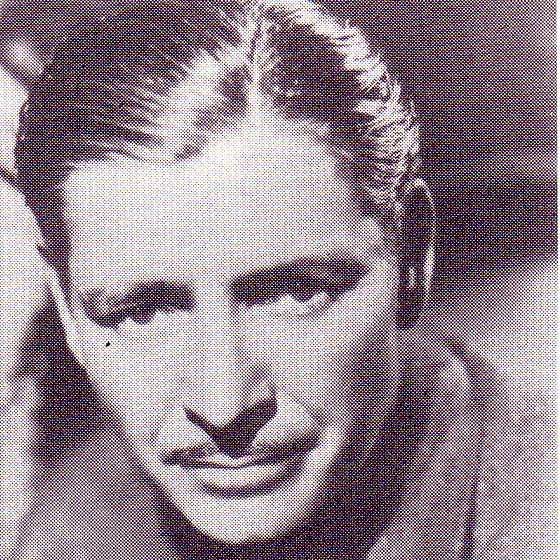 Ronald Colman (1891-1958) – Hollywood hero
‘If I were King’ released in 1938 was a Ronald Colman (1891-1958) vehicle in which he starred as a medieval swashbuckling Francois Villon. It was based on a 1901 play by Justin Huntly McCarthy. In fact, Ronald Colman also starred in the 1937 movie, ‘The Prisoner of Zenda’, a 1894 novel by Anthony Hope. MGR had initially announced that the ‘Nadodi Mannan’ was an adoption of this movie, and subsequently switched the plot to ‘If I were King’. While ‘If I were King’ directed by Frank Loyd had a run time of 110 min, ‘Nadodi Mannan’ was stretched to over three hours.
Ronald Colman (1891-1958) – Hollywood hero
‘If I were King’ released in 1938 was a Ronald Colman (1891-1958) vehicle in which he starred as a medieval swashbuckling Francois Villon. It was based on a 1901 play by Justin Huntly McCarthy. In fact, Ronald Colman also starred in the 1937 movie, ‘The Prisoner of Zenda’, a 1894 novel by Anthony Hope. MGR had initially announced that the ‘Nadodi Mannan’ was an adoption of this movie, and subsequently switched the plot to ‘If I were King’. While ‘If I were King’ directed by Frank Loyd had a run time of 110 min, ‘Nadodi Mannan’ was stretched to over three hours.
MGR’s compliments to the fellow participants in the ‘Nadodi Mannan’
In the felicitation feature article, MGR had complimented the actors, technicians and associated participants who contributed to the movie’s success. These include actresses (Bhanumathi, M.N. Rajam, G. Sakuntala, B. Saroja Devi, K. S. Angamuthu, T.P. Muthulakshmi, Gemini Chandra), actors (P.S. Veerappa, sibling M.G. Chakrapani, M.N. Nambiar, T.K. Balachandran, K.R. Ramsingh, J.P. Chandrababu), story (R.M. Veerappan, Vidwan V. Lakshmanan, S.K.T. Sami), advisor Director K. Subramanyam, cinematographer G.K. Ramu, studio owner Nagi Reddy, script writers (poet Kannadasan, Ravindar), lyricists (N.M. Muthukoothan, Suratha, Pattukottai Kalyanasundaram, A. Lakshmanadas, music directors N.S. Balakrishnan and S.M. Subbiah Naidu, sound artist Menon, editors Arumugam, K. Perumal and Jambu, and office executive S. Govindarajan, make up artist Rangasami. What I found strangely missing in this almost complete listing by MGR who were instrumental in the success of his movie was the non-mention of playback singers such as T.M. Soundararajan、Sirkali Govindarajan, P.G. Krishnaveni (Jikki), P. Leela, P. Sushila, T.V. Ratnam, Jamuna Rani and N.L. Ganasaraswathi.
Standing of ‘Nadodi Mannan’ among other Tamil movies released in 1958
In 1958, a total of 37 Tamil movies (excluding the dubbed movies) were released. Among these 37, the leading heroes featured were Sivaji Ganesan (8 movies), Gemini Ganesan (8 movies), S.S. Rajendran (6 movies), K.R. Ramasamy (3 movies), T.R. Ramachandran (2 movies, plus one of Gemini Ganesan movie), T.R. Mahalingam (1 movie) and MGR had exclusively ‘Nadodi Mannan’. This also explains the success of MGR’s business acumen. While his rivals saturated the movie theaters with multiple movies, MGR timed his own production as the only released movie of the year.
The Encyclopedia of Indian Cinema (1999) lists 26 Indian movies as notable for the year 1958. The language distribution was, Hindi (12), Tamil (2), Bengali (2), Assamese (2), Telugu (1), Kannada (1), Malayalam (1) and Sindhi (1). Four movies were produced in more than one language, by multi-lingual produers and/or directors. 25 of the 26 movies listed in this Encyclopedia were in black and white. Only ‘Nadodi Mannan’ was in black and white, and Geva color (latter half). Genre wise, the 26 movies are distributed into social (10), mythology (4), period history (3), crime thriller (3), comedy (1), avant garde (1), folk tale (1), reincarnation story (1) and adaptation from Dosteoevsky (1). Nadodi Mannan is in the category of period history. The interests of Indian movie goers was changing in late 1950s from mythology, folk tales and period history into social plots. Thus MGR, a keen reader of the audience mind, was forced to switch to social themes in 1960s. It was not an easy undertaking.
Delicate Use of motifs
Quite a number of snob Marxist academics (Chidananda Das Gupta, M.S.S. Pandian, and K. Sivathamby) had derisively commented on the use of DMK’s rising sun symbol in MGR’s movies, including ‘Nadodi Mannan’. But it should not be forgotten, that in the 1957 general election which DMK contested for the first time, the rising sun symbol was not assigned exclusively to the party. This I had pointed out earlier in my book review of S.S. Rajendran’s autobiography. Thus, MGR’s use of the rising sun symbol in his movies was a game winning strategy to compete with the established Congress Party on a level ground, when it comes to attracting voters. Pre-independence Congress Party too made effective use of motifs such as charkha (spinning wheel), khaddar (hand spun and hand woven cloth) and even jail experience to attract the voters in countering the propaganda of British imperialists. In addition, Mahatma Gandhi’s action of intentionally breaking the salt laws imposed by the imperialists in 1930 also made salt as a motif for independence struggle. These motifs were used for propaganda in songs, stories, and stage dramas. Indian Communists used the universal hammer and sickle motif for their propaganda. Thus, MGR’s use of rising sun symbol should not be isolated and commented derisively.
Partiality of the snob Marxist critics is evident when they criticize the use of DMK party motifs in MGR’s movies like ‘Nadodi Mannan’, but ignore the use of motifs by Soviet Union’s elite directors like Sergei Eisenstein (1898-1948) and Alexander Dovzhenko (1894-1956). On Eisenstein’s productions, the observations of David Bordwell is pertinent here. “Each of his (Eisenstein’s) silent films begins with an epigraph from Lenin, and each depicts a key moment in the myth of Bolshevik ascension: the pre-revolutionary struggles (The Strike), the 1905 revolution (Potemkin), the Bolshevik coup (October), and contemporary agricultural policy (The Old and the New).”
Coda
Now 57 years later, almost all the lead players who contributed to the success of ‘Nadodi Mannan’ had departed, with the exception of three: actresses M.N. Rajam, B. Saroja Devi, and R.M. Veerappan, MGR’s then assistant. Their fading reminiscences, if recorded in any sort of media, may divulge still unknown details about the making of this trend-setter Tamil movie.
Cited Sources
‘Film News’ Anandan: Sadhanaigal Padaitha Thamizh thiraipada Varalaru (Tamil Film History and its Achievements), Sivagami Publications, Chennai, 2004.
Eric Barnouw and S. Krishnaswamy: Indian Film, 2nd ed., Oxford University Press, New Delhi, 1980, pp. 179-180.
Sylvan Barnet, Morton Berman and William Burto: A Dictionary of Literary, Dramatic and Cinematic Terms, Little, Brown and Co, Boston, 1971.
- Kirubakaran (ed): Naan Aanaiyittaal…! (If I Ordered..!), Vikatan Pirasuram, Chennai, 2013, pp. 99-133.
Aranthai Narayanan: Thamizh Cinemavin Kathai (A story of Tamil Cinema), New Century Book House, Chennai, 3rd ed., 2008, pp. 501-506.
Geoffrey Nowell-Smith: The Oxford History of World Cinema, Oxford University Press, Oxford, 1996, pp. 168-169.
Ashish Rajadhyaksha and Paul Willemen: Encyclopedia of Indian Cinema, revised ed., Oxford University Press, New Delhi, 1999, p. 355.
- Ravindar: Pon Mana Chemmal MGR, Vijaya Publications, Chennai, 2009. (in Tamil)
Nadodi Mannan movie – MGR in double roles
by Sachi Sri Kantha, March 6, 2015
I received the following critical comments from fellow MGR biographer and friend R. Kannan, for Part 24 (Secured and Damaged Charisma), on Feb.3rd. Initials MKT refers to M.K. Thiyagarajah Bhagavathar, with whom I have compared MGR’s film career:
“Dear Sachi:
I read your part 24 of the MGR series with great interest and as ever was impressed with your research and efforts. I wish to disagree with you though. If I am not mistaken you cite MKT’s arrogance, condescension, self-serving nature as one of the two reasons for his charisma fading away. Also you mention that he was not known for his philanthropy like MGR.
MGR I believe was equally a human being condescending and even punishing people at times. I am inclined to believe that MGR had gone to the extent of ruining many. I believe that it was in MGR’s nature to be a generous man when it came to money. However, I don’t think these explain his charisma in full. Unlike MKT MGR was an actor- politician who cultivated his image early on. MKT was simply an actor. The DMK carried MGR on its shoulders. True that the party greatly benefitted from MGR’s association.
On the philanthropy I think MKT was a Mariamman devotee and I am assuming he would have donated to such causes. Also MGR’s charisma has been greatly saved by several incidents in his life: the first is the 1969 gunshot wounds; the second is the expulsion from the DMK; the third is his poor health in 1984. In the 1980 parliamentary elections and in the 1986 civic body polls MGR’s charisma was not at play. Also the AIADMK peaked after MGR in the last elections winning a record 150 seats. MGR could not win more than 130+ seats. These are my thoughts for now.”
I read your part 24 of the MGR series with great interest and as ever was impressed with your research and efforts. I wish to disagree with you though. If I am not mistaken you cite MKT’s arrogance, condescension, self-serving nature as one of the two reasons for his charisma fading away. Also you mention that he was not known for his philanthropy like MGR.
MGR I believe was equally a human being condescending and even punishing people at times. I am inclined to believe that MGR had gone to the extent of ruining many. I believe that it was in MGR’s nature to be a generous man when it came to money. However, I don’t think these explain his charisma in full. Unlike MKT MGR was an actor- politician who cultivated his image early on. MKT was simply an actor. The DMK carried MGR on its shoulders. True that the party greatly benefitted from MGR’s association.
On the philanthropy I think MKT was a Mariamman devotee and I am assuming he would have donated to such causes. Also MGR’s charisma has been greatly saved by several incidents in his life: the first is the 1969 gunshot wounds; the second is the expulsion from the DMK; the third is his poor health in 1984. In the 1980 parliamentary elections and in the 1986 civic body polls MGR’s charisma was not at play. Also the AIADMK peaked after MGR in the last elections winning a record 150 seats. MGR could not win more than 130+ seats. These are my thoughts for now.”
My response sent on the following day to Mr. Kannan was as follows:
“Dear Kannan,
Thanks for your clear thoughts and analysis on part 24. Sure, you are welcome to disagree with my views. I do appreciate it very much. Can I include your criticism, at the beginning of Part 25?
In fact, about those who were ill-treated by MGR, I plan to write later, in one chapter. I have read, there have been a handful. Kannadasan, Kuladeivam Rajagopal, Chandrababu, T.M. Soundararajan (TMS), later S.A. Asokan and even Jayalalitha (after MGR chose other heroines like Manjula and Latha in 1970s). Karunanidhi had accused that MGR worked against S.S. Rajendran (SSR)’s interest. But, in balance, number of those who have gained from MGR’s munificence outweigh those who were side tracked. Even among the above list, Kannadasan and TMS had kind words later. Jayalalitha returned to MGR.
Thanks for your clear thoughts and analysis on part 24. Sure, you are welcome to disagree with my views. I do appreciate it very much. Can I include your criticism, at the beginning of Part 25?
In fact, about those who were ill-treated by MGR, I plan to write later, in one chapter. I have read, there have been a handful. Kannadasan, Kuladeivam Rajagopal, Chandrababu, T.M. Soundararajan (TMS), later S.A. Asokan and even Jayalalitha (after MGR chose other heroines like Manjula and Latha in 1970s). Karunanidhi had accused that MGR worked against S.S. Rajendran (SSR)’s interest. But, in balance, number of those who have gained from MGR’s munificence outweigh those who were side tracked. Even among the above list, Kannadasan and TMS had kind words later. Jayalalitha returned to MGR.
It’s unfortunate that we don’t have much information about Bhagavathar’s career. Though I didn’t include this in my part 24 chapter, one should also include in this Bhagavathar-
MGR charisma debate, comedian N.S. Krishnan (NSK) as well. NSK also had charisma. He also went to jail with Bhagavathar. But, after his jail term, he was able to retrieve
his lost charisma. His produced movies were not flops. But, why Bhagavathar couldn’t do so?”
MGR charisma debate, comedian N.S. Krishnan (NSK) as well. NSK also had charisma. He also went to jail with Bhagavathar. But, after his jail term, he was able to retrieve
his lost charisma. His produced movies were not flops. But, why Bhagavathar couldn’t do so?”
Nadodi Mannan movie – Bhanumathi (lt) with MGR
Motifs in MGR movies
A dictionary on cinematic terms, define a motif as “a recurrent word, phrase, situation, object or idea.” There are many motifs in MGR movies. One prominent motif is a riding scene with an educational (or philosophical) song. The hero character rides a bullock cart or a small scale chariot, while lip-singing this enthralling song. Occasionally, either the heroine or a side-kick (comedian) or an actor in a minor role is nearby. Here are some selected examples.
‘Manusanai manusan saapiduraandhi’ – in Thaaiku Pin Thaaram (Wife after the Mother 1956)
‘Summa irunda nilathai koththi’ – in Nadodi Mannan (The Vagabond King 1958)
‘Uzhaipathila Uzhaipai peruvathila’ – in Nadodi Mannan (The Vagabond King 1958)
‘Achcham enpathu madamaiyada’ – in Mannathi Mannan (King of Kings 1960)
‘Paarappa Palaniappa Pattanamam Pattanamam’ – in Periya Idathu Penn (High Society Woman, 1963)
‘Nenjam undu Nermai undu Oodu raja’ – in En Annan (My Elder Brother 1970)
It has been stated that MGR adopted this strategy of having an educational song, after the success of Malai Kallan (1954) movie, in which he lip synched a time-less song ‘Ethanai Kaalam Thaan Emaruvar intha Naatile?’ (How long these guys will be cheating us?). For this song, the heroine (P. Bhanumathi, 1925-2005) was riding a horse, while MGR character was walking nearby holding the horse rein. Even though the lyricist, the song arranger (aka music director) and the singer were different individuals, in his fans minds, the song has become entrenched as an arch-typical MGR song, for the sole reason that MGR’s imprint is seen there. Almost all such songs in 1950s, and 1960s were sung by T.M. Soundararajan.
Nadodi Mannan (The Vagabond King) was MGR’s grand project of 1956-57, and it was released on August 22, 1958. In addition to acting in double roles, MGR produced and directed it under his newly formed company banner, Em.Gee.Yar Pictures. In these movie, there were two educational songs with a riding scene. One was ‘Summa kidandha nilaththai koththi sombalillamal yer nadathi’ (Digging an unkempt soil and ploughing it earnestly) sung by T.M. Soundararajan and written by Pattukottai Kalyanasundaram, a Communist Party sympathizer. For this song, MGR was riding a bullock cart with heroine P. Bhanumathi. A second song, ‘Uzhaipathila Uzhaipai peruvathila’ (Is their pleasure in labor or in demanding labor) was sung by Sirkali Govindarajan. For this song, written by poet A. Lakshmanadas, MGR was riding a small scale chariot with an actor in a minor role. In addition, MGR also added a still magical educational song Thoongathe thambi thoongathe (Do not idle younger brother and don’t be a listless fellow), sung by T.M. Soundararajan and written by Pattukottai Kalyanasundaram.
Other motifs in MGR’s movies include rising sun symbol of DMK party (until he was expelled from the party in 1972), frequent use of the word Anna (that literally means ‘elder brother’in Tamil, but used as an euphemism to C.N. Annadurai, the founder leader of DMK), and the word Thai (which literally means ‘mother’) in many of his movie titles.
Troubles and Triumph of Nadodi Mannan (The Vagabond King)
A write-up of Nadodi Mannan story plot, as it appeared in the Encyclopedia of Indian Cinema (1999), is as follows:
“MGR’s period adventure fantasy, with 19 songs, and important DMK propaganda film repeating his successful screen pairing with Bhanumathi (Alibabavum Narpatha Thirudargalum 1955 and Madurai Veeran 1956) in a style derived from Gemini’s post-Chandralekha (1948) films. The good king Marthandan (MGR) is dethroned by the Rajguru (Veerappa) and replaced by a double, the commoner Veerangan (MGR again). Nakedly propagandist (e.g. colour sequences showing the red and black DMK flag and its rising sun party symbol), the film presents the good guys as waiting to overthrow the Rajguru’s corrupt rule, a thinly disguised reference to the Congress Party. Inaugurating MGR’s personal political programme with songs like Thoongathe thambi thoongathe (‘Don’t sleep, young brother)…”
Fortunately, we have MGR’s account on why he produced this ‘Nadodi Mannan’ movie, which appeared in a special issue to felicitate its success in 1959. Thus, I provide selected excerpts of his thoughts in translation.
“Why I began this own movie? I could have earned enough for my life from many offers for other movies. Disregarding that route, why I had to make my own movie by spending own money as well as energy? Like this, many questions were asked by my well-wishers as well as those who wanted me to slip. [We] were shareholders in the Mekala Pictures and released the Naam [We] movie. Then, I was keen on making my own movie and we established the Em.Gee.Yar Productions. ‘We’ meaning my elder sibling M.G. Chakrapani and I. For this movie, Kalaignar M. Karunanidhi was supposed to offer the story and write script. It was titled, ‘VidiVeLLi’ and he began to develop the story. For many reasons, there was a delay. Unexpectedly, he was thrown in jail, after he took part in the Kallakudi Agitation. [Note by Sachi: this happened in 1953]. Then, we stopped the Em. Gee.Yar Productions and established the Em.Gee.Yar drama troupe. [However] the idea of producing a movie didn’t leave my mind. I was awaiting for an opportunity.
I did hear many jeers and loose-talk about my sincere effort. One category belonged to, ‘He had earned some fame. But, he couldn’t live within that with respect.’ Another category was, ‘He is going to be a director!…How timid he is?’. [The third criticism was], ‘He is going lose big. We’ll see with our eyes.’ [The fourth criticism was] ‘How is he going to finish the movie, if he spends so much like this?’ [The fifth criticism was] ‘He is shooting many many things. Repeatedly, he does the same. Poor soul! He doesn’t know what to do.’ [The sixth criticism was] ‘Revolution- what revolution? Let his movie return from the Censors. It will be empty!’
I did hear all these talks with my ears. What I could think of these critics was the words of Lord Jesus, ‘They do not know, what they are doing.’ I laughed at them. They also laughed back at me. After the movie was released, and it received plaudits from the press, those who laughed at me, came to cry. Some of them, still continue to cry. Why? I had escaped from burning myself…”
In the same article, MGR had mentioned that he spent 1,800,000 rupees [in 1957-58] for this movie. As has been mentioned previously in this series, this sum was almost 2.5 times higher than the average movie production budget in Chennai for those times. Ravindar, MGR’s assistant in the story department, offers additional supporting details on the cost.”Usually 40-50 days of shooting are adequate for a movie. But, for ‘Nadodi Mannan’, it took 156 days. In those days with minimal technology, the under-water dream scene for the song ‘Kannil vanthu Minnal pool Thoonruthe’ song had 12 days shooting, the final fighting scene at the rope-bridge had 11 days shooting, the folk dance scene with the song ‘Jimpaka jimba’ had 9 days shooting, the sword fight of MGR and villain Nambiar had 7 days shooting, and the appreciated educational song scene ‘Thoongathe thambi Thoongathe’ shot via a long pipe with MGR (in a lower placed prison floor) and heroine Bhanumathi (lodged in different section of the same prison) taking part without each not knowing their faces had 3 days shooting.”
Young MGR in stage with the rising sun motif behind him
While MGR in his account of 1959 offers whole-some praise to the cooperation of heroine Bhanumathi, Ravindar in his 2009 (book) account provides some background details on the friction between MGR and Bhanumathi during the making of the movie. However, Ravindar’s account first appeared in print in Bhommai movie magazine, between 1992 and 1995. As such, while MGR had died in 1987, Bhanumathi was still alive when Ravindar’s account appeared first. I provide below excerpts from Ravindar’s account in translation. Ravindar uses the honorific Tamil word ‘Chemmal’ to MGR. I simply translates it to ‘hero’.
“Nadodi Mannan movie offered lot of troubles to hero. To make it a success, he took care into all aspects of the movie. The first shooting was for the song scene ‘Sammathama – Naan Ungal kooda vara sammathama?’ [Is it OK, Is is OK if I come with you?] sung by heroine Bhanumathi. Elder [sibling Chakrapani] always talks in non-sexual double entendre. They were humorous and thoughtful. Elder quipped, ‘The song begins with a question, ‘Sammathama – Naan Ungal kooda vara sammathama?’ I doubt whether this lady will be with us till the end. Only God should tell.”
Then, Ravindar described the friction between MGR and Bhanumathi as follows:
Bhanumathi was an all-knowing actress. She was indeed honorable to her job. [She] comes late. After arriving, she won’t sit down. She would complete four hour work in one hour and return. ‘Re-take’ was not in her dictionary. To a song scene, ‘Aandavan Enge? Arasandavan Enge?’, the lyricist was Muthukoothan and N.S. Balakrishnan made arrangements for Bhanumathi to sing. Hero would suggest, if the song’s raga is better like this, Bhanumathi would say differing opinion. Then, hero would say, ‘This is not a stage concert. One can change the raga, because the song should touch the ears of viewers.’ For this, Bhanumathi would retort, ‘I know more about music. You just mind your business.’ Hero was upset. Elder [MGR’s sibling Chakrapani] was scared and ask, ‘Can the movie shooting continue like this?’
One day, while at his home in Lloyd’s Road, hero was in upset mood. When I went, he asked, ‘You all are writers. Isn’t it? Can’t you write a story, without a heroine?’ I realized, for what reason, he had asked me that question. Then, I replied, ‘We can write. But, those who see the movie should appreciate it. Tomorrow, I’ll come with a new story.’
This resulted in the introduction of the second heroine in that movie. B. Saroja Devi was introduced as a new face. Ravindar adds, “Hero did prove, that an expert could produce a movie without an actress. After realizing this experience, Bhanumathi returned for a draw. The shooting for the movie was nearly over. Then, one song scene in which Bhanumathi features, ‘Summa irunda nilathai koththi’ (mentioned earlier as one of the riding scene song) was shot and included.” Ravindar provides a sum up as follows: ‘Disaster turned into triumph. The story was revised to have two heroines, and Tamil movie world was served with a solid heroine [in Saroja Devi]. Though the movie was a popular success, hero couldn’t retrieve the money spent, because area distributors had gobbled their shares. Some even had the gall to show ‘loss’ account, which hero took it into stride, as one of human frailities.”
MGR’s 1959 version of his friction with Bhanumathi was as follows. “While I was acting with Mrs. Bhanumathi in the ‘Alibaba’ movie produced by Modern Theatres, the advertisement for Nadodi Mannan appeared as an adoption of the ‘Prisoner of Zenda’ English story. Few days later, another advertisement appeared for Bharani Pictures. On the day, their announcement appeared, Mrs. Bhanumathi told me, “It looks as if, you are making a movie on the same story we are also interested in. Let there be no competition between us. Please change your story. We have spent much for many months and everything is ready.’ I replied, ‘This design, I have been dreaming for many years. I wanted a change in my life and chose this story. In addition, I take control as the director too.’ We continued the discussion. Finally, I told, ‘I’ll keep only the section of a commoner switched to king in the Prisoner of Zenda story. The rest are different. If you are adamant in keeping your story, you can take it. There won’t be any competition. Because, your story is a direct adaptation of Prisoner of Zenda. Mine is different.’
In reality, I was confused too. She also faced the same situation. Few days later, I replied, ‘We had stopped using that story. Without doubt, you can proceed’. I thanked her sincerely. She didn’t realize that she might have an opportunity to act in ‘Nadodi Mannan’. However, the reality was she gave up, and offered us the story written by Mr. A.K. Velan and asked us to use it. I’m one who likes the freedom to work according to my wish. Mrs. Bhanumathi also shares the same trait. Both don’t give up easily. Those who expected that whether my movie will be completed and whether Bhanumathi will feature in it were disappointed by the cooperation she gave to the character Mathana in the movie, in her inimitable style.”
In his essay, MGR does mention that in the very original advertisement for the movie, they themselves added the information that ‘Nadodi Mannan’ was an adoption from Prisoner of Zenda story. However, when the shooting began, the story plot evolved according to the Indian cultural norms, and the Prisoner of Zenda story was jettisoned.
He specifically mentions three changes. While in the original story, the queen moves intimately with the king’s double, in the Nadodi Mannan story, the king’s double rejects the advances of the queen. Once the queen realizes that the double was a stranger, she switches the relationship terms to that of a ‘brother’. Secondly, in the original story, the king’s double was a kin of the king and share the same interests of the king. But, in the Nadodi Mannan story, the double is a commoner (a vagabond) and had opposing interests to that of a king. In the original story, the character of Rajguru and the island component is absent. But in the Nadodi Mannan story, these were plot foils.
MGR had stated that the plot for his movie was formed in his mind twenty years earlier. To quote, “In 1937-38, when I was acting in Calcutta for the movie Maya Macheendra, I went to see an English movie with friends. The name of that movie was ‘If I were King’. The star was Ronald Colman. In one scene, he speaks ‘If I were a king’. Now I don’t remember the lines. But, that particular thought had got imprinted in my mind. In those days, I had thought about poverty and people’s situation. Rather than saying ‘thinking’, it would be proper to say, I was experiencing the same. Occasionally, I thought, why these problems exist. The answer I received was, ‘It’s because of foreigner’s rule. But I didn’t realize that the foreigner’s rule will be forever. Therefore, even if the foreigner’s rule vanish, the rulers should be of good mind. Then, people will benefit. That’s why I created the vagabond character. Then, I thought about the situation of the king. Those who are ruling us now, belong to our tribe. They live with us. But their thinking and talents are controlled by foreigners. Thus, I imagined, if they join with commoners? This was the focus of the king character. The king realizes the truth and wishes to join with the commoners.”
Ronald Colman (1891-1958) – Hollywood hero
‘If I were King’ released in 1938 was a Ronald Colman (1891-1958) vehicle in which he starred as a medieval swashbuckling Francois Villon. It was based on a 1901 play by Justin Huntly McCarthy. In fact, Ronald Colman also starred in the 1937 movie, ‘The Prisoner of Zenda’, a 1894 novel by Anthony Hope. MGR had initially announced that the ‘Nadodi Mannan’ was an adoption of this movie, and subsequently switched the plot to ‘If I were King’. While ‘If I were King’ directed by Frank Loyd had a run time of 110 min, ‘Nadodi Mannan’ was stretched to over three hours.
MGR’s compliments to the fellow participants in the ‘Nadodi Mannan’
In the felicitation feature article, MGR had complimented the actors, technicians and associated participants who contributed to the movie’s success. These include actresses (Bhanumathi, M.N. Rajam, G. Sakuntala, B. Saroja Devi, K. S. Angamuthu, T.P. Muthulakshmi, Gemini Chandra), actors (P.S. Veerappa, sibling M.G. Chakrapani, M.N. Nambiar, T.K. Balachandran, K.R. Ramsingh, J.P. Chandrababu), story (R.M. Veerappan, Vidwan V. Lakshmanan, S.K.T. Sami), advisor Director K. Subramanyam, cinematographer G.K. Ramu, studio owner Nagi Reddy, script writers (poet Kannadasan, Ravindar), lyricists (N.M. Muthukoothan, Suratha, Pattukottai Kalyanasundaram, A. Lakshmanadas, music directors N.S. Balakrishnan and S.M. Subbiah Naidu, sound artist Menon, editors Arumugam, K. Perumal and Jambu, and office executive S. Govindarajan, make up artist Rangasami. What I found strangely missing in this almost complete listing by MGR who were instrumental in the success of his movie was the non-mention of playback singers such as T.M. Soundararajan、Sirkali Govindarajan, P.G. Krishnaveni (Jikki), P. Leela, P. Sushila, T.V. Ratnam, Jamuna Rani and N.L. Ganasaraswathi.
Standing of ‘Nadodi Mannan’ among other Tamil movies released in 1958
In 1958, a total of 37 Tamil movies (excluding the dubbed movies) were released. Among these 37, the leading heroes featured were Sivaji Ganesan (8 movies), Gemini Ganesan (8 movies), S.S. Rajendran (6 movies), K.R. Ramasamy (3 movies), T.R. Ramachandran (2 movies, plus one of Gemini Ganesan movie), T.R. Mahalingam (1 movie) and MGR had exclusively ‘Nadodi Mannan’. This also explains the success of MGR’s business acumen. While his rivals saturated the movie theaters with multiple movies, MGR timed his own production as the only released movie of the year.
The Encyclopedia of Indian Cinema (1999) lists 26 Indian movies as notable for the year 1958. The language distribution was, Hindi (12), Tamil (2), Bengali (2), Assamese (2), Telugu (1), Kannada (1), Malayalam (1) and Sindhi (1). Four movies were produced in more than one language, by multi-lingual produers and/or directors. 25 of the 26 movies listed in this Encyclopedia were in black and white. Only ‘Nadodi Mannan’ was in black and white, and Geva color (latter half). Genre wise, the 26 movies are distributed into social (10), mythology (4), period history (3), crime thriller (3), comedy (1), avant garde (1), folk tale (1), reincarnation story (1) and adaptation from Dosteoevsky (1). Nadodi Mannan is in the category of period history. The interests of Indian movie goers was changing in late 1950s from mythology, folk tales and period history into social plots. Thus MGR, a keen reader of the audience mind, was forced to switch to social themes in 1960s. It was not an easy undertaking.
Delicate Use of motifs
Quite a number of snob Marxist academics (Chidananda Das Gupta, M.S.S. Pandian, and K. Sivathamby) had derisively commented on the use of DMK’s rising sun symbol in MGR’s movies, including ‘Nadodi Mannan’. But it should not be forgotten, that in the 1957 general election which DMK contested for the first time, the rising sun symbol was not assigned exclusively to the party. This I had pointed out earlier in my book review of S.S. Rajendran’s autobiography. Thus, MGR’s use of the rising sun symbol in his movies was a game winning strategy to compete with the established Congress Party on a level ground, when it comes to attracting voters. Pre-independence Congress Party too made effective use of motifs such as charkha (spinning wheel), khaddar (hand spun and hand woven cloth) and even jail experience to attract the voters in countering the propaganda of British imperialists. In addition, Mahatma Gandhi’s action of intentionally breaking the salt laws imposed by the imperialists in 1930 also made salt as a motif for independence struggle. These motifs were used for propaganda in songs, stories, and stage dramas. Indian Communists used the universal hammer and sickle motif for their propaganda. Thus, MGR’s use of rising sun symbol should not be isolated and commented derisively.
Partiality of the snob Marxist critics is evident when they criticize the use of DMK party motifs in MGR’s movies like ‘Nadodi Mannan’, but ignore the use of motifs by Soviet Union’s elite directors like Sergei Eisenstein (1898-1948) and Alexander Dovzhenko (1894-1956). On Eisenstein’s productions, the observations of David Bordwell is pertinent here. “Each of his (Eisenstein’s) silent films begins with an epigraph from Lenin, and each depicts a key moment in the myth of Bolshevik ascension: the pre-revolutionary struggles (The Strike), the 1905 revolution (Potemkin), the Bolshevik coup (October), and contemporary agricultural policy (The Old and the New).”
Coda
Now 57 years later, almost all the lead players who contributed to the success of ‘Nadodi Mannan’ had departed, with the exception of three: actresses M.N. Rajam, B. Saroja Devi, and R.M. Veerappan, MGR’s then assistant. Their fading reminiscences, if recorded in any sort of media, may divulge still unknown details about the making of this trend-setter Tamil movie.
Cited Sources
‘Film News’ Anandan: Sadhanaigal Padaitha Thamizh thiraipada Varalaru (Tamil Film History and its Achievements), Sivagami Publications, Chennai, 2004.
Eric Barnouw and S. Krishnaswamy: Indian Film, 2nd ed., Oxford University Press, New Delhi, 1980, pp. 179-180.
Sylvan Barnet, Morton Berman and William Burto: A Dictionary of Literary, Dramatic and Cinematic Terms, Little, Brown and Co, Boston, 1971.
- Kirubakaran (ed): Naan Aanaiyittaal…! (If I Ordered..!), Vikatan Pirasuram, Chennai, 2013, pp. 99-133.
Aranthai Narayanan: Thamizh Cinemavin Kathai (A story of Tamil Cinema), New Century Book House, Chennai, 3rd ed., 2008, pp. 501-506.
Geoffrey Nowell-Smith: The Oxford History of World Cinema, Oxford University Press, Oxford, 1996, pp. 168-169.
Ashish Rajadhyaksha and Paul Willemen: Encyclopedia of Indian Cinema, revised ed., Oxford University Press, New Delhi, 1999, p. 355.
- Ravindar: Pon Mana Chemmal MGR, Vijaya Publications, Chennai, 2009. (in Tamil)
MGR Remembered – Part 26
V.C. Ganesan: A reputable rival in Movies and Politics
by Sachi Sri Kantha, April 7, 2015
MGR’s biography would be incomplete, if the rivalry offered by Villuppuram Chinnaiah Ganesa Moorthy aka Sivaji Ganesan (1928-2001), his junior contemporary and reputable rival in Tamil movies and Tamil Nadu politics, is left uncovered. As such, in this chapter, in addition to entering the 1960s, I focus on (1) Sivaji Ganesan’s thoughts on this rivalry (2) an American observer Susanne Hoeber Rudolph, who had compared the parallel career of Sivaji Ganesan and MGR, and (3) the expressed view of one of his heroines, Vyjayanthimala Bali, also a reputed dancer who later became a Congress Party MP.
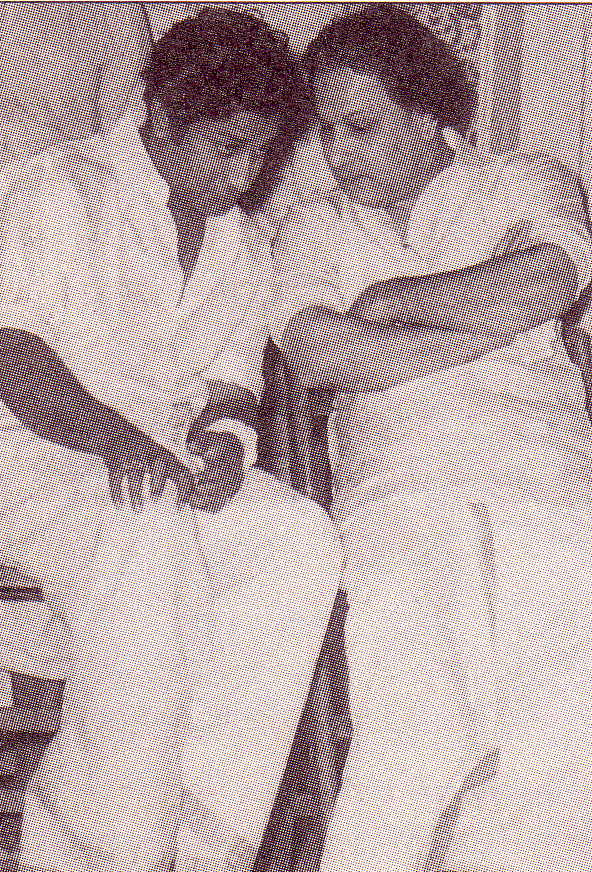
MGR with Sivaji Ganesan – young days
Criteria of Success in Film Industry
Psychologist Dean Keith Simonton began his 2009 review on the economics of film making in Hollywood, with the following three sentences. “The mainstream film industry faces a tough challenge every single year. The vast majority of the films released each year fail to make money during their theatrical run. In fact, most films lose millions of dollars. The only reason why the core industry survives at all is because a small percentage of films bring in substantial box office receipts, and an even smaller percentage of these attain the status of outright blockbusters with earnings in hundreds of millions of dollars.”
If one alters the currency ‘dollars’ to ‘rupees’, the above statements apply well to film industry in India as well, for any particular period. That’s why movie industry in any nation is propped by super heroes and talented heroines. For the Tamil movie industry of 1960s, the leading stars who pulled in substantial box office receipts were MGR and Sivaji Ganesan. Simonton identified three main criteria by which a movie’s success is evaluated: critical evaluations, financial performance and movie awards. Of these three, one can distinguish that critical evaluations are decided by ‘egg heads’, critics and academic scholars. Financial performance is decided by the movie goers who purchase the tickets. Movie awards, in many instances, are decided by the peers in the industry.
As for Tamil movie industry of 1960s, Sivaji Ganesan’s movies cornered the critical evaluations. MGR’s movies ranked high in financial performance. As for movie awards (international or indigenous), with a few exceptions, there weren’t many awarded for Tamil movies. What Simonton had observed for the Hollywood movies remains true for the Tamil movies as well. One critical aspect was the distribution of the movie, during its theatrical release. Five notable variables were, (1) season of release, (2) number of screens, (3) major distributor, (4) marketing expenditures, and (5) market competition. For Hollywood movies, the big-money making movies are mostly likely to be released in summer months. The secondary period with good box office returns are Christmas and to a lesser extent, Easter.
Check the movie release dates in the Table (in separate PDF file above) for essential details of the movies in which MGR starred from 1960 to 1967. For Tamil movies, there are three specific seasons; namely, Thai Pongal (in mid-January), Hindu New Year (in mid-April) and DeepavaLi (in late October-early November). The movie release dates for MGR movies fall in this pattern; almost every year, there will be a Thai Pongal release and a DeepavaLi release, and occasionally a Hindu New Year release.
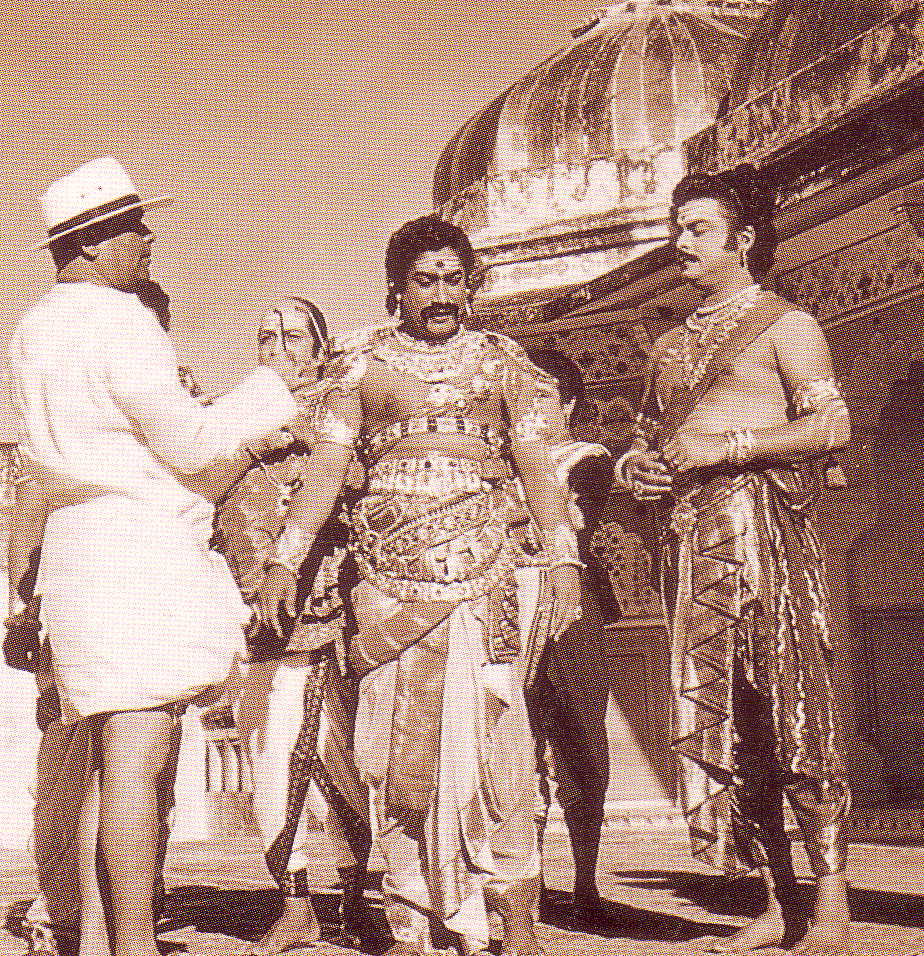
Veera Pandiya Kattabomman shooting – Panthulu (lt), Sivaji (middle), Gemini (rt)
Sivaji Ganesan’s Success with Veera Pandiya Kattabomman (1959) Movie
If MGR found success with his Nadodi Mannan (1958) movie, it was Sivaji Ganesan’s turn in 1959, with Veera Pandiya Kattabomman (Heroic Pandiyan Kattabomman) movie. It was a biopic of a Tamil chieftain named Kattabomman (1760-1799), who was arrested and executed by the British colonialists. Unusually for a Tamil movie, this movie received an international award at the Africa-Asian Film Festival held in Cairo. Though a founder enthusiast of DMK party, Sivaji Ganesan had drifted away from DMK in late 1950s. MGR, S.S. Rajendran (SSR) and poet Kannadasan were the prominent faces of DMK then. Kannadasan produced a movie Sivakangai Seemai, with SSR in the lead role, in rivalry to Veera Pandiya Kattabomman. While the latter movie (in techniccolor) was released on May 6, 1959, the former movie (in black and white) was released on May 19, 1959. Lead actors, script writer, lyricist, director and music director and producer were different for both movies. Only actress S. Varalakshmi acted in both movies.
On the production of the Kattabomman movie, Sivaji Ganesan had reminisced as follows: “I will remember Kattaboman forever. The play served as a platform to display the talents of several artistes and helped to bring people together. Once he saw the play, director B.R. Panthulu decided to make it into a film. Shakthi Krishnasamy wrote the dialogues for this film. Nowadays nobody writes dialogues like his, and no one delivers them like we did. This film won an award at the Africa-Asia film festival. This is because of the powerful story telling in the film. I faced many hurdles when I was acting in the film.
There was a character called Vellaiyadevan in the story and initially S.S. Rajendran was slated to play this role. He refused as he was committed in the making of another similar film called Sivagangai Seemai, which portrays the struggle of two South Indian kings against the British. This film was pitched against Kattabomman. As justification, we were told that Kattabomman was a king belonging to Andhra Pradesh while the Sivagangai Maruthus were Tamilians. This was the kind of attitude which prevailed in the industry at that time and I am not going to elaborate on it further. We faced a contingency as we needed a good actor for the part of Vellaiya Devan. I came up with a plan. What do you think? I approached the actress Savitri, a gem of a person whom I consider as my sister. She had almost reached full term pregnancy at that time. ‘Please send your husband Gemini Ganesan to act the role of Velliya Devan. This is the biggest gift that you can give your brother’, I said to her. Although she was due to deliver any time, she willingly allowed her husband to leave her for the shooting in Jaipur.”
Whereas, Nadodi Mannan (1958) was a half black and white, and half Geva-color production, Veera Pandiya Kattabomman (1959) was a complete techni-color production. This distinction also made a difference in glamor. Comparatively, Kannadasan’s Sivakangai Seemai was only a black and white production. Thus, it lost out in competition to Veera Pandiya Kattabomman. A month following the release of Veera Pandiya Kattabomman movie, as recorded earlier in parts 13 and 22, MGR suffered a leg injury at a drama stage in Sirkazhi on June 16, 1959. This accident incapacitated him for the next six months. As such, only one of his movie, Thai Magalukku Kattiya Thali (story by his mentor Anna) was released on the last day of 1959. It turned out to be a financial flop! According to his writer assistant Ravindar, MGR’s interpretation for the flop was that the movie’s producer cum director R.R. Chandran was an expert cameraman. Thus, his focus was more on camera angles, but he had ignored other vital aspects of movie making. It was the only movie, MGR was paired with Telugu actress Jamuna (b. 1936). The story plot of the movie was about caste discrimination in Tamil society. Like in Nadodi Mannan, both T.M. Soundararajan and Sirkazhi Govindarajan were used as playback singers for songs of MGR. Despite the lilting, memorable songs (especially, Govindarajan’s duet Adivarum adaga Pot-Pavaiyadi Nee, and Soundarajan’s duet Chinnan chiru vayathu muthal sernthu naam pazhaki vanthoom, a ‘riding educational song’ Onralla Irandalla Thambi – an MGR movie motif, see Part 25 – extolling the greatness of ancient Tamil Nadu, sung by Govindarajan, set to music by music director/violinist T.R. Paapa), the movie flopped.
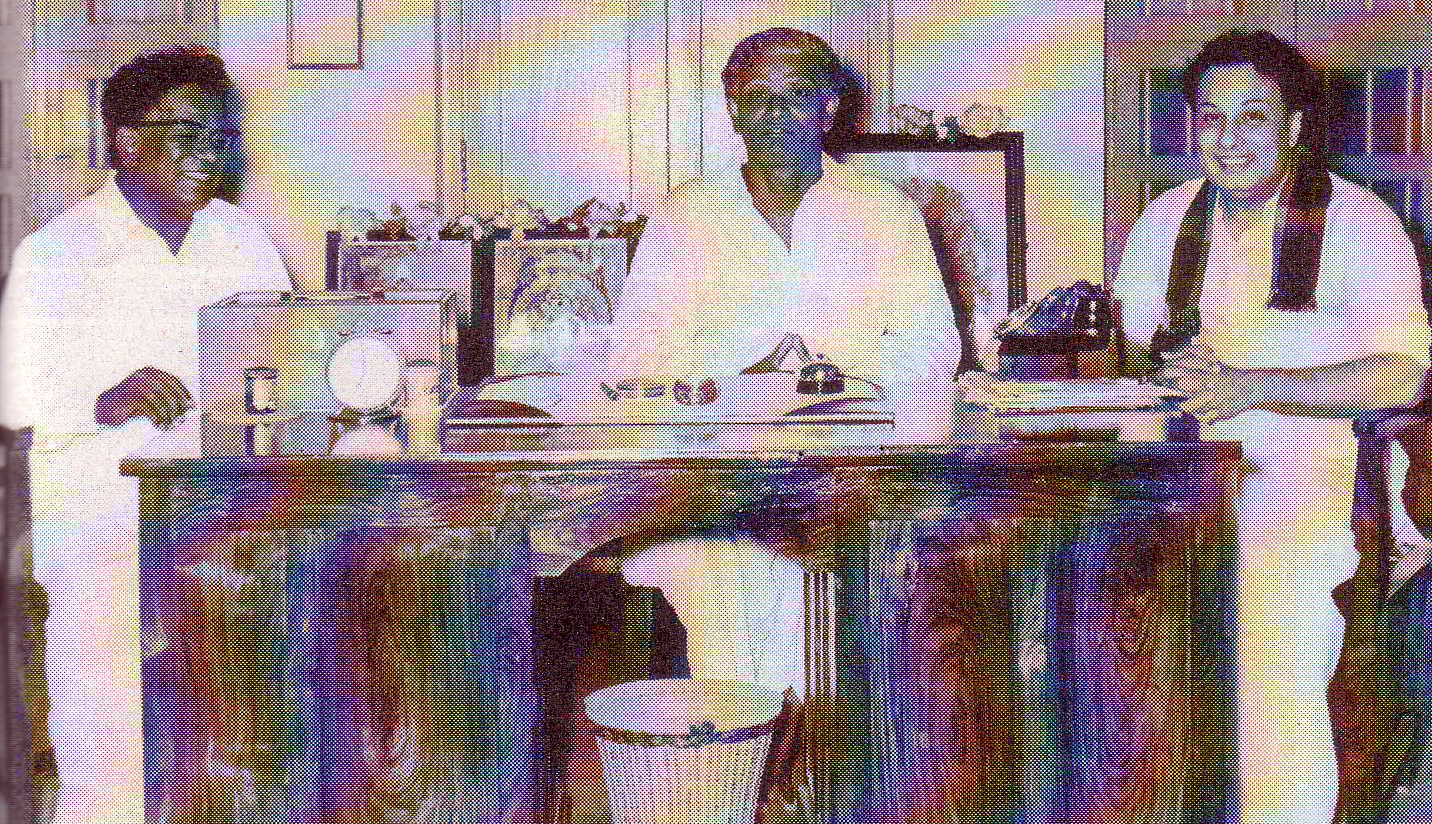
MGR with M.R. Radha (lt) and Sinappa Thevar (middle)
Movies and Main Events between 1960 and 1967
During this period, two individuals whom MGR had known for decades influenced his career in movies and politics tremendously. They were, body builder turned producer Sandow M.M. A. Sinappa Thevar (1915-1978) and elder mentor/actor of stage Madras Rajagopalan Radhakrishnan (M.R. Radha, 1907-1979). MGR reached the pinnacle of his movie career (a star with superior earning power) and took his first direct political step, by being elected to the Madras Legislative Assembly in 1967 and simultaneously influencing the electoral victory of DMK party over the Congress Party in the Madras State. Prior to that, he faced a life threatening second accident, in a shooting incident involving his elder mentor M.R. Radha on Jan.12, 1967.
Some significant dates in MGR’s life of this decade (until 1967) are as follows. That MGR is a stickler in demanding ‘politically correct’ names for his movies from producers is well known. As such, some of MGR’s movie titles are not easy to translate into English. A good example is Petraal Thaan Pillaiya (1966), the movie which was linked to his shooting incident by M.R. Radha. Thus, wherever it is infeasible, I have omitted the translated English titles.
1960: number of movies released 3 – Bhagdad Thirudan (Thief of Bagdad), Raja Desingu
(Raja Desingu) and Mannathi Mannan (King of Kings)
1961 April 9: E.V.K. Sampath and Kannadasan quit DMK party to form Tamil Nationalist Party (TNP).
1961: number of movies released 5 – Arasilankumari (The Princess), Thirudathe (Don’t Steal), Sabash Mapillai (Greetings Bridegroom), Nallavan Vazhvan (Good One will Live) and Thai Sollai Thattathe (Don’t reject Mother’s Words).
1962 Feb.25: death of second wife Sadhanandavathi.
1962: nominated as the DMK Member of Legislative Council (MLC) of Madras State.
1962: number of movies released 6 – Rani Samyukta (Queen Samyuktha), Maada Pura (Balcony Pigeon), Thayai Kaatha Thanayan (The Son who saved the Mother), Kudumba Thalaivan (Leader of the Family), Paasam (Love), and Vikramathithan (King Vikramathithan).
1963: First of the two years, in which a maximum number of 9 movies were released. These were, Pana Thottam (Money Garden), Koduthu VaithavaL (The Blessed Lady), Dharmam Thalai Kaakkum (Order will Save Life), Kalai Arasi (Artistic Queen), Periya Idaththu Penn (High Society Woman), Ananda Jyothi (Happy Flame), Neethiku In Paasam (Love after Justice), Kanchi Thalaivan (Leader of Kanchi), Parisu (The Prize).
1964 March: resignation of MLC nominated position.
1964 July: at a birthday felicitation function, creating a stir among DMK party cadres by calling Congress Party leader Kamaraj as his ‘leader’ and mentor Anna as his ‘guide’.
1964: number of movies released 7 – Vettaikaran (The Hunter), En Kadamai (My Duty), Panakkara Kudumbam (The Rich Family), Theiva Thai (Divine Mother), ThozhilaLi (The Laborer), Padakotti (Fisherman), and Thayin Madiyil (In the Lap of Mother)
1965 Oct: first and only trip to his birth place Ceylon.
1965: number of movies released 7 – Enga Veetu Pillai (Our House Child), Panam Padaithavan (Rich Man), Ayirathil Oruvan (One in a Thousand), Kalankarai ViLakkam (The Light House), Kanni Thai (Virgin Mother), Thazhampoo (Pandanus flower), and Asai Mugam (Lovely Face).
1966: Again, a maximum number 9 movies were released. These were, Anbe Vaa (Come here Love), Naan Anaiyittal (If I Ordered), Nadodi (Vagabond), Chandrodayam (Rising Moon), Mugarasi (Luck of Face), Thali Bhagyam (Luck of Thali thread), Thani Piravi (Exceptional One), Parakkum Paavai (The Flying Lady), Petraal Thaan Pillaiya (difficult to translate this title!)
1967 Jan.12: shooting incident at his house, by actor M.R. Radha.
1967 Feb.: Elected as the DMK Member of the Legislative Assembly for St. Thomas Mount constituency.
1967: number of movies released 4 – Thaiku Thalaimagan (Eldest son of Mother), Arasa Kattalai (Order from Kingdom), Kavalkaran (Protector), Vivasayee (Farmer).
Between 1960 and 1967, when his age advanced from 43 to 50, a cumulative total of 50 of his movies were released. He was the hero in each of these movies. He neither played second fiddle to any other heroes, nor took honorary roles. This was a contrast to the career of Sivaji Ganesan. As the compiled Table shows, during this period MGR’s lead heroines in these 50 movies were, B. Saroja Devi (25 movies) and Jayalalitha (8 movies). In one movie, Arasa Kattalai, released after the 1967 shooting incident, both appeared together. Other notable heroines were, Padmini (5 movies), K.R. Vijaya (5 movies), Savitri (2 movies) and P. Bhanumathi (2 movies). Jayalalitha and Vijaya appeared together in one movie, Kanni Thai.
A second look at the compiled Table also reveals the consistency of MGR’s producers, among whom two were prominent. Devar Films (owned by MGR’s long time buddy Sandow M.M.A. Sinappa Thevar) and R.R. Pictures (belonging to director T.R. Ramanna). Though Ramanna had produced movies with Sivaji Ganesan and did produce the only movie Koondu KiLLi, in which MGR and Sivaji Ganesan were featured, for financial success, he relied more on MGR. Then, we have a couple of producers, who had shifted their allegiance from Sivaji Ganesan to MGR, for better financial success. These include, B.R. Panthulu (Padmini Pictures), who had produced classic Sivaji Ganesan movies like Veera Pandiya Kattabomman, Karnan and Kappalottiya Thamizhan, moving to MGR’s camp in 1965 to produce Ayirathil Oruvan (1965) – the first pairing of MGR and Jayalalitha, Nadodi, and. Rahasya Police 115 (Secret Police 115). Another producer was G.N. Velumani (Saravana Films), who previously had success with Sivaji Ganesan with movies like Bhaga Pirivinai and Paalum Pazhamum, later landing in MGR’s camp with many hit movies such as Panathottam, Padakotti, Kalangarai ViLakkam, and Chandrothayam. These producers were unaffiliated to DMK party, and some were ardent Congress Party sympathizers. It is my surmise that MGR creating a stir among DMK party cadres in 1964 by calling Kamaraj as his ‘leader’ might have been a ploy to placate the sentiments of these movie moguls as well.
That B.R. Panthulu and G.N. Velumani left Sivaji Ganesan’s camp to join with MGR also stresses the relevance of financial performance and the ‘bottom line’ of the final product of their effort. Whatever the critical evaluations by the egg-heads on the quality of the plot and the acting performance of the players, if the final product flops in the box office, there couldn’t be another repeat opportunity in the high risk film industry. Later in 1970s, even other reputed directors like C.V. Sridhar and A.P. Nagarajan who gained respect by associating themselves with Sivaji Ganesan, had to move into MGR’s circle also highlighted the same phenomenon.
Sivaji Ganesan’s Lament on the insensitivity of Congress Party Circle
In his autobiography, Sivaji Ganesan had stated the following:
“B.R. Panthulu produced good movies such as Karnan [Karna, a ranking character in Maha Bharatha epic], Kappalottiya Tamizhan [The Tamil Who Owned a Ship – a biopic on V.O. Chidambaram Pillai] and so on….I was able to excel in my role as V.O. Chidambaram in Kappalottiya Tamizhan… This film was not a box office hit because V.O.C. belonged to the Congress Party. Certain people did not want the masses to be stirred by the nationalist spirit. It was the time when the DMK was gaining political ground in Tamil Nadu. A time when there was competition between parties, and films were pitched against each other. The opposition unleashed a malicious propaganda that since V.O.C belonged to the Congress Party Kappalottiya Tamizhan was a Congress Party film. In those days, the DMK had the strength of numbers…The difference between the DMK and the Congress is that the latter did not pay much importance to the field of performing arts. My professional accomplishments or my speeches were not appreciated by them whereas the attitude of the DMK was different. It used films as the primary medium to widen the party base. Since the Congress did not understand artistic sensitivities, Kappalottiya Thamizhan, which was a film made for the Congress, was a box office failure…”
Susan Rudolph on Sivaji Ganesan (in 1967)
Susan Rudolph was an associate professor in political science at the University of Chicago, when her ‘Letter’ on ‘Southern Film’ appeared in the Yale Review in 1971. In this feature, she had looked back to 1967, when she met Sivaji Ganesan at Kodaikanal when he was shooting a film for AVM Productions. At that time, he was 39 years old, after DMK party was elected to power. Excerpts:
“Shivaji Ganesan, the reigning male idol of the Tamil film, and his wife Kamala celebrated their fifteenth wedding anniversary on May 1…Shivaji is about five foot eight inches, with lean hips and a barrel chest, and that extra bit of flesh around the chin that film-goers in a hungry country like to see in their stars…Shivaji wears his clothes – which range from dhoti and shirt to Italian-cut raw silk suits – with the air of wearing costumes. For his pictures, the makeup men tone him up from his natural warm middling brown to a false dark apricot….
We asked him how he came to be in the films.
‘I have been an actor since I was a boy. I ran away from home when I was six and joined a touring company of actors. We traveled from town to town. We never knew when we would eat and what would happen. It was a hard life.
‘But they taught me so many things. It was called a gurukulam, a traditional school. It worked by apprenticeship to a master or masters. Boys joined it when they were young. We learned how to dance, and sing, and act. I know how to do all the classical dances, khatakali, Bharatanatyam, and also the twist. An actor had to be able to do everything and the boys learned from the elders. It was a hard discipline. I used to play women’s roles when I was young. My hair was so long.’ He made an expressive gesture of combing heavy, knee-length tresses.
‘I was a good-looking girl. In those days the young boys played the women’s roles because there were no women in the company. Only today are there women actors. The director Gopalkrishna [i.e, K.S. Gopalakrishnan], he also used to act women’s roles. Then, when I became better known, I in turn had young boys who learned. But now there is nothing left of the gurukulams. Mine was the last. We still try to keep up an acting company in Madras and have a play once a week. But now it is the college boys who come, not young boys. And they don’t want to work at the discipline. They want immediately to have such big roles.
‘I finished one film today. In two days, I shoot another. They take six months to film. But sometimes we have a double schedule, one film in the morning, another in the afternoon. The film I shoot in two days is Mr. Trilok’s [i.e., director A.C. Trilokchandar]. He is a very good director and script writer. And a young man, too, younger than me.’…
Films are serious business in India, and Shivaji is a valuable property. The country has been producing more than three hundred films a year for the last six years, making it one of the largest film producers in the world. They are enormously popular not only among literate city people but among millions of illiterates for whom other mass media are less accessible. The Tamil films account for about fifty pictures per year and Shivaji accounts for between 10 and 20 percent of these.”
In the same feature, MGR also makes a cameo appearance because the talk of Susan Rudolph twists to comparing the movie careers of Sivaji Ganesan and his older contemporary MGR, among those who were present then. Excerpts:
“ ‘MGR sounds like John Wayne and Shivaji like Alec Guinness,’ I said. John Wayne and Alec Guinness were not, in fact, quite right for contrasting MGR and Shivaji. MGR, we presently discovered, is more like Charlie Chaplin with a Dean Martin face and physique. In Petrtaldan Pillaya, he plays a cheerful wayward tramp, slightly overwhelmed by the elegance and big city life of Madras, and the wily ways of its demimonde of magicians and thieves and fortune tellers. His gait and grin are so much like Chaplin’s that the resemblance cannot be entirely accidental. But while this makes him a box-office attraction, it also gives him a bit of a reputation as a light weight. People give their remarks about Shivaji a gravity they do not apply to MGR.”
Susan Rudolph was partially right and partially wrong, in the above stated excerpt. Overall, MGR indeed projected a John Wayne image in his Tamil movies, which I have indicated in previous chapters. Only for the movie Petral Than Pillaiya (supposed to be a marginal adaptation of Chaplin’s acclaimed The Kid plot), MGR played the Chaplin face. But remember, The Kid was a silent movie released in 1921 with a running time of little more than an hour; Petral Than Pillaiya (1966) released after 45 years was a talkie with song sequences and other popular attractions to the Tamil audience. MGR’s screen persona can hardly be compared to that of ‘Chaplin with a Dean Martin face and physique’. What an insult to both MGR and Chaplin?
Actress Vyjayantimala Bali on MGR
Between 1948 and 1970, actress-dancer Vyjayantimala (born 1932) acted in only 64 movies (majority in Hindi). Only 10 of her movies were in Tamil. Among these 10 Tamil movies, she was the heroine for 4 of Gemini Ganesan movies, 2 of Sivaji Ganesan movies and one of MGR movie. That one movie, released in 1960, was Bhagdad Thirudan (Thief of Bagdad). Later, Vyjayantimala became a politician and represented the South Chennai constituency as a Congress Party MP at the Lok Sabha. In her 2007 memoirs (20 years after MGR’s death), Vyjayantimala had written the following. She mentions one Yagamma , her maternal grandmother and guardian.
“Then, coming face to face with the screen idol, M.G. Ramachandran, I was totally lost to begin with. One had grown with his larger than life image, right from childhood to youth. What all I had heard about him, but when I met him, he came across as a normal person so modest and smiling all the time. He didn’t seem conscious of the stature he enjoyed, for it didn’t show. There was no sense of superiority considering he was put on a pedestal. In Bhagdad Thirudan (Thief of Baghdad), I had to play a lively, spontaneous dancer, who’s sold and taken as a slave. MGR rescues me. It was also a good-humoured film with a lot of comic sequences.
One memorable scene was where he had to pick me up, and after lifting me throw me on a couch. Look at the maryada [note by Sachi: respect] they had at that time, anybody else would have just done it. But sought Yagamma’s due permission and she as usual kept at it, ‘Oh, my child should not get hurt. Be very careful.’ She went on giving all her instructions. He did it so graciously after it was enacted by the director’s assistant. All this came naturally to MGR, for he really knew how to behave with his leading ladies. It spoke very high of him. He was so decent and gracious, very gentle and quiet. He wouldn’t talk much and would speak up only when the shot was ready and followed the director. He would even extend the courtesy of asking me, ‘Shall I start?’ And I would just nod my head. It was all very cute.
MGR was the most loved person, for whatever he did on the screen was lapped up. He came up tops. He was a stalwart, for he looked the role, though unlike Sivaji [Ganesan] he had a more swashbuckling style. Besides, he also brought in his party ideology through cinema. People would even prostrate, as he was an idol for the masses in Tamil Nadu. No wonder, he was known as Makkal Thilagam (People’s King).”
The expressed opinion of Vyjayantimala do not differ from that of many of MGR’s other heroines, but does differ from the characterization of some of MGR’s rivals and critics such as M. Karunanidhi, journalist Cho Ramasamy and writer D. Jayakanthan. (I mention only those who are living now). There is no necessity for Vyjayanthimala to offer pleasing sentiments on MGR, 20 years after his death, unless she was touched by his attributes.
Cited Sources
‘Film News’ Anandan: Sadhanaigal Padaitha Thamizh thiraipada Varalaru (Tamil Film History and its Achievements), Sivagami Publications, Chennai, 2004.
- Ravindar: Pon Mana Chemmal MGR, Vijaya Publications, Chennai, 2009, pp. 56-57.
Rudolph, Susanne Hoeber: From Madras – A view of the Southern Film, Yale Review, spring 1971, 60(3): 468-480.
Simonton, D.K. Cinematic success criteria and their predictors: The art and business of the film industry. Psychology & Marketing, May 2009; 26(5): 400-420.
Sivaji Ganesan: Autobiography of an Actor, edited by T.S. Narayana Swamy, English version by Sabita Radhakrishna, Sivaji Prabhu Charities Trust, Chennai, 2007.
Vyjayantimala Bali: Bonding…A Memoir, Stella Publishers Ltd, New Delhi, 2007, pp. 99-100.
MGR Remembered – Part 27
1962 Elections and Aftermath
by Sachi Sri Kantha, May 7, 2015
Losses of Unexpected Kind
Excluding one chapter towards the end, in which MGR describes the political vivacity of his friend P. U. Shanmugam (1924-2007; who was one of the 15 DMK candidates to be elected at the 1957 State Assembly Elections of Madras State), for some reason, MGR had failed to mention much about 1957 election in his autobiography. In addition, MGR had noted, “Respected Kamaraj publicly announced that at the end of 1962 general elections, there will be news that all 15 DMK MLAs had lost. Except Kalaignar (aka, M. Karunanidhi), the current chief minister of Tamil Nadu, the rest 14 did lose in that election. The principle of late Anna that claiming a victory even in defeat, did triumph even in these defeats. At the same legislative assembly, 50 representatives sat, in place of 15.”
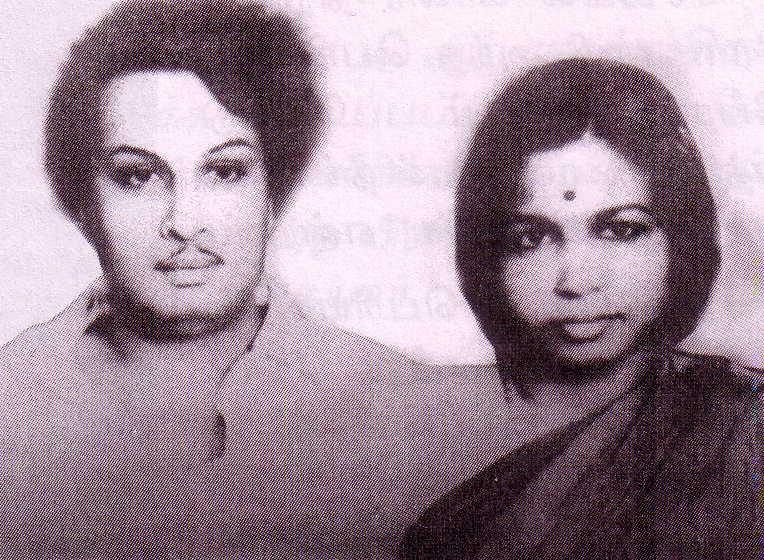
MGR and Sadhananthavathi
The 1962 State Assembly Elections of Madras State receive specific mention in MGR’s autobiography, apart from the gratitude mentality of P.U. Shanmugam to his constituents who defeated him in 1962. Reasons could be, (1) The death of his 2nd wife Sathanandavathi on Feb.25, 1962, few days after the election date of Feb. 21st. She was his wife for 20 years. (2) It was the first election in which MGR actively campaigned for DMK seriously, though he was not a candidate himself. Not to be ignored was the recurrent taunts by E.V.K. Sampath (the then No.2 of DMK) in the preceding years, on the growing influence of movie stars in DMK. After Sampath deserted the DMK in April 1961, in collusion with poet Kannadasan and Sivaji Ganesan to form a splinter Tamil National Party (TNP), MGR might have taken the taunts of Sampath as a prestige issue to test his political standing and influence among the Tamil masses as a ‘crowd puller’ for the DMK. In his autobiography (chapter 131), MGR passingly mentioned that Sampath as well as poet Kannadasan (when both were in DMK) felt irritated on him because of this ‘crowd puller’ image that their speeches were routinely disrupted by the crowd behavior, when MGR entered the stage.
I provide translated excerpts from two chapters of MGR’s autobiography.
“That Night (chapter 109)
During February 1962 General Elections, I toured many towns to speak at Kazhagam (aka, DMK) meetings. Tentatively, I spoke 30 to 40 meetings per day. If I was scheduled to speak at 10 meetings, there would be another 30 in which I was stopped to speak without any prior information. While I was traveling like that, my wife Sathanandavathi was fighting for her life with Lord Yama.
Her wish was also that I should speak at Kazhagam’s propaganda meetings. Though I had many worries in my mind about her, in the faith and confidence that she wouldn’t leave, whenever I had the opportunity in any town, I was in phone contact about her.
If anyone known to me approached the stage, my mind got panicky. They may be coming to tell me the sad story about Sathanandhavathi, I did worry. When they told alternate news such as about the schedule for next meeting or about a flag raising ceremony, I did sigh with a loud breath ‘Uhm’. Like this, as the elders used to admonish, ‘Daily danger – Long Life’, I was dying all time, but still living.
Somehow, I completed the election propaganda meetings and returned to Chennai. I had heard that Anna was facing a ‘big opponent’ in the election. Thus, I wished to go there and speak [to support Anna]. Yes, it was my real wish. But Anna had instructed to his friends, ‘If MGR spent time at other constituencies, instead of at mine, chances of wins for our Kazhagam candidates may become better’. They came to tell me, ‘You better work at constituencies which are weaker (for our candidates). Anna also prefers this.’ I did told them, at least one day I’ll be there.
I was taken to a specific location. No loudspeaker facility was available at the truck. I borrowed a ‘tin-funnel’ tube from friends, and spoke louder. I was not allowed to speak in not more than two or three meetings. Later only I realized the truth. As many of our party candidates were facing difficult situations, Anna might have taken a vow not to use the best available facilities for himself and such a suspicion shouldn’t be allowed to form in the minds of party candidates.
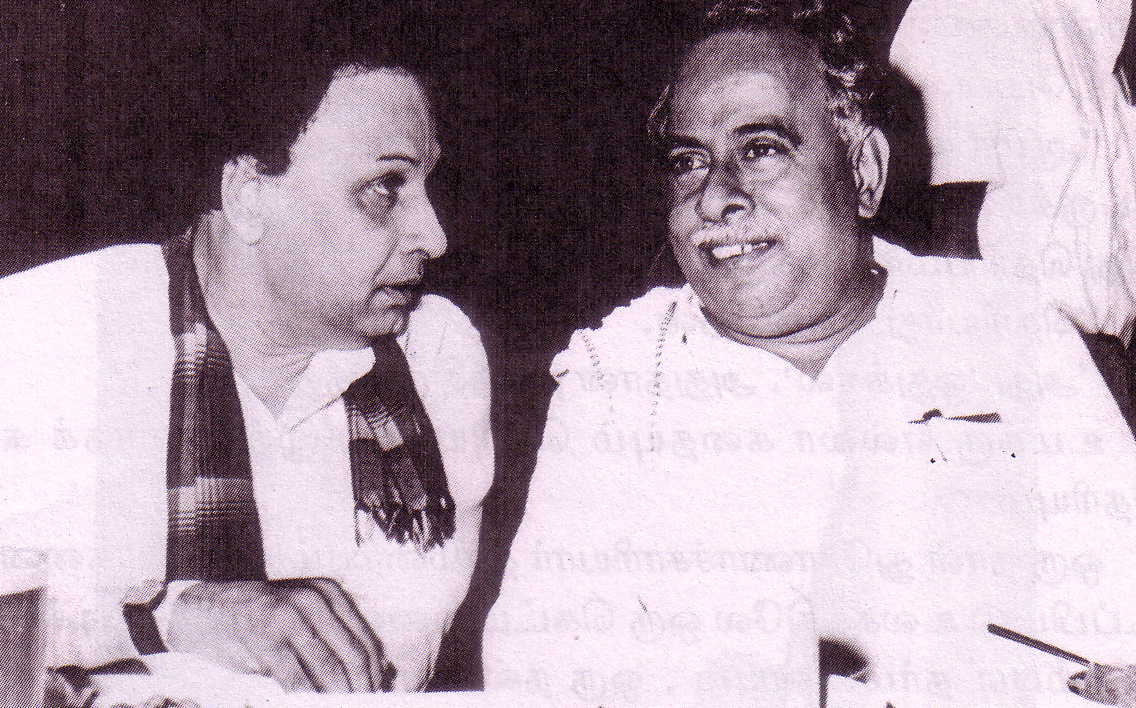
MGR with his mentor Anna
Food was available at Anna’s residence. I ate. Wished to return to his constituency. But was stopped, and forced to return to Chennai….
February 24th was the voting day. Had a look at the voting booths and returned home after 5 pm. After I had taken a bath, Sathanandavathi asked, ‘Have you completed the election work?’
Responded, ‘Yes, somehow, it’s over.’
She retorted, ‘Now, there aren’t any out of town trips?’
Smiled at her and said, ‘As long as you say ‘Go away’, I’m intending to stay here.’ I laughed. She also laughed. It had been months, since she laughed like that. Almost all days, she was breathing with tubes from oxygen cylinder….
Even while staying in bed, she did take care of events in our household. On February 24th night of 1962, she talked to me as follows:
‘Will Anna win? I hear other views. They are counting the votes tomorrow. Why not pray to God…Anna should win?’
Like this, she was keen about the electoral news about Anna’s chances.
‘Why not you be silent for a while?’ I asked her.
‘OK OK. You seems a little worried. Why I should I trouble you by asking questions?’
She talked like this, and slept calmly after meal. While sleeping, she held my left hand with her right hand. I was tired too and had fallen sleep.
It was 25th early morning around 4 am. To turn over, I wished to release my hand. But, felt some unpleasantness. I noted that her hand slipped without life. She was just lying there. Couldn’t hear the breathing sound. With surprise, I checked her. Called her name. No response. Shook her body. Frightened that ‘Could it be that?’
Screamed, ‘Anne’ [elder brother]. Ran on the stairs. All assembled from my unusual reaction. Sent word for the doctor. He did come. But, the life departed from Sathanandavathi’s body didn’t return…”
That MGR was hit hard by this loss is reflected sincerely in his autobiography. Having married Sadhananthavathi in 1942, next to his elder brother Chakrapani, only she knew and experienced the life with MGR when he was a struggling movie actor looking for opportunities in 1940s. She was also the one who could have given him a child, but that wish was unrealized. Having been sick with tuberculosis, that Sadhanandavathi came to accept MGR’s extra-marital relationship with movie star V.N. Janaki, on her own terms for the last 12 years of her life have also been recorded by MGR in his autobiography. In this sense, the autobiographies of his peers in movies and politics (Karunanidhi, Kannadasan and SSR) were defective by evasion.
“Thousands of Hearts Wailed (chapter 110)
… On that particular day, ‘while enjoying the news of the victories of Kazhagam friends at the election’, I had to suffer from the death of my wife. Waves of sorrow hit my heart with full strength…The experience I felt was different. I had to console those who came to express their sympathy on my loss. Only when I received my dear pal Mr. V.P. Raman, I was able to cry…
Many leaders of Kazhagam came. While I was crying with bowed head, I felt someone’s nice touch. Raised my head. Anna was the one who had touched my head, to console me. When I looked at him, I couldn’t stop crying. Anna told,
‘Something unexpected had happened. What to do? Sometimes, what we expect don’t happen. What was not expected do happen. This is reality. Keep a firm mind, and continue what has to be done.’ Then, he was silent for a while.
I wiped my eyes and asked Anna. ‘Isn’t today the day for ballot counting?’ He shook his head to say, ‘Yes’.
‘You are here. If some hanky-panky happened there?’ I asked.
He calmly replied, ‘There cannot be any fault, hereafter.’
I felt like, I’ll be dealt another blow on my head. ‘I’ll be firm Anna. Would you please take care of vote counting issue?’ He was silent for a while. Then, he consoled me again, and left with friends…”
1962 Election Results
As MGR had the premonition, when the Madras Legislative Assembly election results were released, though DMK increased its number of wins to 50 as a recognized State party (compared to the 15 in 1957 Election, competing as Independents), Anna had lost in his Kancheepuram constituency, to S.V. Natesa Mudaliar, the Congress Party candidate. The results were,
S.V. Natesa Mudaliar (Congress Party) 46,018 votes (54.8%)
C.N. Annadurai (DMK) 36,828 votes (43.86%)
M.K. Parasuram Naicker (Independent) 1,128 votes (1.34%).
Not only Anna, but 13 other DMK MLAs who won the 1957 election (excluding M. Karunanidhi, contesting this election at Thanjavur constituency) did lose. That MGR’s labor as a vote puller for DMK was proved convincingly, when the total votes polled for the party increased to 3,435,633 votes (27.1%), next to that of Congress Party’s 5,848,974 votes (46.14%). These numbers should be compared to the 1957 harvest of votes. On that election, DMK’s tally was 1,424,319 votes (12.8%), next to Congress Party’s 5,046,576 votes (45.3%). In the span of five years, while Congress Party’s votes in the Madras State remained stagnant, DMK more than doubled its vote base, mainly due to its influence on cinema glamor of its stable of ranking actors (MGR, SSR and to a lesser extent K.R. Ramasamy, D.V. Narayanaswamy), script writers (Karunanidhi, Murasoli Maran, Rama Arangannal), lyricists (Udumalai Narayana Kavi, Kannadasan, Muthukoothan) and playback singers (Chidambaram S. Jayaraman).

MGR and Kannadasan
Contrastingly, Sampath’s splinter party, Tamil National Party (TNP) fared dismally in the 1962 election. It contested 9 seats and forfeited deposit in 8 of them, polling a dismal 44,048 votes (0.35%). Sampath himself, standing for Lok Sabha election at Madras South, failed miserably! That constituency was captured for DMK by Nanjil K. Manoharan convincingly by 44.73%, compared to Sampath’s 18.78%. Other than Nanjil Manoharan, six more MPs were elected on DMK ticket in 1962 election. In 1957 election, only two DMK MPs were elected, among whom one was Sampath.
In April 1962, for some unknown reason, Kannadasan played a practical joke. He himself released a rumor that ‘Kannadasan had suddenly died’, to shock the film industry folks and fans. There was pandemonium in the Madras movie circles. Why Kannadasan played this practical joke? Reasons could be many. First, he was depressed by TNP’s dismal performance. Secondly, he had lost money and stature in the society in betting against DMK’s success. Thirdly, by his own admission, he was in debt due to his foolish ventures in movie production. Fourthly, as he had become an alcohol/drug addict, maybe it was an after effect of such addiction. Fifthly, he merely wanted to evaluate the affection he had among his friends, fans and supporters. In his autobiography, Kannadasan had stated that, “At that time, there was problem between him and Mr. MGR. Both were not in talking terms. However, Mr. MGR called him on phone and advised him to ‘take care of his health’.” This indication by Kannadasan suggests that MGR (though not in talking terms) was worried and had duly guessed that Kannadasan was damaging his health by alcohol/drug addiction and this practical joke was nothing but an after effect of such an addiction.
Member of Legislative Council of Madras State
To felicitate MGR’s activity on behalf of DMK’s success in the 1962 election, he was nominated as a Member of Legislative Council (MLC). He made his first speech at this assembly on May 1, 1962. In it, he addressed the lack of sponsorship for drama promotion by the state. He also focused on the pathetic plight of workers who were in cinema field and demanded setting up ‘minimum wage’ requirement. MGR critiqued the address by the Governor for missing components in the area he was familiar with; (a) wage protection for nearly 100,000 workers in the cinema field, (b) lack of training facilities for prospective acting students at the universities, and (c) plans for studies in Tamil drama and cinema.
A joint felicitation meeting was organized by the fan clubs of MGR, Sivaji Ganesan and Gemini Ganesan for MGR. Excerpts of the speech made by MGR at this meeting held on May 11, 1962 are as follows:
“I welcome the attempt made by the three fan clubs. Many have spoken differently on why I was chosen for the Legislative Council. Now, I tell you the truth. I was chosen to the Legislative Council, against my wish. My duty to the art world remains incomplete. I thought of working as a director, after the ‘Nadodi Mannan’ movie. But, I have to complete the movies for which I’ve signed contracts. Some may get angry, when I continue to act. The reason for this is that, I belong to a party. Some newspapers cuss me. An artist belonging to a party have suffer like this. But, I don’t care. The reason is, artists are committed to their beliefs. They cannot be bought…
All know that recently, actress P.S. Gnanam expired. She did talk to me ten days before her death. Now, her life is easily forgotten. The life of an artist disappears so quickly. This should be recognized by artists. As for me, I believe that I should continue acting, as long as folks tell me ‘I’m not wanted’. This is not an adamant attitude. I trust the passion of my fans.
Now I see that the fan clubs of Sivaji and MGR function jointly. How many times, thamby Sivaji and I had spoken about this unity? But, we couldn’t find a proper path for this. Reason is due to mischief of some newspapers. You shouldn’t patronize such journals.
Now, municipal council have the right to tax cinema. For every one taxed rupee, only 15 cents reaches the producer. Capital could be retrieved only if 10,000,000 rupees are earned. Only by ‘mega hits’ such an amount could be earned. For example, it cost 1,300,000 rupees for producing ‘Vira Thirumakan’ movie. Only when 10,000,000 rupees are earned, the capital could be retrieved. Is it real? Think for a while. Those who yearn for new faces, should think about this tax.
In the cinema field, 100,000 folks are involved. Government doesn’t offer help to this industry. They had opened a film role production facility at Uthakai (Ooty). By the time, when film roles appear (in market), they become unusable. Director K. Subramaniam, who had been to France, had told this.
It is a joke, why the government folks had designed this new tax. [I guess] it was by keeping in mind MGR, Sivaji and Gemini. They think, others are like us. In reality, others are dying. In Tamil Nadu, all the fan clubs of artists should pass a condemning resolution and send it to the government. A copy should be send to the Actor’s Guild (Nadigar Sangam). If we demand closure of cinema theaters, whether theater owners are complying with it should be checked and by that you will make our conviction (to oppose such a tax) a success….
When you watch movies, you should write to us the good and bad aspects in them. I’ll pass a resolution against the new cinema tax, and forward it to Madras Government, Film Chamber and Actor’s Guild. This should be done in a respectable manner…”
MGR’s comment about the ‘Vira Thirumakan’ [Successful Hero, 1962] movie is of some interest. It was released on May 5, 1962, by Murugan Brothers (M. Murugan and M. Saravanan, sons of reputed movie mogul A.V. Meiyappan Chettiar). The hero of this movie was C.L. Anandan, an upcoming ‘new face’ with action star potential and thought to be a rival for MGR’s niche. In fact, he was a Muslim by birth (name Hakeem), and debuted in 1960. After this ‘Vira Thirumakan’ movie, Anandan lost his hero status and rumor had it that MGR made it sure that Anandan wouldn’t succeed. This rumor may have its origin to this 1962 speech by MGR. Subsequently, Anandan did appear in one or two MGR’s movies (Thani Piravi,1966; and Neerum Neruppum,1971) in subsidiary roles.
Around this time [i.e., May 1962], Sivaji Ganesan was in USA, on a US State Department sponsored visit for 100-odd days. Thus MGR ended his speech with a comment that all three fan clubs (MGR, Sivaji Ganesan and Gemini Ganesan) should participate in the felicitation ceremony to Sivaji after he returns from America, and this unity should continue.
Anna’s Historic Speech at Rajya Sabha on May 5, 1962
Falling in between the dates of two speeches made by MGR [May 1 and May 11], his mentor Anna made a historic speech in New Delhi at Rajya Sabha on May 5th, demanding secession for four Dravidian states. The New York Times reported this speech as follows:
“The cry for secession was heard this week for the first time in India’s Parliament.
It was uttered in the Upper House by C.N. Annadurai, leader of the Dravida Munnetra Kazhagam (Society for Dravian Uplift). He called the turning the ‘subcontinent of India’ into ‘a comity of nations instead of a medley of disgruntled units’.
Questions have been raised whether such a demand is constitutional in Parliament.
Mr. Annadurai’s organization advocates the secession of the four states of southern India. However, virtually all of its support comes from the state of Madras. Few or no demands for secession have been heard in Mysore, Kerala and Andhra Pradesh.
The Dravidian Uplift Society’s basic contention is that these four states, where Dravidian languages are spoken, do not belong with the rest of India, where Aryan languages derived from Sanskrit prevail.
Mr. Annadurai complained that southern India had been discriminated against in the country’s planned industrial development and that the Government was trying to impose Hindi on all of India….
Mr. Annadurai was named to the Upper House of Parliament after he had been defeated in Madras for a seat in the Lower House [sic., Madras Legislative Assembly] in recent elections by a candidate of the ruling Congress Party.
However, Dravidian Uplift Society candidates were elected to seven of the forty one seats allotted to Madras in the Lower House and the society formed the main opposition in the Madras State Legislature, with fifty of the 206 members.
Moreover, Mr. Annadurai and Chakravarti Rajagopalachari, former Governor General of India and leader of the free-enterprise Swatantra or Freedom Party, established an informal alliance against the Congress Party in Madras.”
How the then Prime Minister Nehru and other parties in the parliament reacted to Anna’s speech was written as follows in the same report :
“Spokesmen of all parties in Parliament, from the Communist to the Jan Sangh, a nationalist Hindu party for the propagation of Hindi, opposed the Dravidian Uplift Society’s demands after Mr. Annadurai had finished speaking.
A few days later Prime Minister Nehru asserted that the Balkanization of India demanded by Mr. Annadurai was ‘so outrageous I can’t conceive of it.’
Mr. Nehru previously had said that any attempt by the South to secede would be fought, even if it meant civil war. He repeated his stand, declaring that any effort would be ‘resisted with all our force.’
The Prime Minister, a champion of Indian integration, said the creation of Pakistan, formed through a partition of the Indian subcontinent, had been ‘bad enough’. Further divisions, he added, would break India into ‘thousands of bits’. He called on the people of Madras to repudiate the Dravidian Uplift Society’s demands.”
Whether the people of Madras heeded to Prime Minister Nehru’s request is altogether a separate issue. In hindsight, it may not be wrong to believe that the desertion of E.V.K. Sampath in 1961 on purported allegation that the influence of movie stars in DMK was one of the reason for his distaste of Anna’s policies is merely a smokescreen created by intelligent gumshoes of Central Government to weaken DMK’s hold in the Tamil Nadu. To his credit, Kannadasan also had written about the weakness of will and character flaw of Sampath, after his desertion from DMK and then merging his fledgling party into Congress Party.
Cited Sources
Anon: Secession urged for India’s South – Parliament hears demand by Dravidian leader. New York Times, May 6, 1962.
Kannadasan: Manavaasam (autobiography), Vanathi Pathippagam, Chennai, 5th edition, 1991 (originally published 1988), pp.118-119.
- Kirubakaran (ed): Naan Aanaiyittaal – Pon Mana Chemmalin Pokkisham (Collection of published materials of MGR), Vikatan Pirasuram, Chennai, 2013.
MGR: Naan Yean Piranthen [Why I was Born?] autobiography – Part 2, Kannadhasan Pathippagam, Chennai, 2014, chapters 109 and 110.
MGR Remembered – Part 28
Heroines and Muses
by Sachi Sri Kantha, June 6, 2015
Prelude
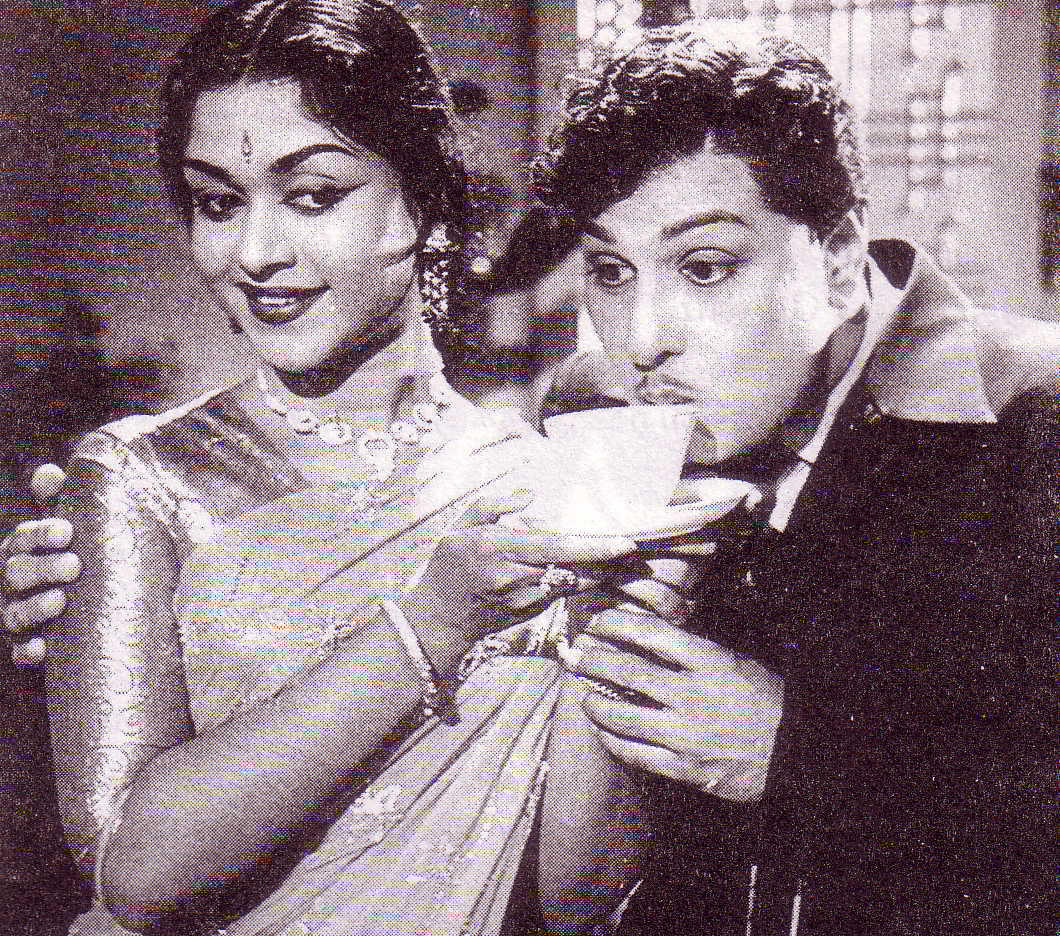
MGR and first muse B. Saroja Devi
As of now, in 27 chapters (and approximately 87,000 words), I was able to cover MGR’s life until 1962. I need to cover the remaining 25 years of his successful career, in which he transformed himself as a politician and a chief minister of Tamil Nadu. Writing at a snail speed of one chapter per month or two months, it had taken 30 months! I began this series in December 2012. Up to now, I have been guided mostly by MGR’s own autobiography, originally written during 1970-1972 and published in the Ananda Vikatan weekly. But, MGR failed to describe his life events in depth, after the death of his 2nd wife Sadhanandavathi.
Thus, biographers like me had to rely on the impressions published about him by those who had worked closely with him. Among these, one has to rely on the published writings of three different sources; (1) friends turned foes (such as M. Karunanidhi and poet Kannadasan), (2) those who worked under MGR for a salary (writing assistants K. Ravindar and Vidwan Lakshmanan, body guard K. P. Ramakrishnan), and (3) reminiscences of fellow colleagues for whom MGR was a patron in the movie field (script writer Aroordas, poet Vaali and comedians Nagesh, Cho Ramasamy) and in administrative affairs (police chief K. Mohandas). Views of the fourth source (academics, critics and journalists such as Robert Hardgrave Jr., and M.S. S. Pandian) should be ignored. But, they have their own in-built biases as well. I plan to write the remaining chapters chiefly from these sources, and as much as possible I avoid using hagiographic descriptions on MGR’s life published in short Tamil books and booklets.
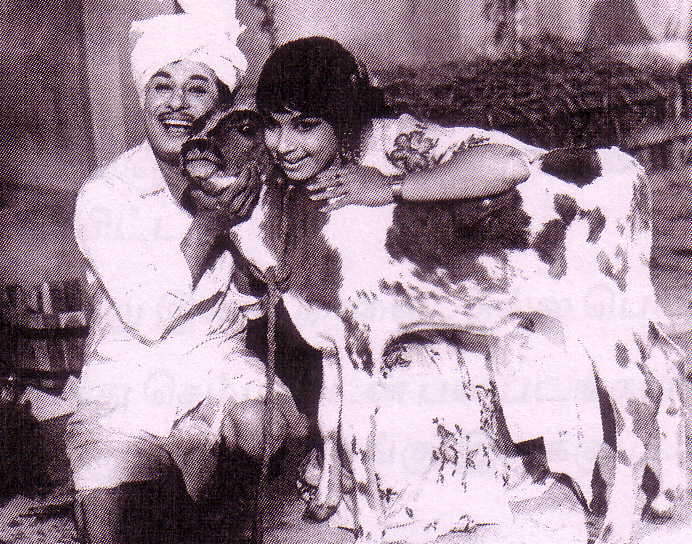
MGR and second muse Jayalalitha
‘Turns’ in Cinematic Life
In chapter 111 of his autobiography, MGR identified 14 of his movies as providing ‘turns’ in his cinematic life, among a cumulative total of 133 movies in which he had starred. These were,
1st turn: ‘Rajakumari’ (The Princess, 1947); debut as hero.
2nd turn: ‘Maruthanaatu Ilavarasi’ (The Princess from Marutha Land, 1950); pairing with V.N. Janaki and its difficulties.
3rd turn: ‘Marma Yogi’ (Mysterious Mystic, 1951)
4th turn: ‘Malai Kallan’ (Mountain Thief, 1954)
5th turn: ‘Nadodi Mannan’ (Vagabond King, 1958); double role, own production.
6th turn: ‘Thirudathe’ ( Don’t Steal, 1961)
7th turn: ‘Thai Sollai Thattathe’ (Don’t reject Mother’s Words, 1961)
8th turn: ‘Enga Veetu Pillai’ (Our Own Child, 1965); double role.
9th turn: ‘Kaavalkaaran’ (Protector, 1967)
10th turn: ‘Kudiyiruntha Kovil’ (Family residing temple, 1968); double role
11th turn: ‘Oli Vilakku’ (Light Lamp, 1968) – 100th movie
12th turn: ‘Adimai Penn’ (Slave Woman, 1969); own production
13th turn: ‘Maatukara Velan’ (Cowherd Velan, 1970); double role
14th turn: ‘Ricksawkaran’ (Rickshaw Guy, 1971)
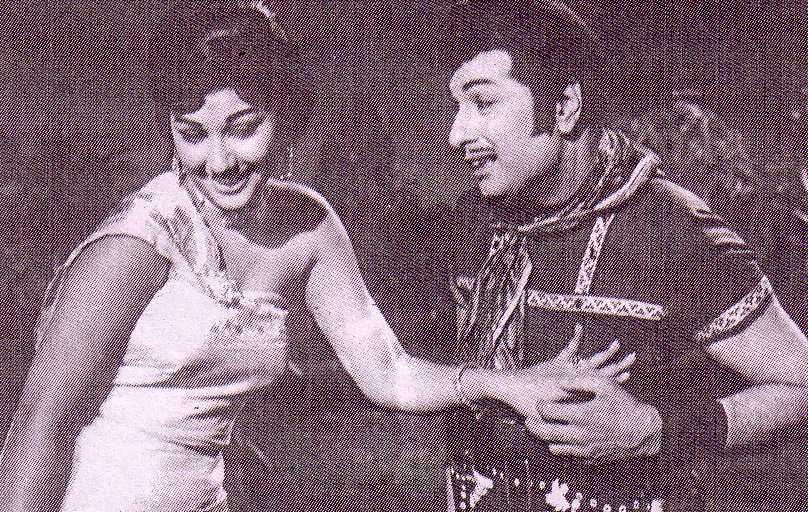
MGR and third muse Manjula
Heroines of 1950s
Decade-wise ‘turns’ in MGR’s cinematic life tally shows, 1940s – 2 movies; 1950s – 3 movies; 1960s – 8 movies, and 1970s – 1 movie. Thus, MGR himself considered that he was at his peak in 1960s. Unfortunately MGR do not provide any descriptive details for these movies from the production angles. Only three movies, Rajakumari (1st turn), Maruthanaathu Ilavarasi (2nd turn) and Thirudathe (6th turn). Listed among the 14 ‘turns’, were his two own productions, Nadodi Mannan (5th turn) and Adimai Penn (12th turn).
As of now, other than occasional mention of his third actor-wife V.N. Janaki (1923-1996) and P. Bhanumathi (1925-2005), I have hardly mentioned MGR’s heroines. Since 1947, when he received hero billing, up to 1958, MGR’s heroines were born in 1920s and first half of 1930s. The year of birth of MGR’s first heroine K. Malathi (a Telugu actress) who starred with him in Sri Murugan (1946) and Rajakumari (1947) is not available in the sources I’ve collected. Prominent among MGR’s other heroines of 1950s were, P. Bhanumathi, Anjali Devi (1927-2014), B.S. Saroja (b. 1922?), Sri Ranjani Jr. (1927-1974), Madhuri Devi (b. 1929) Padmini (1932-2006), Savitri (1933-1981), E.V. Saroja (1936? – 2006), and Jamuna (b. 1936). As is well known for movie actresses in other countries, birth years of this breed have to be accepted with some reservation for the single reason that birth records in the early decades of 20th century India were not properly maintained, and majority of the births took place at homes and not in hospitals.
Only after gaining stature as a hero with box office potential in the latter half of 1950s, MGR came to dictate terms to the producers, whom he’d like to have as his heroine. With the possible exception of Padmini (who got married in 1961), most of MGR’s heroines of 1950s (Bhanumathi, Anjali Devi, Madhuri Devi and Savitri) were of married types and they had earned their spurs before MGR could gain a firm hold at the top of Tamil cinema. Thus, it may not be a wrong view to hold that from 1960s, MGR choose younger, unmarried heroines as his muses.
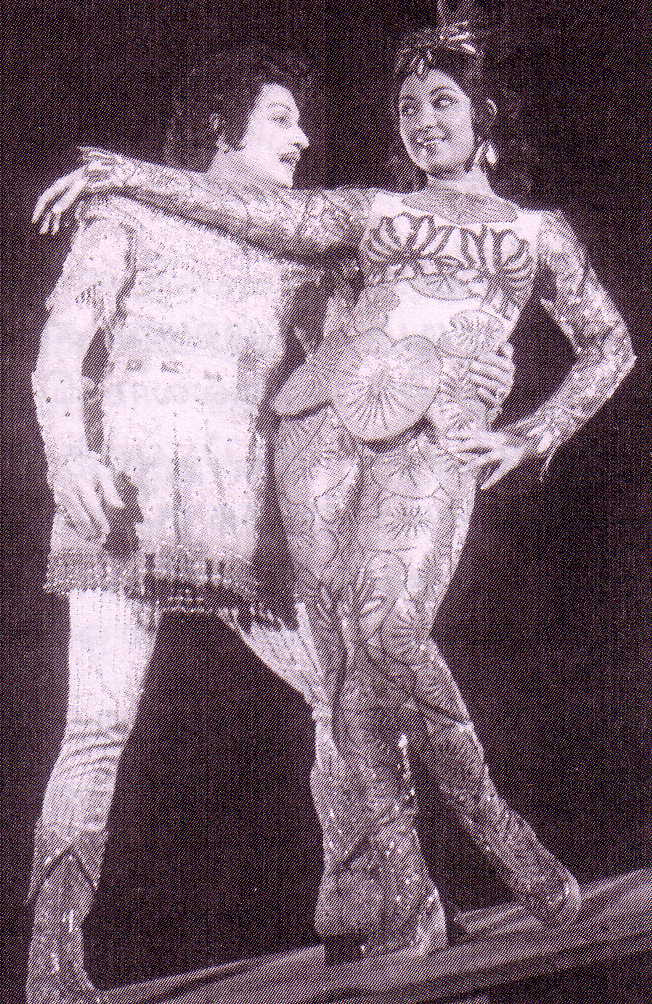
MGR and fourth muse Latha
MGR’s Four Muses of 1960s and 1970s
Nine muses (Clio, Calliope, Erato, Euterpe, Melpomene, Polyhymnia, Terpsichore, Thalia and Urania) were recognized in Greek mythology. They were identified as the daughters of Zeus and Mnemosyne (Memory), and conceived as minor goddesses who inspired poetry, music and drama. Even in the 20th century, this muse concept prevailed for poets and artists. Nine women were identified as muses of Pablo Picasso (1881-1973); namely, Germaine Gargallo (1881-1948), Fernande Olivier (1881-1966), Eva Gouel (1885-1915), Gaby Lespinasse (1888-1970), Olga Khokhlova (1891-1955), Marie-Therese Walter (1909-1977), Dora Maar (1907-1997), Francoise Gilot (b. 1921) and Jacqueline Roque (1927-1986). What is interesting are the facts that, (1) the ages of Picasso’s muses decreased from same age to 46 years younger. Picasso married only two of his muses. (2) Picasso married only two of his muses, Olga and Jacqueline.
If cinema was the 20th century art form, the same muse concept applied for popular and predominant actors and directors. Among his heroines, multi-talented Charlie Chaplin (1889-1977) had three muses; namely, Edna Purviance (1895-1958), Georgia Hale (1906-1985) and Paulette Goddard nee Levy (1910-1990). These three muses were 6 – 21 years younger than Chaplin. Chaplin married only Goddard.
Similarly, MGR also had four muses, who played the heroine role in majority of his 133 movies. They are, B. Saroja Devi, Jayalalitha, Manjula and Latha. The age difference between MGR and these four muses were, 21 years (Saroja Devi), 31 years (Jayalalitha) and 36 years (both Manjula and Latha). One who dominated MGR’s movies in the first half of 1960s was B. Saroja Devi (b. 1938). Three of MGR’s chosen 1960s movies, Thirudathe (6th turn), Thai Sollai Thattathe (7th turn) and Enga Veetu Pillai (8th turn) featured her. Saroja Devi also had appeared previously as a second heroine in MGR’s own production, Nadodi Mannan (5th turn). Then, Jayalalitha (b. 1948) came to dominate MGR’s movies in the second half of 1960s. Saroja Devi got married in 1967. Check the fact that there is a ten year age gap between Saroja Devi and Jayalalitha. Five of MGR’s chosen 1960s movies, Kaavalkaaran (9th turn), Kudiyiruntha Kovil (10th turn), Oli Vilakku (11th turn), Adimai Penn (12th turn) and Maatukara Velan (13th turn) featured Jayalalitha. Saroja Devi and Jayalalitha did appear together in one MGR movie, Arasa Kattalai (King’s Command, 1967), which was touted as the one show a ‘rejuvenated’ MGR, after his gun-shot injury. More about this incident, later.
K.R. Vijaya (b. 1948), another competent heroine, was also paired with MGR in 1964 and 1965 for three movies. In one additional MGR movie (Kanni Thai/ Virgin Mother, 1965), Vijaya shared the second billing with Jayalalitha. But in the subsequent year, Vijaya got married and temporarily left the arena for childbirth. This made it easier for Jayalalitha to become MGR’s leading lady, until the latter switched his interest to two muses in 1970s, who were younger than Jayalalitha. These two, in the chronological order, were Manjula (1953-2013) and Latha (b. 1953). MGR had identified his 14th turn with the Ricksawkaran (1971) movie, which featured Manjula.
As his autobiography ends in October 1972, with his eviction from post-Anna DMK party, MGR became more interested in politics after founding his splinter Anna DMK party and building it as alternative option for DMK in Tamil Nadu. Thus, the final 16 of MGR movies (released between 1973 and 1978) in which his fourth muse Latha appeared (a total of 12 movies) never receive mention at all.
Vagaries of Indian Censors
Ruling politicians of Congress Party of post-independent India in 1950s found it easier to apply censorship rules indiscriminately for free expression of political activism that differed from their viewpoint. Movies were not exempt from censorship scissors. In a paper presented on June 7, 1951, K.M. Modi (then President, The Indian Motion Picture Producers’ Association) commented on censorship as follows:
“Every picture has to be censored before it is exhibited. There is a government nominated Censor Board for this purpose. Till the end of 1950, pictures were censored by State government boards. This gave rise to innumerable difficulties. A picture certified in one State was sometimes banned in another and vice versa. After repeated requests from the trade, censorship has now become a Union Government concern. There is now a Central Board of Film Censors situated at Bombay with regional offices at the three important centres of production, Bombay, Calcutta and Madras. The regional offices examine the pictures produced in their respective regions and issue certificates valid for the whole of India.”
To illustrate the trend of those times, I provide two paragraphs from Barnouw and Krishnaswamy’s ‘Indian Film’ (1963).
“The [Indian] Constitution itself, in its Article 19, had established ‘the right to freedom of speech and expression’. India’s First Amendment, adopted in 1951, whittled this down by authorizing parliament to enact ‘reasonable restrictions’ on the freedom of speech and expression [Note: emphasis by Sachi] ‘in the interests of the security of the State, friendly relations with foreign states, public order, decency or morality, or in relation to contempt of court, defamation or incitement to an offence.’ Thus censorship in India acquired a firm, explicit constitutional base, which has given the government censorship powers almost impossible to challenge. A court could presumably interfere only on the ground that a restriction was ‘unreasonable’. To date there have been no court actions of this sort.
Poet Vaali’s autobiography book cover
Operating on firm constitutional grounds, the Indian censors have proceeded with a sense of assurance. The Central Board of Film Censors which began functioning on January 15, 1951, has provided its examining committees with instructions that compromise a sort of code, listing types of material that maybe grounds for censorship action. Issued in November 1952, and subsequently revised from time to time, the list has retained items that date from colonial days of the 1920s, such as taboos on ‘excessively passionate love scences,’, ‘indelicate sexual situations,’ ‘unnecessary exhibition of feminine underclothing,’ ‘indecorous dancing,’ ‘realistic horrors of warfare,’ ‘exploitation of tragic incidents of war,’ ‘blackmail associated with immorality,’ ‘intimate biological studies,’ ‘gross travesties of the administration of justice,’ as well as material likely to promote ‘disaffection or resistance to Government.’ ”
Apart from trying to preserve the modesty of Indian women, Censors were also given the power to not to criticize the ruling party of the day. As far as the Tamil movies of 1950s and early 1960s were concerned (when the Congress Party had majority in the then Madras State legislature and the Central Government), any overt propaganda for DMK party by the actors, script writers and lyricists was clipped by scissors of sycophantic Censors. An interesting comparison should be made between the movies of MGR and his rival Sivaji Ganesan (who was with DMK until 1957, and later became unaffiliated and subsequently affiliated himself with the Congress Party leader Kamaraj). None of Sivaji Ganesan’s movies had problems with the Censors. But, the movies of MGR and especially the two movies [Raja Desingu, 1960 and Kanchi Thalaivan, 1963] in which SSR co-starred with MGR (both prominent DMK actors of the day) had problems with the Censors.
In between these two movies, one MGR movie Nallavan Vazhvan [The Good one will live] was released in 1961. The script writer for this movie was MGR’s mentor Anna. Though financially not a successful movie like MGR’s other movies of that period, it has one recognition. Poet T.S. Rangarajan (aka Vaali, 1931-2013) wrote his first lyric (a duet) for MGR. At that time, there was bad blood between MGR and his pal poet Kannadasan. Thus, MGR opted to promote Vaali as his favorite lyricist. Lady Luck also smiled on Vaali, because one who could have competed with him, Pattukottai Kalyanasundaram (1930-1959) had died in a botched operation.
I provide a translation of excerpts from Vaali’s autobiography below, in which he describes how few lines of his debut lyric for MGR were clipped by the Censors.
“The movie’s title was ‘Nallavan Vazhvan’. The song I’d to write was a love duet for MGR and Rajasulochana. I wrote about 50 variations of the lyric during the night and the next morning, carried to Arasu Pictures. My mind pointed to me that my future depends on how I make use of this opportunity. Mohan took my lyric and showed them to director Neelakantan. Among those, Mr. Neelakantan picked up the one which began with ‘Sirikinraal Inru Sirikinraal’ [She’s smiling – now she’s smiling]. This was the first lyric I wrote for MGR. Thus, the movie Nallavan Vazhvan and the lyric it has a special place in my mind.
The entire lines of that lyric was sent to Anna. In the latter half of the lyric, he had underlined some words and impressed that they should appear without deletion. As it was praised by Anna himself, the pleasure I received then couldn’t be measured.
Then, Annan Mr. T.R. Paapa [the music director for the movie] sang the song to MGR. MGR had liked it. I felt a big relief that MGR had liked it.
The date for the recording of song was fixed at Saratha Studio. I prayed to all my favorite Gods and went to Saratha Studio. MGR came at 12 o’ clock. He mentioned that the background music for the lyric was unimpressive. As time to make changes were inadequate, the song recording was postponed.”
There were two additional postponements according to Vaali, because the duet singers (Sirkazhii Govindarajan and P. Sushila) were indisposed one after the other. Subsequently, the producer/director held the view that the lyric was inauspicious and wished to omit it altogether and choose a better lyric from Aiyampillai Maruthakasi (1920-1989), a senior lyricist. After reading the lines of lyrics penned by Vaali, Maruthakasi excused himself with the words that Vaali had written well and he was not willing to spoil the opportunity of a younger lyricist. Thus, it was decided by the producer/director to retain the lyric Vaali had written. Finally, few lines in the latter half of the lyric were deleted by the Censors as objectionable and received green light ultimately.”
Vaali did not indicate which lines were deleted by the Censors. But when we listen to the song, two lines ‘Udaya sooriyan ethiril irukkaiyil ullath thamarai malaratho’ [If rising sun is in front of it, wouldn’t the heart lotus bloom?] and Ethaiyum thaangum ithayam irunthaal, irunda Pozhuthum pularaatho’ [If one has a heart which can bear anything, wouldn’t there be a sun rise from darkness?] can be tagged as propaganda for DMK party. Rising sun was the assigned symbol of DMK party. ‘Having a heart to bear anything’ was one of Anna’s popular tag lines to overcome ill will and hardships.
Hardgrave, after interviewing Murasoli Maran (1934-2003; a film script writer/producer turned politician, and a nephew of Karunanidhi) in 1969, wrote that film censorship was consciously used by the Congress government to ‘undercut the [growth] of DMK. “One technique, he [Maran] says, was to censor and cut critical elements of a film so as to destroy the picture’s coherence and thus ensure financial failure.”
A paragraph from Hardgrave’s 1973 paper is reproduced below verbatim, to describe the outcome of the duel between the producer of MGR-SSR starrer Kanchi Thalaivan (1963) movie and the Censors. The producer(s) [Mekala Pictures] was none other than Karunanidhi-Maran duo in 1963.
“In producing films under close censorship, the DMK turned to subterfuge. The use of double meanings in dialogue became a DMK a forte. They also created a character called ‘Anna’ – the Tamil word for older brother and the popular name for Annadurai – who appeared in almost all the DMK films as a wise and sympathetic counsellor. In an historical film, for example, the dialogue might go, ‘Anna, you are going to rule one day,’ at which the audience would break into wild applause. The historical film was particularly useful for the party, for it provided both an opportunity to eulogize Tamil culture and the glory of the Tamil kingdoms and, at the same time, to subtly comment on current political affairs. Maran tells the story of one film, Kanchee Talaivar, about a Pallava king whose capital was the city of Kanchee (Kancheepuram). Not without coincidence, Annadurai was from Kanchee, and he was known as Kanchee Talaivar, ‘the leader of Kanchee’. The censors demanded a change of title, but, after all, it did refer to a Pallava kingdom. The DMK got the title, but the censors so badly mangled the film that it was a financial failure.”
The script writer for Kaanchi Thalaivan movie was none other than Karunanidhi. It was the 9th and the last MGR movie for which Karunanidhi wrote the script, thus ending the collaborative partnership that began with MGR’s debut movie as a hero Rajakumari in 1947.
Cited Sources
Barnouw E and Krishnaswamy S: Indian Film, Columbia University Press, 1963, pp. 208-209.
Beckson K and Ganz A: Literary Terms – A Dictionary, 3rd ed., Andre Deutsch, London, 1990, pp. 168-169.
Hardgrave RL. Politics and the film in Tamilnadu: the stars and the DMK. Asian Survey, 1973 March; vol.13(3): 288-305.
Modi, K.M. The Indian Film Industry. Journal of the Royal Society of Arts, 1951; vol. 99: 865-876.
Kavignar Vaali: Naanum Intha Noorandum [This Century and Me], Kalaignan Pathipagam, Madras, 1995, pp. 188-206. (in Tamil)
MGR Remembered – Part 29
Salary and ‘Black Money’
by Sachi Sri Kantha, August 15, 2015
Three Other Actresses
I should acknowledge that, my convenient choice of heroines and muses in the previous chapter does disservice to three actresses who had been regulars in MGR’s movies. They are, M.N. Rajam, C. R. Vijayakumari and comedian actress Manorama. All three, in their mid or late 70s, are still living. Rajam as well as Vijayakumari were competent heroines, who had shifted to character roles subsequently in numerous Tamil movies. As opposed to other popular heroines of their era whose native tongue was not Tamil by birth (Bhanumathi, Anjali Devi, Padmini, Savitri, Saroja Devi and Jamuna), these three were Tamilians, and their Tamil diction was a forte for their successful careers.
M.N. Rajam had acted in seven MGR movies, released between 1957 and 1966. These include, Mahadevi (1957), Nadodi Mannan (1958), Raja Desingu (1960), Baghdad Thirudan (1960), Thirudathe (1961), Rani Samyuktha (1962) and Thaali Bhagyam (1966). Whereas in MGR’s own production, Nadodi Mannan, Rajam played the third heroine role, for the other six movies, she was the second heroine. Vijayakumari (who was a spouse of S.S. Rajendran), also acted in four of MGR’s movies, namely Kanchi Thalaivan (1963), Vivasayee (1967), Kanavan (1967) and Ther Thiruvizha (1968). Vijayakumari had acknowledged that after her marriage with S.S.R soured, it was due to MGR’s munificence that she was offered roles in Devar Films movies in 1967 and 1968. Comedian Manorama was a constant presence of dozens of MGR movies.
‘Black’ Money in Indian Movie World
The history of the origin of ‘black’ money has been described by Erik Barnouw and Krishnaswamy authentically, in their classic study on Indian Film. They had traced this trait to industrial activity in the first half of 1940s when ‘Indian factories, in spite of the war boycott by the National Congress, were making field guns, machine guns, bombs, depth charges and ammunition for British and Allied forces.’ Illicit profit earned by speculators in various trades were funneled into film industry and came to be identified as ‘black market money’.
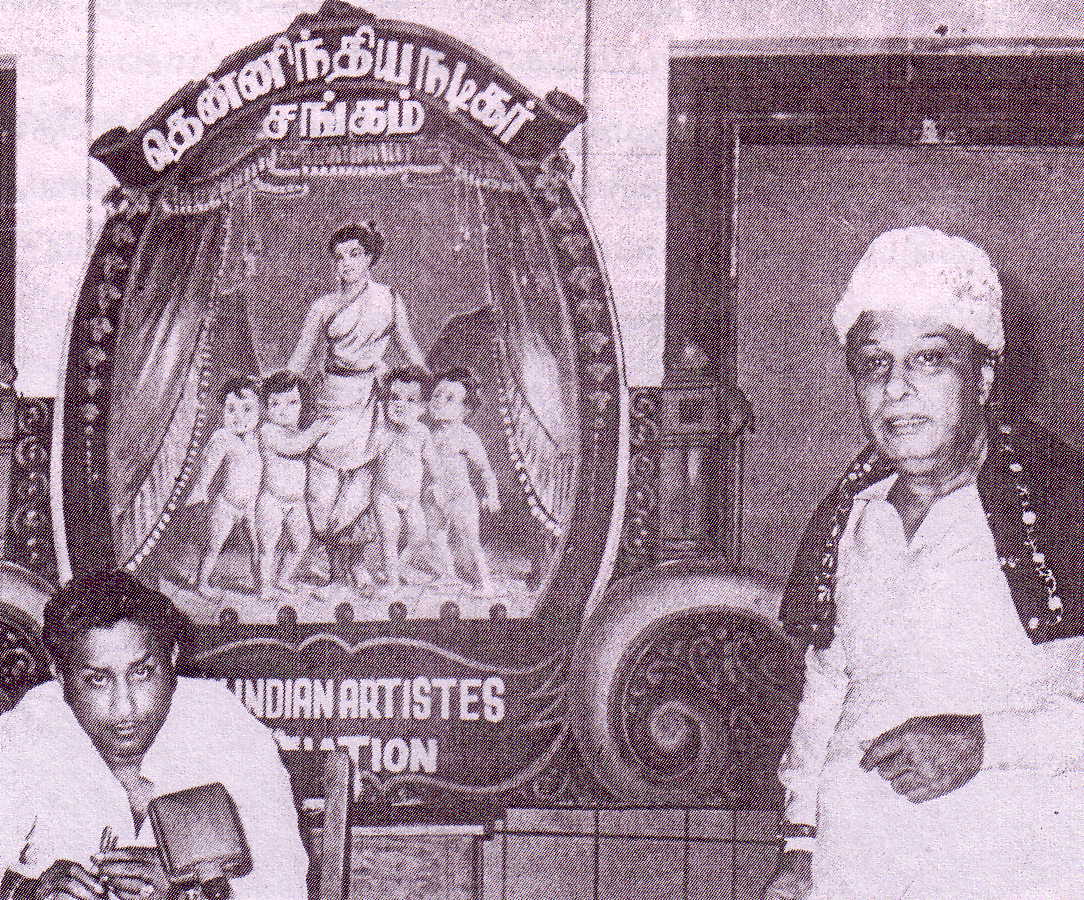
South Indian Artistes Federation logo, Sivaji Ganesan and MGR
There is no doubt that Krishnaswamy is an authentic source, because his father K. Subrahmanyan (a patron of MGR in 1940s and 1950s) was a reputed movie producer, director and speculator. As Barnow and Krishnaswamy illustrated with an example, “a star would receive a one film contract calling for payment of Rs 20,000. In actuality, he would receive Rs 50,000, but the additional Rs 30,000 would be in cash, without any written record. To the star, this extra sum, this payment ‘in black’ was of course tax-free.”
Furthermore, according to Barnouw and Krishnaswamy, an added benefit of this tax-free payment was that it also gave a ‘patriotic tinge’, because in the pre-Independent period, Indian National Congress promoted non-payment of taxes to the British Empire. What was established in the pre-Independent period of early 1940s, continued as a tax-evading tradition, after India entered the post-Independent period. Another tid-bit from Barnouw and Krishnaswamy was the fact, ‘By 1955, star salaries, in the bidding against Bombay, were rumored to have reached Rs 400,000 per film, in white and ‘black’.’
It is a mistake to belief that this sort of black money practice in India is limited to movie industry only. According to a comment by Subrata Chattopadhay, which appeared in the Indian Journal of Medical Ethics in 2008, many professors in private medical colleges in India also are paid a part of their salary (in proportions such as 75:25, 70:30 or 80:20) as black money.
To highlight the role played by black money in the Indian society, poet Kannadasan cavalierly produced a Tamil movie with a stark title, Karuppu Panam (Black Money, 1964). Typical of him, he himself played the villain Thanigasalam role in that movie. A humorous lyric Kannadasan wrote began with the lines,
‘If one has money in hands, even a donkey will be the king,
If there are folks to clap hands, even a crow will be beautiful
If one swims in the lies, the liar will become the leader’
There was some doubt among Tamil movie fans then, whether this movie was a parody of MGR’s public life per se. At that time, relationship between MGR and Kannadasan had been punctured. To deflate Kannadasan’s pride, MGR had offered patronage to a new lyricist, Vaali (birth name T.S. Rangarajan, 1931- 2013).
Roopa Swaminathan had mentioned MGR’s thoughts on black money as follows: “Once, while speaking at a rally, MGR stunned his aides when he openly admitted to talking black money! He explained that film producers generated a lot of black money and if he didn’t talk what was offered, the producers would keep it for themselves. But he took the money and gave it to the poor – a la Robin Hood. What was wrong with that? There were no answers to that question.” However, Swaminathan had failed to provide detailed reference to this comment, as to when, where and in what context MGR made this assertion. Curiously, it was the same logic that was offered by Kannadasan’s villain Thanigasalam character in his Karuppu Panam movie.
Earning a segment of one’s income in black money and tax dodging are two sides of the same coin. In India, movie stars and producers were notorious for tax dodging. Due to his rank as a popular movie hero and a ranking politician, in 1970s, MGR’s image was tarnished as a tax dodger. But, this allegation has to be balanced in proper context. MGR did have company among his Tamil, Telugu and Hindi movie peers. It was revealed in Lok Sabha on March 26, 1982, that almost 60 movie stars (men and women) had a total of Rs. 182,33 lakhs in tax arrears [ One lakh = 100,000]. The movie star who led this list at that time was actress Hema Malini with Rs. 18.11 lakhs. Rest of the movie stars, in decreasing order of tax arrears as of October 30, 1981 were as follows:
Ranbir Raj Kapoor Rs 17.34 lakhs, MGR Rs 9.27 lakhs, M.R. Radha (deceased) Rs 8.52 lakhs, Randhir Kapoor Rs 7.33 lakhs, Savitri Rs 6.93 lakhs, A. Nageswara Rao Rs 6.12 lakhs, Jamuna Rs 5.79 lakhs, Kishore Kumar Rs 5.18 lakhs, Meena Kumari (deceased) Rs 4.67 lakhs, Vijayanirmala Rs 3.98 lakhs, Sivaji Ganesan Rs 3.78 lakhs, Dev Anand Rs 2.98 lakhs, and N.T. Rama Rao Rs 2.39 lakhs.
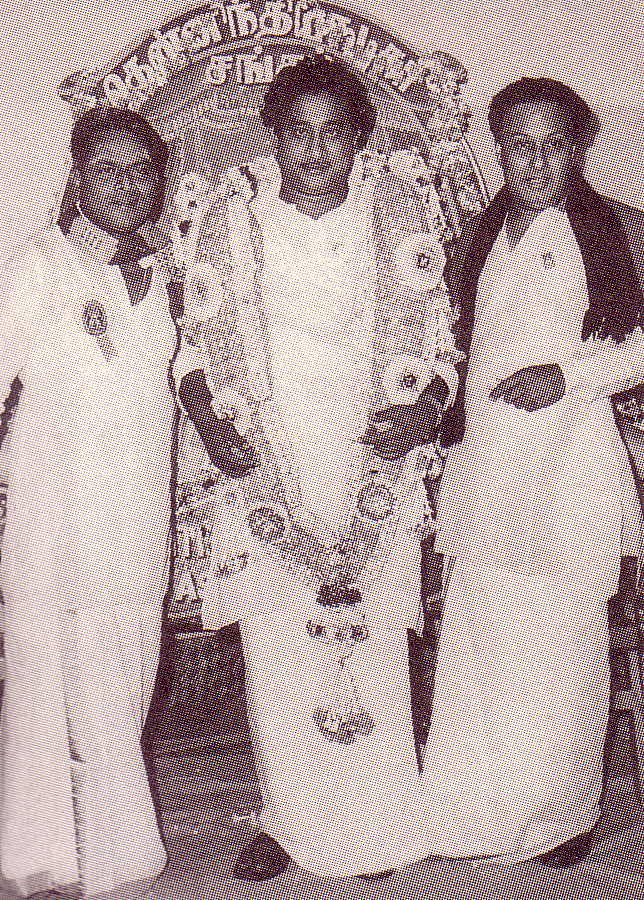
Sivaji Ganesan (with garland) flanked by K.A.Thangavelu and MGR
After he gained status as one the ranking heroes in the Tamil movies in late 1950s, how much MGR was paid (in white and ‘black’) for a movie has not been revealed by him, in his autobiography. To be fair by him, the published autobiographies/memoirs/diary notes/memos of other ranking actors (Sivaji Ganesan, Gemini Ganesan, S.S. Rajendran and Sivakumar) and actresses (Vyjayanthimala) of Tamil movies that I have checked, also don’t include the payments they received, when they were in their peaks. If there is one chronicler of Tamil movie history with insider knowledge, it should be script writer Arurdhas (birth name S. Jesudas, b. 1931). Now in his 80s, he had written 7 books in Tamil, occasionally re-cycling the same anecdotes. He should know because he had written numerous scripts for MGR, Sivaji Ganesan and Gemini Ganesan movies. Even Arurdhas, who has nearly 800 credits for script writing and dubbing, do not provide any numbers on the economics of Tamil movie production and the pay rate for actors, actresses, comedians, villains and extras.
This seems to be a bad omen for not only Indian actors, but even for the Hollywood stars. I have accumulated a collection of over 30 autobiographies and memoirs of Hollywood stars beginning from Chaplin to Michael J Fox. Even if their professional and personal lives were so open, for various reasons (tax purpose, vanity, professional pride etc.), they hardly mention the payments they earned for their hits as well as ‘bombed’ movies.
Ravindar, in his memoirs, passingly mentions that in 1965 (when his super-hit movie Enga Veetu Pillai was being produced), MGR’s payment for a film was Rs. 75,000. It was his 75th movie. According to Ravindar, until MGR reached his 100th movie in 1968, his asking rate didn’t reach Rs. 100,000. But, this rate doesn’t jibe well with the statistic offered by movie mogul A.V.M. Saravanan. In his 2005 memoir, Saravanan informs that MGR was arranged for Rs 300,000 to star in their 1966 production, Anbe Vaa [Come (My) Love], an adoption from 1961 Hollywood movie Come September, starring Rock Hudson and Gina Lollobrigida. Then MGR had a busy call sheet schedule in 1965, and as usual was committed to release one movie in January 1966 as Thai Pongal day release. But the scheduled film was a black and white production of his then manager R.M. Veerappan, under Satya Movies banner. MGR negotiated a better deal with AVM company by postponing the release of this black and white movie, and in the January 1966 slot to release the color production Anbe Vaa of AVM company. For this marginal adjustment, MGR demanded an additional payment of Rs 25,000. According to Saravanan, AVM had to end up paying Rs, 325, 000, to a slight discontent of its founder A.V. Meiyappa Chettiar.
How can one align the discrepant numbers provided by Ravindar and Saravanan for 1965? One clue could be, MGR might have been paid in the range of Rs. 75,000 – 100,000 per movie in ‘white’ and the balance sum ~ Rs. 200,000 in ‘black’ money. Now, 50 years later, considering the crore (one crore = 10,000,000) figures charged by MGR’s successors like Rajinikanth (b. 1950) and Kamal Hassan (b. 1954), MGR’s earned pay looks like peanuts! It is to the credit of MGR that even with the relatively meagre sum he earned then, he gained reputation as a philanthropist. This hardly-earned reputation, even his enemies couldn’t deny. What have prevented either Rajinikanth or Kamal Hassan to achieve such an elite status among the Tamils now?
A Pillar of South Indian [Film] Artistes’ Association in 1950s and 1960s
The South Indian Artistes Association [Then-India Nadigar Sangam, aka Nadigar Sangam, in Tamil] was a grouping formed in 1952, to protect the rights and welfare of the community involved in the South Indian movie industry. In late 1950s and early 1960s, MGR was active in this organization as the President as well as the Secretary. Not much information is forthcoming about MGR’s role in establishing this association in the previously published English biographies (Attar Chand, Mohandas, Pandian, Swaminathan and Veeravalli. (see, Parts 7 and 18). Even in his autobiography, MGR had inadvertently ignored this topic.
Why it was so? One can guess that MGR himself knew insider facts and rather than hurting the sentiments of then living artistes, he might have played it safe by ignoring outrightly. Only K. Ravindar and Vidwan Lakshmanan (MGR’s two writing assistants) had offered some meager information they were privy to. Hints recorded indicate that there was much ill-will, antagonism and rivalry among the members of this association. This pattern has not changed even in 2015. Thus, by late 1960s, MGR had relieved himself from this Association. I provide excerpts from Ravindar’s memoirs.
“Mehboob Khan (1907-1964) was a prominent producer-director of Hindi movies. He paid a visit to the Silver Jubilee celebration of Southern India Chamber of Commerce. At the reception function to Khan, MGR also participated. In a speech referring to Mehboob Khan’s past, MGR had told the fact that ‘Mehboob joined the studio as a sweeper and elevated his status step by step’. Some had criticised to such openness. But, MGR stood his ground by saying, ‘Those who hide and forget their past cannot be humans.’ Subsequently, Mehboob Khan and MGR met privately, and I was there too. The foundation stone for the Nadigar Sangam was set then.
Mehboob had expressed the opinion that the community of actors lacked protection and to promote their welfare and demands, there wasn’t even an organization. He also pleaded with MGR to make a ‘revolution’ in setting up such an organization. Ravindar had recorded further,
“Since then, MGR, music director S.M. Subbiah Naidu, director T.P. Sundaram and actor Somu worked actively to organize this Sangam. They also wished to design an appropriate logo. They settled on to the opening greeting song for a drama, penned by lyricist Muthukoothan that had a line stating, ‘Kannada, beautiful Telugu, Tulu and Malayalam’ – four of which were the progeny of Tamil mother. Artist great P. Mathavan was commissioned to create a logo based on this idea for the Sangam. Furthermore, a journal called Nadigan Kural (Voice of the Actor) was started. MGR functioned as the executive editor and Vidwan Lakshmanan worked as the sub-editor.”
In a commentary MGR contributed to the Nadigan Kural (July 1958) entitled, ‘Pitiable state of Film Industry’, he criticized the decision made by government officials in selective distribution of film rolls based on past records of producers. MGR’s view was that, ‘The status of many producers who have a track record may depreciate. Newcomers to the industry may rise to the top, when their debut movie becomes a hit. As of now, no one can predict the success and failure in this business. Therefore, it is not feasible to decide who has the capability or not. Thus, film roll distribution to producers should be well balanced.’
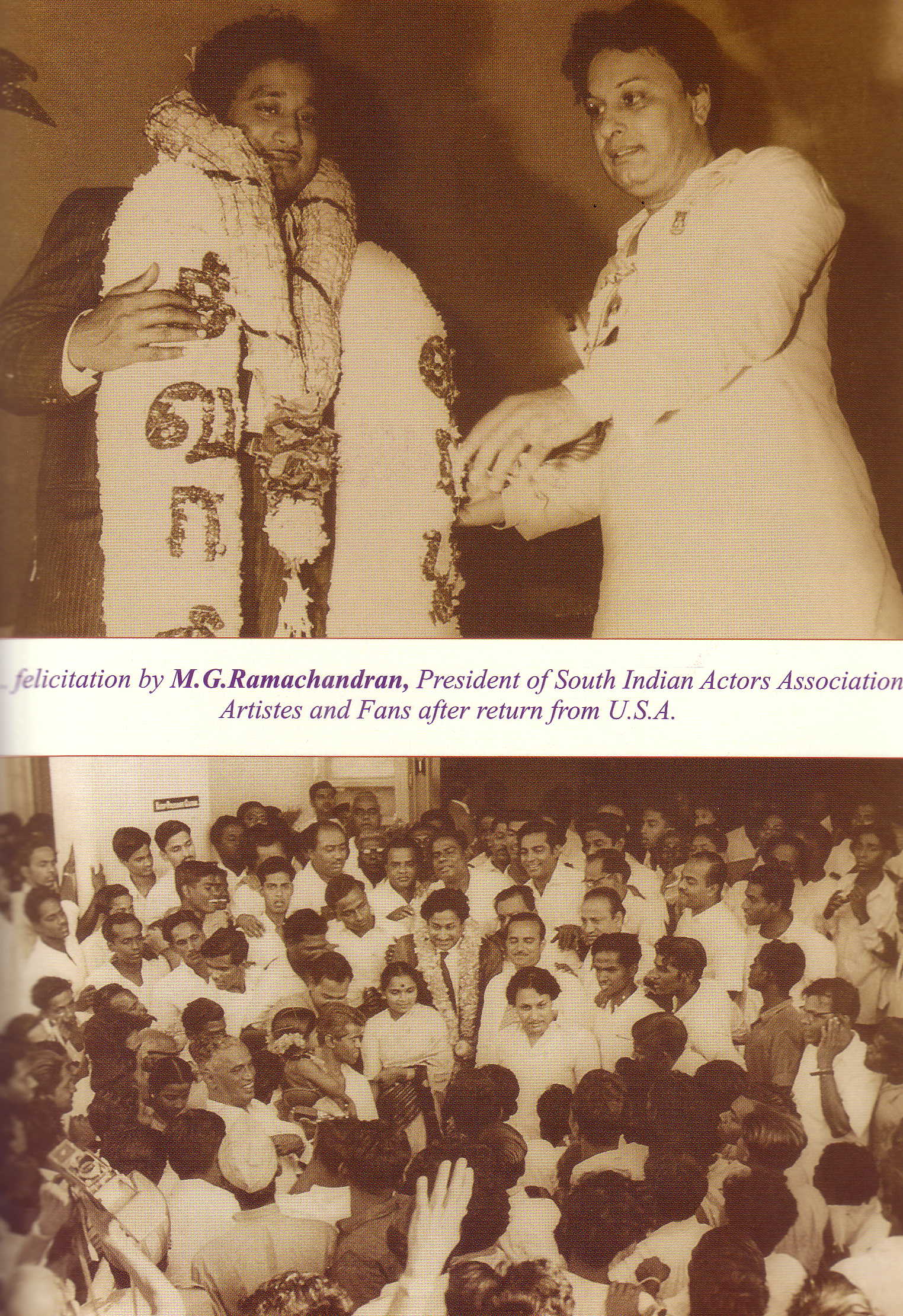
Sivaji Ganesan felicited by MGR in 1962
Furthermore, in this commentary MGR also offered few statistics on the distribution of studios and movie theaters in the South. ‘In south India, there are 72 studios. However, both in Bombay and Calcutta the total number of studios were only 99. The total number of movie theaters in India amounts to 4,000. However, south India alone has 2,026.’ These numbers tell a partial story of the success of film industry in south India of 1950s. Though risky, it had attracted much interest of entrepreneurs (akin to the Jews who had a hand in building the Hollywood in early 20th century) who had invested in studios and movie theaters. The outcome being, ten years later, a political trend originated that since 1967, four major chief ministers of Tamil Nadu (Anna, Karunanidhi, MGR and Jayalalitha) had their professional accreditation from film industry. There were two stop-gap chief ministers (V.N. Janaki and O. Pannerselvam), among whom Janaki (2nd wife of MGR) also had movie credit as a heroine.
It could be viewed that in this 1958 commentary, MGR had diplomatically used ‘south India’ (aka, Dravidian India, consisting of Tamil, Telugu, Kannada and Kerala states) to incorporate the movie industries of Telugu, Kannada and Malayalam languages. However in late 1950s, Chennai was the capital of movie production in all four languages, as the number of studios then active in Hyderabad, Bangalore and Trivandrum were relatively few. Majority of the movie producers, actors and technicians also had Chennai as their main base.
Vidwan Lakshmanan had written in his short biography of MGR, that though MGR belonged to DMK party, he functioned impartially to the needs and requests of the film community, even when the requests came from the Congress Party (then in power). In 1957, when the centenary celebrations of the Indian freedom movement was held, MGR was serving as the secretary of the Nadigar Sangam. A request was made by the Congress Party to produce three short dramas for the function, and MGR supervised and directed three such short dramas, depicting the lives of freedom fighters Thirupoor Kumaran, Muthu Vadivu and Veerar Chidamparanar. Among these three, Muthu Vadivu was a heroine and MGR solicited the script-writing help of Lakshmanan.
In addition to this, in 1962, when Sivaji Ganesan was chosen as a cultural ambassador by the American government for a three months visit, MGR then functioning as the President of the Nadigar Sangam, organized a send-off as well as welcome celebratory functions on behalf of the film community, despite the fact that Sivaji Ganesan had shifted his alliance to the Tamil National Party of E.V.K. Sampath and Congress Party.
MGR’s sincerity and dedication to the growth of Nadigar Sangam and welfare of his fellow peers, even after he became the Chief Minister of Tamil Nadu in late1970s, has been attested by Sivaji Ganesan himself. In his autobiography, Ganesan had reminisced as follows:
“Sri M.G. Ramachandran was the chief minister at that time. There was contemplation on whom to appoint as the President of the Association. Anna MGR advised the future members to request me to head the Association. ‘He is the only one who will take up the responsibility in a perfect manner. Sivaji is bound to refuse at first, but do not accept his refusal!’ said anna MGR. As per his advice, many people invited me and entreated me to head the Association. I relented only upon their insistence, and because my elder brother MGR wished me to take up the post.”
A critical version of MGR’s deeds as the chief functionary of Nadigar Sangam in 1960s had been presented by Karunanidhi in 1975. When this was written, MGR and Karunanidhi had become rivals in politics. Writing a chapter of his autobiography, with a non-sexual double entendre meaning as a title, ‘Nanayam Keddathu’ (Depreciation of Currency, or Bad Decorum) Karunanidhi pique on MGR was as follows: The regional DMK conference was scheduled to be held in Tiruchi-Tanjavur district on June 14-15, 1966. While he was planning to attend this conference, MGR’s deeds in supporting the candidacy of comedian Kaka Radhakrishnan (sponsored by the opposing parties) for the Presidential election of the Nadigar Sangam against his DMK party pal S.S. Rajendran (SSR) the same position, couldn’t allow Karunanidhi to participate in the Tiruchi conference.
Karunanidhi had written that he resented MGR’s campaign for Radhakrishnan over-riding decorum and party discipline. He did complain about MGR’s behavior to party leader Annadurai. As the outcome of that particular election turned in favor of SSR, Anna was disinterested in Karunanidhi’s complaint for the simple reason that the affair was merely a storm in a tea cup.
How can one interpret MGR’s behavior in this 1966 Presidential election for the Nadigar sangam? Why he preferred Kaka Radhakrishnan as opposed to SSR? Did he distrust the capabilities of SSR? The same SSR himself magnanimously, had failed to mention this particular election episode in his autobiography published last year. I had reviewed this book early this year [see, http://sangam.org/autobiography-actor-politician-s-s-rajendran/]. First, it may be implied that it might have been the intention of MGR to accommodate artistes belonging to all political parties, and not offer special privilege to DMK party members in the movie industry. But, Karunanidhi was not in favor in such open mindedness. Secondly, from MGR’s perspectives, both Kaka Radhakrishnan and SSR were his pals from stage-drama days, and MGR came to be acquainted with Radhakrishnan earlier than SSR. This was attested by Sivaji Ganesan in his autobiography. Thus, it might have been a matter of choice of heart rather than any indulgence of politics.
Cited Sources
Anon: Hema Malini tops in income-tax arrears. The Hindu (Madras), March 27, 1982, p.6.
Arurdoss. Cinema Nijamum Nizhalum, Arunthathi Nilayam, Chennai, 2001. (in Tamil)
Arurdhas. Naan Mugam Paartha Cinema Kannadigal, Kalaignan Pathippagam, Chennai, 2002. (in Tamil)
Arurdoss. Kottaiyum Kodambakkamum, Vikatan Pirasuram, Chennai, 2006 (in Tamil)
Arurdhas. Cinema Kalai KaLanchiyam, Manivasagar Pathippagam, Chennai, 2011 (in Tamil)
Arurdhas. MGR-Sivaji; En Iru Kangal, Manivasagar Pathippagam, Chennai, 2011 (in Tamil)
Arurdhas. Kodambakkathil Arupathu Aandukal, Manivasagar Pathippagam, Chennai, 2011 (in Tamil)
Arurdhas. Sivaji Venra Cinema Rajyam, Manivasagar Pathippagam, Chennai, 2012 (in Tamil)
Vyjayanthimala Bali: Bonding…A Memoir, Stella Publishers Ltd, New Delhi, 2007.
Eric Barnouw and S. Krishnaswamy: Indian Film, 2nd edition, Oxford University Press, New York, 1980, pp. 127-129, 143, 169, 177, 284.
Subrata Chattopadhyay: Black money in white coats: whither medical ethics? Indian Journal of Medical Ethics, 2008; 5(1): 20-21.
Narayani Ganesh: Eternal Romantic My Father Gemini Ganesan, Roli Books Ltd., New Delhi, 2011.
- Kirubakaran: Naan Aanaiyittaal… [Collection of MGR’s writings], Vikatan Pirasuram, 2nd ed., 2014, pp. 24-26. (in Tamil)
- Lakshmanan: Makkal Thilagam MGR, Vanathi Pathipagam, Chennai, 4th ed., 2002, pp. 13-15. (in Tamil)
T.S. Narayana Swamy: Autobiography of an Actor Sivaji Ganesan, English version, Sabita Radhakrishna, Sivaji Prabhu Charities Trust, Chennai, 2007, p. 214.
S.S. Rajendran: Nan Vantha Pathai, Akani Veliyeedu, Vandavasi, 2014 (in Tamil).
- Ravindar: Pon Mana Chemmal MGR, Vijaya Publications, Chennai, 2009, pp. 39-41. (in Tamil)
- Saravanan: AVM60- Cinema, Rarajan Pathipagam, Chennai, 2005, pp. 159-179. (in Tamil)
Sivakumar: Diary 1946-1975, Alliance Co, Chennai, 6th ed., 2012. (in Tamil)
Roopa Swaminathan: M. G. Ramachandran – Jewel of the Masses, Rupa & Co, New Delhi, 2002.
MGR Remembered – Part 30
Personality, Character and Regular Routine
by Sachi Sri Kantha, September 21, 2015
Kannan’s comment and My response
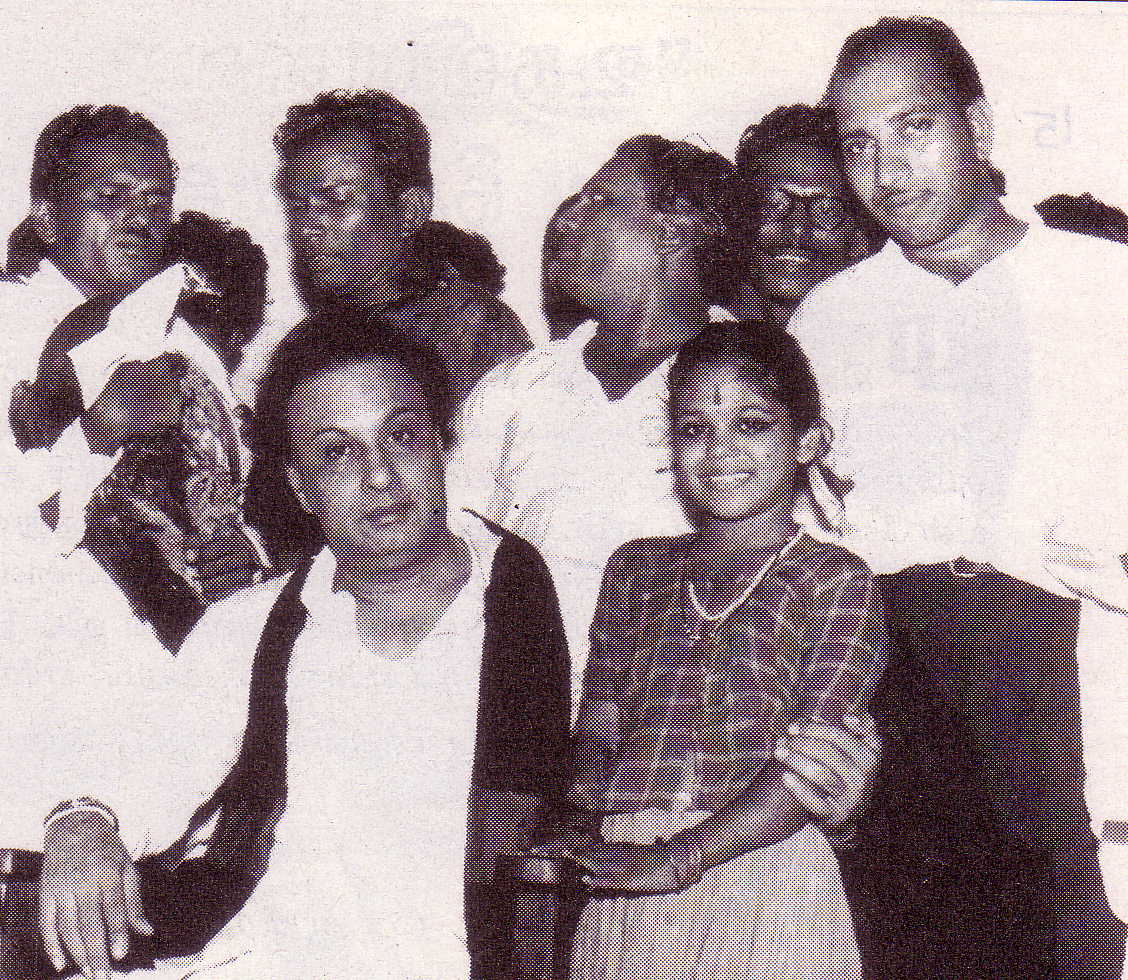
MGR (seated) with his ‘double’ K.P Ramakrishnan (rt) – circa 1960s
A critical comment received from my friend R. Kannan, on Aug. 19 (after reading Part 29), was as follows:
Sachi, very well researched, as always. I greatly benefit from your hard and committed work. My feeling is that NSK [comedian N.S. Krishnan] was the one who was behind the idea of Nadigar Sangam. I have been trying to get some more info albeit unsuccessfully so far. Also my recollection is that Sivaji Ganesan was never allied with [E.V.K.] Sampath. He may have been sympathetic to them. On black money and MGR’s earnings there are two sources; one is his weekly responses in Dinamani in the ’70s and the second is the Murasoli digital archives which I would encourage you to access. MGR’s statement and cross examination at [M.R.] Radha’s trial [held in 1967, after the shooting incident at MGR’s residence] are there and it is my recollection he reveals his earnings.”
My response, sent the following day was as follows:
“Kannan, Thanks for your thoughtful comments. I appreciate them very much. I’d like to place them at the beginning of my next chapter, with your permission.
I’m clueless about your fact that NSK was behind the formation of Nadigar Sangam. You indeed may be correct. About, NSK’s life, there are many mysteries which haven’t come out openly. I’m curious to know about when did he become an alcoholic, after he actively promoted anti-alcohol campaign in his songs? Was it, after his release from jail?
I’m clueless about your fact that NSK was behind the formation of Nadigar Sangam. You indeed may be correct. About, NSK’s life, there are many mysteries which haven’t come out openly. I’m curious to know about when did he become an alcoholic, after he actively promoted anti-alcohol campaign in his songs? Was it, after his release from jail?
I remember you did write earlier as well that Sivaji Ganesan was not allied with Sampath. You may be correct here too. But, I have depended on Hardgrave’s ‘Pacific Affairs’ 1964-65 paper on, ‘The DMK and the Politics of Tamil Nationalism’, in which he has a sentence which reads, ‘Shivaji Ganesan extended his support to Sampath’s Tamil Nationalist
Party but warned, ‘Artists keep away from politics.’ His cited original references for this quote are to ‘Economic Weekly‘, Sept.24, 1961.
Party but warned, ‘Artists keep away from politics.’ His cited original references for this quote are to ‘Economic Weekly‘, Sept.24, 1961.
Cho Ramaswamy ‘Lucky Experiences’ book cover
Hardgrave also REPEATS the same information in his ‘Asian Survey’ Mar. 1973 paper ‘Politics and the Film in Tamil Nadu: the stars and the DMK’. I find this article the best and very informative, because he had interviewed many film personalities including MGR, Sivaji Ganesan, SSR, M.R.Radha (in Madras Center Jail!), Panju of Krishnan-Panju duo, Murasoli Maran.
Thanks for letting me know about Murasoli’s digital archives. As of now, I have never bothered to check it. I did get MGR’s testimony from Malai Malar net versions, published between May 31 2012 and June 15 2012 from the shooting Case. While checking it yesterday, I found a contradiction, and it was illuminating to the issue I had covered in this part (part 29).
During cross examination, MGR had answered that for acting in ‘Anbe Vaa’ movie, he had received, Rs.150,000! This should be the ‘white money’ payment. This was in 1967. Then, A.V.M. Saravanan had stated in his 2005 memoir, that they had to pay Rs 300,000 plus 25,000 for the same movie. Thus, this makes one infer that Rs. 175, 000 was ‘black money’ payment.”
Further on White Money and Black Money Earnings
I wish to add a paragraph from Robert Hardgrave’s 1975 essay, which was inadvertently missed in part 29. According to Hardgrave,
“MGR is today the highest paid star in South India, and while there are Hindi stars who may be paid more for a single picture, MGR – because of the large number released each year – has topped all Indian film artists in annual income and paid an income tax of nearly 7 lakhs [Rs. 700,000] on his reported earnings. The amount he receives per picture varies, but he is rumored to get about six lakhs [Rs. 600,000] for a film – most of it ‘black’. Shivaji [Ganesan] who reportedly receives two to three lakhs [Rs. 200,000 – 300,000] per film, has made wise investments and has substantial properties. MGR, however, has been less careful. One associate believes that the DMK has been a financial drain on him. ‘The white money is taken away by taxes; the black money by the party’. A considerable portion as well goes to fulfil his philanthropic image, an investment in his continued popularity and following among the masses.”
Personality, Character and Regular Routine
As of now, I haven’t described what sort of a person MGR was in his real life. For this information, we have to rely on what is recorded by his assorted helpers, after his death. ‘No man is a hero to his valet’ is an adage in English. But, with a notable exception (like R.M. Veerappan, MGR’s manager of Satya Studio and later a Cabinet colleague), MGR’s personality and character were adored by his valets.
K.P. Ramakrishnan (b. ~1930) functioned as a personal body guard, ‘dupe’ actor in stunt scenes since Nadodi Mannan (1958) movie for MGR for nearly 30 years. He had serialized his reminiscences in Thina Malar journal. I summarize below Ramakrishnan’s as well as Ravindar’s (one of MGR’s writing assistants, who joined MGR’s drama troupe in 1954) records on MGR’s personality, character and regular routine from 1950s to 1977, until he shifted his career from an actor to full time politician. Ramakrishnan is of Kerala origin, but long settled in Tamil Nadu.
MGR gets up regularly by 4 am. First item for the day was his body building exercises in his mini-gym. Then, he drinks a cup of ovaltine (malted milk) and takes rest for an hour. Around 8 am, he takes his breakfast, consisting of South Indian foods idli or thosai with mutton korma (marinated mutton). After breakfast, he prays for a while in front of his mother’s framed photo. By 10 am, he drinks Sathukudi fruit (sweet lime, Citrus limetta) juice. It was his conviction that Sathukudi juice cleanse his blood and reduces body heat. By 1 pm, he eats lunch. If a shooting is scheduled, then he shares his lunch with fellow artistes and technicians with at least 20 folks. Non-vegetarian items like mackerel fish and chicken fry were his favorites. Only on Fridays, MGR limits his meal to vegetarian items. Then, he rests in chair for two hours, before commencement of shooting. His dinner at home consists of idli, idi-appam, sambar with vegetables like tomato. Before retiring to bed, he eats two bananas and drink a cup of ovaltine.
While recuperating at a hospital bed in Brooklyn, New York, following his life-threatening stroke and kidney complications, MGR had given some health advice to Sivaji Ganesan’s wife Kamala to protect her husband. According to Ganesan’s recollections, “He [MGR] had said to Kamala, ‘This boy is as short tempered as I am. Do not make him angry. He has a weakness for good food. Do not add too much salt in his diet. To tell you the truth, I also love aapam and salt fish curry as much as he does. Do not give it to him very often. My health has suffered because I ate too much such food.’ ”
MGR was a strict teetotaler, and also refrained from smoking cigarette and chewing betel. Though he tolerated cigarette smoking (comedian Nagesh) and alcohol use (M.R. Radha, lyricists Kannadasan and Vaali for example) among his fellow actors to a degree, he would insist to his junior contemporaries that these unhealthy traits were not to his liking.
MGR also would hardly tolerate behavioral disrespect to seniors, such as crossing one’s leg while seated, or not standing up when a senior passes by. To the best of his ability, protecting his fellow colleagues in movie industry or those who are less fortunate, from hunger was MGR’s passion.
While traveling in car, MGR preferred to listen to Karnatic Music songs of M.K. Thyagarajah Bhagavathar, nagaswaram instrumental music. When he fiddles with his nose infrequently, it may indicate that he was in anger or irritated with something. At his home, he had set up movie projection facilities and enjoyed watching the ‘rushes’ of his shooting scenes as well as other quality movies in the company of his helpers.
MGR was also a ‘moody’ person. He disliked his helpers describing events of the day in ‘beating around the bush’ style. He wanted the messages to be delivered crisply and in easily understood style. There was another condition too. Apt timing to report events was essential. Only what was needed at that particular moment should be delivered. The rest should be told, only when MGR asked about it. When he became angry, MGR would hit his helpers. Then, after his temper had cooled, MGR would offer money to compensate the victim’s wounded feeling. Ravindar had noted that Ramakrishnan was the one who benefitted most by MGR’s short temper. MGR was also keen that his ‘designated’ helpers (quite a range – such as managers, writers, account clerks, cooks, drivers, body guards, gardeners, massagers) should do only the task they were assigned to perform, and not any tasks interchangeably.
MGR was a risk taker par excellence. Kondath Mohandas, who functioned as MGR’s bogey man’ and ‘trouble shooter’ in the last 10 years of the actor’s life as the Chief Minister of Tamil Nadu, had observed in his memoir that when warned about the risks involved in supporting the Liberation Tigers of Tamil Eelam (LTTE) led by V. Prabhakaran and antagonizing the Indian officialdom in New Delhi, MGR had retorted that, ‘Life is not worth living without risk taken.’
On the character traits of risk takers, risk averse folks and risk neutral people, Robert Charette had offered the following distinction. “Value judgments and psychology highly influence a person’s behavior in the face of a perceived risk. Some people are risk takers; others are risk averse; and still others are risk neutral. Risk-averse people are those who will only take a risk if the odds are favorable, whereas risk-neutral people will take a risk if the odds are favorable, but will continue to take the risk as long as it yields a profit on average, even after a string of losses. Risk takers are those who are willing to accept situations possessing less than favorable odds. To risk-averse individuals, risk connotes something negative, whereas to risk takers, risk is (always) heard as the siren song of opportunity.”
It is a reality that, if not for this risk taking trait of MGR (during 1984 and 1987), LTTE would have wilted prematurely in 1980s itself.
About the story for a movie plot, MGR’s conviction was, “A story is like a child. It should be brought forth by one individual only. What is produced by combined thoughts of four individuals cannot be a good story.”
Views of MGR’s illustrious contemporaries on rapport with the audience
MGR’s movies had been roasted by Tamil movie critics for (1) their stereotype, two dimensional portrayal of hero characterization, and (2) pampering the illiterate Tamil masses by fist fights. To illustrate, how wrong were MGR’s movie critics among Tamil speakers (such as K. Sivathamby and M.S.S. Pandian) and elsewhere, in evaluating his movie roles, I cite the views of his three illustrious contemporaries.
 The one and only Laurence Olivier (1907-1989), renowned stage and movie actor, in his book ‘On Acting’ (1986) had offered the following advice. “Never underestimate the audience, never patronize them, because, if you do, they will know. They are far more intelligent than you may think. They pay your bills and fill your stomach. Without them you are in an empty room again with a bare cupboard. You must always treat them with respect, be they one or a thousand.” One would presume that MGR also had the same sentiments about his audience, as that of Olivier.
Marlon Brando (1924-2004) also had re-formatted the similar thoughts in his autobiography ‘Songs My Mother Taught Me’. He had said, “People often say that an actor ‘plays’ a character well, but that’s an amateurish notion. Developing a characterization is not merely a matter of putting on makeup and a costume and stuffing Kleenex in your mouth. That’s what actors used to do, and then called it a characterization. In acting everything comes out of what you are or some aspect of who you are. [Note by Sachi: words in italics, as in original.] Everything is a part of your experience. We all have a spectrum of emotions in us. It is a broad one, and it’s the actor’s job to reach into this assortment of emotion and experience the ones that are appropriate for his character and the story.”
I also cite the opinion of eminent Japanese director Akira Kurosawa (1910-1998) on the snobbish movie critics. He had opined to his interviewer, “Critics may be affecting today’s audience negatively; they see films here [pointing to his head.] No! I want to tell them to see films here [pointing to his heart.] because I make films thinking that way. I do not want them to try to reason everything. The people who pay to see films will see a film as it is. Furthermore, I do not believe that film is simplistic, but multifaceted. Ideally, a film should be spherical. This is physically impossible; however, it is possible to approach such a shape. A film should appeal to sophisticated, profound-thinking people, while at the same time entertaining simplistic people. Even if a small circle of people enjoy a film, it will not do. A film should satisfy a wide range of people, all the people.”
Listless critics of MGR Movies
The problem with listless critics of MGR’s movies, was that they were totally ignorant about movie making in other cultures and writings of movie maestros. A flawed critic M.S. S. Pandian (1957 – 2014) from socialist school, whose extended essay, ‘The Image Trap: M.G. Ramachandran in Film and Politics’ (1992) is still cited as a holy grail of anti-Dravidian literature, has the following lines:
“MGR’s screen roles comprised several stereotypical characters, all of which constituted the MGR. A characteristic MGR role was that of a working man attempting to combat everyday oppression. Thus, he had acted as a peasant, fisherman, rickshaw-puller, carter, gardener, taxi driver, quarry worker, circus artiste, shoe-shine boy, cowherd etc. In fact, many successful MGR films get their titles from these occupational groups of subaltern classes: Thozhilali (Worker, 1964), Vivasayee (Peasant, 1967), Padakotti (Boatman, 1964), Mattukara Velan (Cowherd Velan, 1970). Rickshawkaran (Rickshaw puller, 1971) and Meenava Nanban (Fishermen’s Friend, 1977).”
I picked these four lines, because four of the movies cited by Pandian were released between 1964 and 1970. All relates to the travails faced by the majority of post-independent Indian populace. Pandian had erred in identifying only the screen roles of MGR as ‘stereotypical characters’. If so, the roles portrayed by MGR’s contemporaries such as Chaplin, John Wayne, Clint Eastwood and Toshiro Mifune (to name only a few actors) also belong to the same category.
Akira Kurosawa (1910-1998)
Pandian also describes the use of food, in many MGR’s movies as ‘employing a carefully constructed system of mise en scene’. The French expression, simply means, ‘placing on stage’, i.e., visual theme. Pandian’s gripe was that, in all the frames, MGR plays to the balcony, by characterizing an illiterate village bumpkin. So what? One may ask, as MGR (like Chaplin) had experienced humiliating poverty in his early life (and he was not faking it!), and majority of the movie going public in India could identify themselves with such a precarious life, what is wrong in characterizing such life in numerous movies?
This is what, the inimitable Chaplin pointed out in doubting the authenticity of Shakespeare’s authorship of his plays. Chaplin wrote, “In the work of the greatest of geniuses humble beginnings will reveal themselves somewhere – but one cannot trace the slightest sign of them in Shakespeare….I am not concerned with who wrote the works of Shakespeare, whether Bacon, Southampton or Richmond, but I can hardly think it was the Stratford boy.” Another of Chaplin’s vital thought was, “The so-called realism [in movies] is often artificial, phoney, prosaic and dull; and that is not reality that matters in a film but what the imagination can make of it.” Pandian’s book (1992) provides a bibliography listing 115 items. But, excluded in them were the works of Chaplin and Olivier!
In another page, without any context, Pandian had presented a particular point made by fellow actor, comedian and political critic Cho Ramaswamy’s, following MGR’s death in Dec 1987. It was as follows: “According to Cho Ramaswamy, a co-actor of MGR in a number of films, ‘All the fights in his [MGR’s] films were personally shot and edited by him’.” [Cho Ramaswamy, ‘MGR: Triumph of will’, Indian Express, Dec. 26, 1987] So what? Fifteen years later, the same Cho himself, had published his expert’s opinion on MGR’s multi-faceted talent in movie making in 2007. I provide the translation below.
“What I have observed in the cinema world was another special distinction MGR had. He was well versed with all aspects of movie making. There is no doubt that he did possess all the qualities and attributes of a good director. I have heard that he’s an expert in shooting fighting scenes. On occasions, when some films had title credit, ‘direction – MGR’, I have heard that some mention that ‘he had used someone else’s direction and placed his name for vanity.’ This is nothing but nonsense. To go further, even if some director’s name is mentioned, it was MGR who would have directed many frames. This was the reality.
“In the movie world, there is a common impression about difficulties with MGR. The charge was that, due to his indifference in handling call sheets, many producers are faced with numerous difficulties. Those who had produced movies with MGR had complained the same to me, when those movies were in production. One producer griped, ‘Enough of this problem.’ Another producer, even spoke worse than this. I had to pacify another producer who was so upset. All these guys, subsequently produced their next movies with MGR too.
“The reality was that, whatever difficulties were faced by MGR movies during production, at the end, producers could reap few 100,000 rupees profit. Compared to making movies with other actors, it is not so easy to produce a MGR movie. But, the bottom line is, making a movie with MGR is profitable compared to making a movie with other actors.
“Philanthropy of MGR is well known to all. Some do say, ‘He does this to reduce his load in paying income tax, or for publicity.’ Even if this was so, one should think how many of us have the heart to provide such service to the less fortunate. Furthermore, much had benefitted from MGR’s assistance in time, done without any publicity. Those who had received such help, had told me openly. There isn’t anything which can be compared, when such help is done in times of need. That MGR had offered his help to many in such occasions cannot be refuted at all.”
Pandian’s another pet peeve was that MGR had been deified by illiterate Tamil masses. He had written, “Deification of human beings is a generalized religio-cultural practice in Tamilnadu, particularly among the non-Brahmin caste groups. People deify the good, the troublesome and the heroic.” But, he hardly offers any comparison to deification practiced in Communist circles, like the tombs of Lenin and Mao Ze Dong in Russia and China respectively.
Cited Sources
Marlon Brando: Songs My Mother Taught Me, Century, London, 1994.
Bert Cardullo (ed): Akira Kurosawa Interviews, University Press of Mississippi, Jackson, 2008.
Charles Chaplin: My Autobiography, Penguin Books, Harmondsworth, Middlesex, 1966.
Robert N. Charette: Managing the risks in information systems and technology. Advances in Computers, 1997; 44: 1-58.
Robert L. Hardgrave Jr: When Stars displace the Gods: The Folk Culture of Cinema in Tamil Nadu, Essays in the Political Sociology of South India, Usha Publishers, New Delhi, 1979, pp. 92-124. [Originally appeared, as Occasional Papers No. 3, Center for Asian Studies, University of Texas at Austin, 1975].
- Mohandas: MGR: The Man and the Myth, Panther Publishers, Bangalore, 1992.
Laurence Olivier: On Acting, Hodder and Stoughton Paperbacks, London, 1986.
M.S.S. Pandian: The Image Trap: M.G. Ramachandran in film and politics, SAGE Publications, New Delhi, 1992.
Malathi Rangarajan: Double impact (reminiscences of K.P. Ramakrishnan, MGR’s ‘double’ and personal bodyguard). The Hindu (Chennai), June 8, 2013.
K.P. Ramakrishnan: MGR Oru Sagaaptham [MGR, An Epoch], Vikatan Pirasuram, Chennai, 8th ed. (originally published in 2007), 2013. (in Tamil).
Cho [Ramaswamy]: Athirshtam thantha Anupavankal [Lucky Experiences], 3rd ed., Alliance Company, Chennai, 2008. (in Tamil)
- Ravindar: Pon Mana Chemmal MGR [Golden Hearted MGR], Vijaya Publications, Chennai, 2009, pp. 39-41. (in Tamil)
- Saravanan: AVM60- Cinema, Rajarajan Pathipagam, Chennai, 2005, pp. 159-179. (in Tamil)
Sivaji Ganesan: Autobiography of an Actor, English version by Sabita Radhakrishna, Sivaji Prabhu Charities Trust, Cehnnai, 2007, p. 223.
MGR Remembered – Part 31
Directors and a Superstition
by Sachi Sri Kantha, October 29, 2015
Comments and Questions from a Correspondent
I was alerted by the sangam web editor about a few questions posted in French text by a correspondent from France. Here were the comment and questions of Ferdinand O. Lacour. The editor had translated the text into English.
Comment: Monsieur,Votre sujet sur MGR est une mine d’informations que je parcours assez régulièrement…Merci pour ces précieux renseignements ! [Your subject of MGR is a mine of information that I read regularly, Thank you for this precious information!]
Question (1) — Monsieur,Peut-être que vous pourriez me répondre à la question suivante :
Le film de MGR, Dheiva Thaai, 1964 de P.Madhavan, (sur une idée originale de Nanabhai Bhatt), proviendrait d’un film hindi, du même Nanabhai Bhatt ?. Je recherche le titre de ce film. Connaîtriez-vous par hasard, la réponse ? [Did the MGR film Dheiva Thaai 1964 de P. Madhavan (from an original idea of Nanabhai Bhatt) come from a Hindi film, from the same Nanbhai Bhatt? I am looking for the title of the film. Do you know it by chance?]
Le film de MGR, Dheiva Thaai, 1964 de P.Madhavan, (sur une idée originale de Nanabhai Bhatt), proviendrait d’un film hindi, du même Nanabhai Bhatt ?. Je recherche le titre de ce film. Connaîtriez-vous par hasard, la réponse ? [Did the MGR film Dheiva Thaai 1964 de P. Madhavan (from an original idea of Nanabhai Bhatt) come from a Hindi film, from the same Nanbhai Bhatt? I am looking for the title of the film. Do you know it by chance?]
Question (2) — Monsieur,Une autre question, l’histoire que MGR rédigea pour le scénario de son film Kanavan (1968) de Pa.Neelakandhan, lui fut inspiré par un roman russe, je cherche également le titre. Le connaissez- vous ? Merci d’avance pour votre réponse ! [Another question, the history that MGR wrote for the screenplay for his film Kanavan 1968 of Pa. Neelakandhan was inspired by a Russian novel for which I am seaching for the title. Do you know it?]
Question (3) — Bonjour ou bonsoir Monsieur,Auriez-vous une photo de l’acteur M.K.Mustapha ?Monsieur, merci d’avance ! [Do you have a photo of the actor M.K. Mustapha?]
Thank you for your interest in this MGR Remembered series. As per question 1, I’m not aware of this information. If you are interested, I can suggest why not check with the producer of the movie and then MGR’s writing assistant R.M. Veerappan (b.1926). He is still living. He should know! As per question 2, again I cannot offer a definitive answer. But, the plot appears an ‘Indianized (or Tamilized) version Shakespeare’s play ‘The Taming of the Shrew’ (1590). If the Kanavan movie plot was inspired by a Russian novel, one may infer that this Russian novel couldn’t have preceded Shakespeare’s play. As per question 3, I have presented a photo in Part 13 of this series, captioned ‘MGR drama troupe members (circa mid 1950). I reproduce the same here as well. It was from K. Ravindar’s book, ‘PonMana Chemmal MGR’ (2009). In this photo, among those seated in the chair (second row), M.K. Mustapha is third from left, MGR is fifth from left, MGR’s elder brother M.G.Chakrapani is sixth from left, Ravindar is eighth from left and R.M.Veerappan is nineth from left. M.K. Mustapha had acted in a few MGR movies, Thirudathe (1961), Madapura (1962) and Parisu (1963).
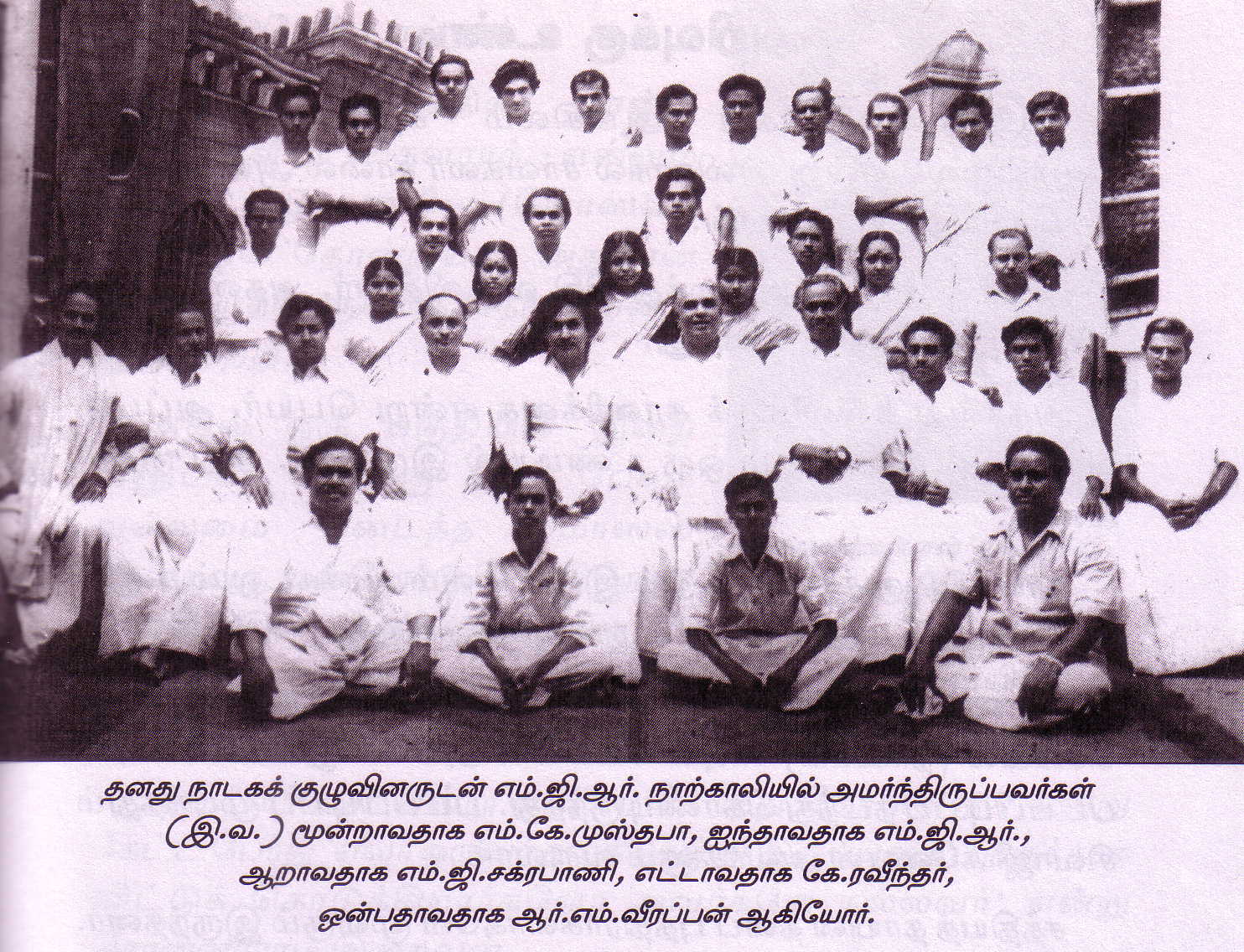
MGR Drama Troupe Members circa 1950s
Other than Ferdinand Lacour, I appreciate the comment made by correspondent Arul as well.
Unauthorized Blatant Plagiarism of this ‘MGR Remembered’ Series
While searching for some information on actor M.K. Mustapha, I accidentally stumbled onto a site www.tamilnavarasam.com/Books/Others/M.G.R.PDF which had plagiarized this series without any acknowledgment or attribution either to Sachi Sri Kantha or to the Tamil sangam website, in which this series had continued to appear since Dec 2012. The PDF version of this site contains 314 pages, among which only the first 13 pages are in Tamil. The remaining content is simply copy and paste material lifted from my series, with deliberate deletion of the contributor’s name! Each of the PDF page at the bottom has a handle name carries a handle name Ranga Rakes (at left) and tamilnavarasam.com (at right)! I checked the 300-odd pages, where my name appears inadvertently, due to carelessness of the plagiarist. It does, in pages 130 and 240.
I have seen quite a number of my writings re-posted with due acknowledgment to the author and the sangam website. But, this sort of plagiarism chicanery by Ranga Rakes deserves strong condemnation. What I find further distressing is that, in almost every chapter I have included a list of cited sources, to indicate that I have taken care to do research on writing this MGR biography. This list distinguishes my biography from that of other popular MGR biographies published in Tamil, without any proper citations. In the plagiarized version which have been assembled by this plagiarist, the cited sources have been deliberately omitted.
I feel a little sad about writing this, because it appears the individual who had done this is none other than an MGR fan. If this individual is indeed a sincere fan of MGR, then respecting MGR’s warning about stealing in his classic movie ‘Thirudathe’ becomes a necessity for such individuals. Penned by lyricist Pattukottai Kalyanasundaram and sung by T.M. Soundararajan, MGR advised the wrong doers as follows:
‘Thirudathe – Paapaa thirudathe. [Do not steal – Boy, do not steal]
Varumai ninanithu payanthu vidathe [Do not fear being poor]
Thiramai irukku maranthuvidathe’. [Do not forget that you have talent.]
Sinthithu paarthu seihaiyai maathu [Think for a while and change your habit]
Sirusai irukkayil thiruthikko [Its better to change when the fault is small]
Therinjum theriyaama nadanthiruntha [If it has happened inadvertently]
Athu thirumbabum varaama paarthukko [Make sure it will not be repeated]
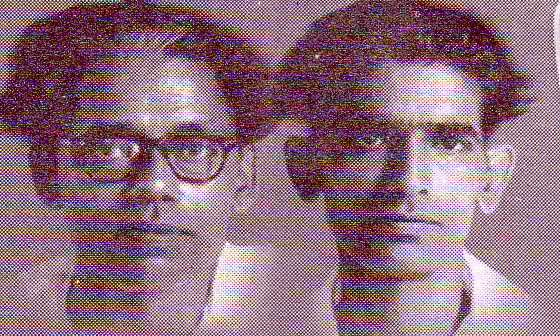
Directors Krishnan – Panju duo
Directors in creating the MGR ‘Persona’ since 1950
Among the 133 Tamil movies MGR acted, he had to act in minor and subsidiary roles in his first 20 (from 1936 to 1949, excluding his 1947 debut as a hero in Rajakumari) movies. Thus, only from 1950, his status was raised to the hero status. Of the remaining 113 movies, MGR acted as a hero, seven directors (including Krishnan – Panju duo) listed below played a prominent role in creating and sustaining the MGR ‘persona’ for the Tamil screen. 60 (53%) out of 113 movies were directed by these directors.
Neelakantan (17)
Chakravarthy Thirumagal (1957), Nallavan Vazhvan (1961), Thirudathe (1961),
Koduthu Vaithaval (1963), Kavalkaran (1967), Kannan En Kathalan (1968), Kanavan (1968), Mattukara Velan (1970), En Annan (1970), Kumarikottam (1971), Neerum Neruppum (1971), Oru Thai Makkal (1971), Sange Muzhangu (1972), Raman Thedia Seethai (1972), Netru Indru Naalai (1974), Ninaithathai Mudipavan (1975), Neethikku Thalaivanangu (1976).
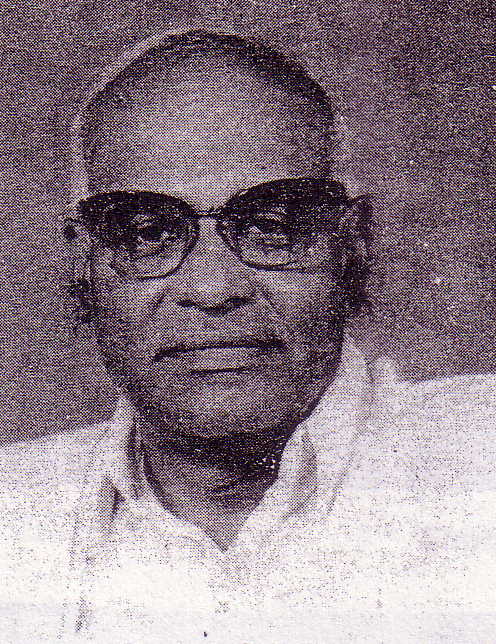
Director P. Neelakantan
M.A. Thirumugam (16)
Thaiku pin Tharam (1956), Thai Sollai Thattathe (1961), Kudumpa Thalaivan (1962), Thayai Kaatha Thanayan (1962), Dharmam Thalai Kaakum (1963), Neethikku pin Pasam (1963), Thozhilali (1964), Vettaikaran (1964), Kanni Thai (1965), Mugarasi (1966), Thani Piravi (1966), Thaiku Thalaimagan (1967), Vivasayee (1967), Ther Thiruvizha (1968), Kathal Vaganam (1968), Nalla Neram (1972)
T.R. Ramanna (8)
KoondukkiLi (1954), Gul-e-bakaavali (1955), Pudumaipithan (1957), Paasam (1962), Periya Idathu Penn (1963), Panakkara Kudumbam (1964), Panam Padaithavan (1965), Parakkum Pavai (1966)
- Sankar (8)
Panathottam (1963), Kalankarai Vilakkam (1965), Chandrodayam (1966), Kudiyiruntha Kovil (1968), Adimai Penn (1969), Pallandu Vazhga (1975), Uzhaikkum Karangal (1976), Indru Pol Endrum Vazhga (1977)
Tapi Chanakya (4)
Enga Veetu Pillai (1965), Naan Anaiyittal (1966), Puthiya Boomi (1968), Oli ViLakku (1968),
B.R. Panthulu (4)
Ayirathil Oruvan (1965), Nadodi (1966), Rahasiya Police 115 (1968), Thedi Vantha Mappillai (1970)
Krishnan – Panju duo (3)
Petral Than Pillaiya (1966), Engal Thangam (1970), Idaya Veenai (1972)
Director K. Shankar
Among this list, T.R. Ramanna and B.R. Panthulu served double duty as producers as and directors. M.A. Thirumugam was the younger sibling of MGR’s intimate pal M.M.A. Sinnappa Thevar. Thus, these producers had a preferential eye on box office collection offering entertainment to masses, rather than artistic quality of the film. With the exception of R. Krishnan (1909-1997) – S. Panju (1915-1984) duo, it is difficult to include others among the top ranked movie directors in India. From late 1940s to early 19790s, Krishnan – Panju duo were the iconic directors of DK and DMK party’s popular movies such as Paithiakaran (1947), Nallathambi (1949), Parasakthi (1952) and Ratha Kaneer (1954). In fact, before becoming a full-fledged hero, MGR had acted in subsidiary roles of Krishnan – Panju directed, Paithiakaran (1947) and Ratnakumar (1949) movies.
Later, C.V. Sridhar, who deserves a placing among the top ranked movie directors of India did work with MGR in two movies, Urimaikkural (1974) and Meenava Nanban (1977). This MGR- Sridhar association was primarily financial. As Sridhar himself had explained in his autobiography, MGR opted to bail out Sridhar’s production company, by acting under Sridhar’s direction. Before Sridhar, B.R. Panthulu reached for MGR in 1965, after his movies with Sivaji Ganesan (especially the biopic on Indian freedom fighter, V.O. Chidambaram Pillai (1872-1936), flopped in box office. It was in Panthulu’s movie Ayirathil Oruvan (One in a Thousand, 1965), MGR was paired for the first time with Jayalalitha, though the latter’s debut movie was Sridhar’s Vennira Aadai (White colored Dress, 1965). While Vennira Aadai was released in April of that year, Ayirathil Oruvan was released three months later in July. Thus, this year marks the 50th anniversary of Jayalalitha’s entry into Tamil cinema.
Playwright and journalist Palaniyandi Neelakantan (1916-1992) leads the above list by directing 17 of MGR movies. Here is a short profile of him, which appeared in 1981, when he was the President of Film and TV Institute of Tamil Nadu, Madras, having been appointed to that position by MGR, when the latter was the Chief Minister.
“Palaniyandi Neelakantan, playwright and film director was born on 2nd October 1916 at Villupuram. He started his career as a journalist at the age of 19 and contributed many short stories, criticisms and articles on various journals. He has written many radio dramas. Out of his many stage plays, Mullil Roja (Rose in Thorn) and Nam Iruvar (We Two) were most popular. His drama ‘We Two’ was later produced as a film. His book entitled, Vannappukkal (in three volumes) is a rare publication. He is one of the well known film directors in Tamil Nadu. Having directed more than forty pictures in Tamil, two in Kannada and two in Sinhalese. He was awarded Kalai Mamani or Sigamani by Tamil Nadu Sangeetha, Nataka Academy and was also adjudged as the best director for the year 1970 by the Tamil Nadu government.”
An entry on Neelakantan in the Encyclopedia of Indian Cinema, also reiterates Neelakantan as ‘a Tamil director associated mainly with MGR’s persona’ while giving credit that he made his directorial debut with Annadurai scripted film Or Iravu (1951), and he also had directed Karunanidhi scripts, Poompuhar (1964) and Poomalai (1965). Borrowing the thoughts of an academic critic M.S.S. Pandian, the compilers of this Encyclopedia had filled in further about Neelakantan as, “According to M.S.S. Pandian (1992), the hit Thirudathe inaugurated the MGR persona of a subaltern in the service of society. This trend continued in Mattukkara Velan with MGR playing the double role of the cowherd and the lawyer, and in Ninaithathai Mudippavan with MGR demonstratively consuming proletarian food and displaying an inability to eat peas with a fork.”
Why MGR opted to act under docile, subservient, weak-willed directors? Was it, because he had a streak of narcissism and could manipulate the movie’s story line according to his whims and party interest? Was it, because he found it incompatible to work under strong-willed directors? Was it, because he was given a free hand by the producers & directors to choose his co-stars, lyricists, playback singers, movie directors, stuntmen, costume designers etc?
On the subservience of MGR’s directors, lyricist Vaali offers an anecdote in his memoir, Ninaivu Naadaakal (Memory Threads). Here is a word to word translation of this anecdote.
“One MGR picture. Direction by Mr. T.R. Ramanna. In that, an actress was playing the role of MGR’s mother – that too, a poor mother living in a cottage. I went to the shooting location to see Ramanna. I asked him quietly, ‘Why Elder? Does MGR knows that this actress has been arranged to play the role of his mother?’ Ramanna was a bit surprised and replied, ‘No he doesn’t know. What’s the matter?’
Many many years ago, when MGR was acting as a hero under Rajah Chandrasekhar’s direction in the movie ‘Chaaya’ [Note by Sachi: this was in 1941; and the movie wasn’t completed!]. There was a scene in which MGR had to mount a horse. But, while doing that scene, MGR had slipped and fell. That movie’s heroine was this lady, and she had laughed then. Now, she had been arranged to play the role of MGR’s mother. When I told this, Ramanna instantly said, ‘Aiyyaio’ [Oh’ My God!] and quickly changed that actress and arranged another lady to complete that shooting. How can my mouth would remain silent? After one or two weeks, I told this to MGR. [His response was] “Too bad! It’s not appropriate to change that actress. Then, she was big heroine. When I fell while mounting the
horse and she did laugh, I felt little embarrassed too. Nevertheless, one shouldn’t take that into account now and ill treat her.” MGR called Ramanna, and requested to re-shoot the same scene with that heroine actress. MGR also solicited and made arrangement to pay 10,000 rupees (then, a big sum) for her. This is what Sage Valluvar called, magnanimity [இன்னா செய்தாரை ஒறுத்தல் அவர் நாண நன்னயம் செய்து விடல்; Make a wrong doer feel shy, by doing a favor to that individual] in one of his verses. MGR was a living example for it.”
horse and she did laugh, I felt little embarrassed too. Nevertheless, one shouldn’t take that into account now and ill treat her.” MGR called Ramanna, and requested to re-shoot the same scene with that heroine actress. MGR also solicited and made arrangement to pay 10,000 rupees (then, a big sum) for her. This is what Sage Valluvar called, magnanimity [இன்னா செய்தாரை ஒறுத்தல் அவர் நாண நன்னயம் செய்து விடல்; Make a wrong doer feel shy, by doing a favor to that individual] in one of his verses. MGR was a living example for it.”
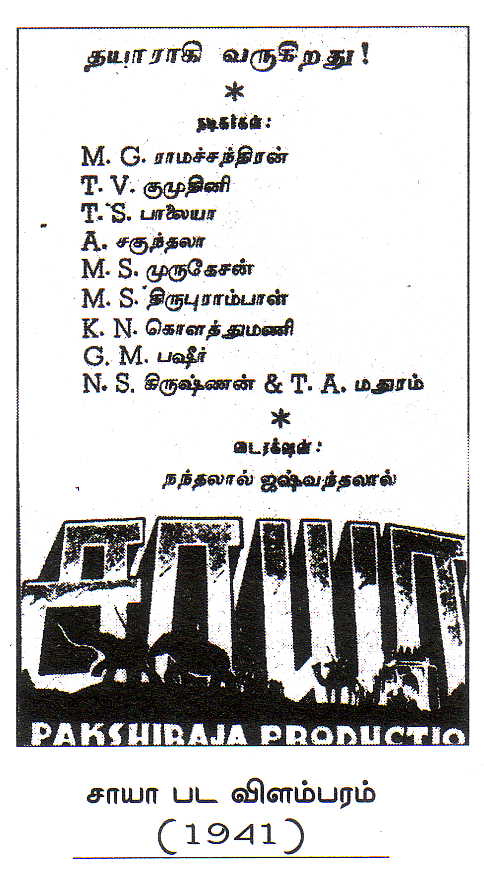
Though lyricist Vaali didn’t identify that actress by name, we can identify this heroine actress as T.V. Kumuthini, who starred with M.K. Thiyagarajah Bhagavathar in the 1941 hit movie Ashok Kumar. MGR himself acted in a minor role in this movie. About his acting and horse riding experiences in the unreleased Chaaya (1941) movie, MGR had reminisced in chapters 10 to 12 of his autobiography. He had mentioned that for the hero role assigned to him, he was paid a monthly sum of 385 rupees.
Some comments about the influence of directors of Tamil movies are warranted. In the early years, many of the directors were producers themselves. These included, K. Subramaniam (1904-1971), S.S. Vasan (1904-1969), T.R. Sundaram (1907-1963), A.V. Meiyappan (1907-1979) as well as B.R. Panthulu (1910-1974). They would have probably felt that if they were investing the money, why offer the direction task to a second guy. There were a few respected directors like Raja Chandrasekhar (1904-1971), A.S.A. Sami (1915-1998), T.R. Raghunath (1912-1990), and Krishnan (1909-1997) – Panju (1915-1984) duo who were employed by other producers. MGR had acted in the movies of such respected directors. Then, in 1950s and 1960s, few powerful directors appeared to sculpt movies according to their taste. These included, A. Bhimsingh (1924-1978), A.P. Nagarajan (1928-1977), C.V. Sridhar (1933-2008), K.S. Gopalakrishnan (b.1929) with the sobriquet ‘Iyakunar Thilakam’ and K. Balachandar (1930-2014). All opted to work with Sivaji Ganesan and other leading heroes of Tamil cinema. For their taste, MGR was considered as an outlier by these directors.
But, when reality struck the bottom-line, few like Panthulu, Sridhar and Nagarajan were at MGR’s gate to retrieve their financial losses. K. Balachandar’s entry into Tamil movies was via MGR’s Deiva Thai (1964) as a script writer. K.S. Gopalakrishnan also worked as a script writer in one of MGR’s movies Sange Muzhangu (1972). Bhimsingh never worked with MGR.
There was another movie director from Kerala with the same name and initials K.S. Gopalakrishnan, who had directed one MGR movie Panakkari (1953), an adaptation of Tolstoy’s novel Anna Karenina (1877). According to Tamil movie historian, Randor Guy, this K.S. Gopalakrishnan, “didn’t meet with much success. He is scarcely remembered today and many mistake him for the other K.S. Gopalakrishnan, a successful Tamil film maker.” Randor Guy’s clarification on the identities of two directors carrying the same name and initial is of much help.
Superstition on Lucky Number 7
Lyricist Vaali also had recorded one of MGR’s superstition in believing the success of being associated with number 7. He records that, whenever feasible, MGR wanted his movie titles to be in 7 Tamil alphabets cumulatively. I did check on this fact. Among the 113 movies MGR had acted as hero between 1950 and 1978, 21 movies had 7 alphabet titles (18.6%!). Two conditions did apply. One, unlike recent times, Tamil grammar was not made flexible to create 7 alphabet titles in MGR movies. Second, for political correctness, titles should have positive, up-beat meanings. Here is the list:
Manthiri Kumari (1950), Anthaman Kaithi (1952), Malai Kallan (1954), Nadodi Mannan (1958), Sabash Maapille (1961), Rani Samyuktha (1962), Pana Thottam (1963), Vettaikaran (1964), Thayin Madiyil (1964), Chandrothayam (1965), Thali Bhagyam (1965), Parakum Paavai (1965), Arasa Kattalai (1967), Ther Thiruvizah (1968), Kathal Vahanam (1969), Rickshawkaran (1971), Sange Muzhangu (1972), Annamitta Kai (1972), Urimai Kural (1974), Navarathinam (1977) and Meenava Nanban (1977).
Comparatively, only two MGR movies, between 1936 and 1949, when MGR was minor player in the naming of Tamil movies, had 7 alphabet titles. These being, Dakshayagnam (1938) and Harishchandra (1944).
‘Lucky number 7’ is a universal belief. Questions may arise, why MGR came to believe in lucky number 7 concept, and whether it did work in his real life? The financial success of Manthiri Kumari movie in 1950, after a long wait for recognition as a hero might have tempted MGR to trust this superstition. Nevertheless, not all of his 21 movies which carried 7 alphabet titles were successful in box office. Some were duds, by MGR’s movie yardstick in Tamil Nadu. These include, Thali Bhagyam, Arasa Kattalai and Navarathinam. The last two deserves mention. Arasa Kattalai (released in May 1967) was promoted as the first movie after MGR’s shooting incident in Jan. 1967, after the Feb. 1967 General Election, when DMK party was elected to rule the Tamil Nadu for the first time. This movie was directed by MGR’s elder sibling, M.G. Chakrapani. Like some MGR’s successful movies in the past, it did have two heroines, B. Saroja Devi and Jayalalitha. But, it flopped. Navarathinam (released in March 1977), directed by much respected A.P. Nagarajan (1928-1977, an influential director in Sivaji Ganesan’s camp, who in 1950s had directed a few movies with anti-DMK plots), who had switched to MGR to retrieve his financial losses. MGR’s magic couldn’t help Nagarajan much and the latter died few weeks later on April 1, after the release of his movie, aged 49!
Cited Sources
Randor Guy: Blast from the Past – Panakkari (1953), The Hindu, Chennai, Dec. 26, 2008.
- Neelakantan: Film and Television Institute. In: Spotlight on Tamil Nadu, Associated Journals Ltd, New Delhi, 1981, pp. 106-108.
Ashish Rajadhyaksha and Paul Willemen: Encyclopedia of Indian Cinema, Oxford University Press, New Delhi, revised ed., 1999, p. 165.
MGR: Naan Yean Piranthen [Why I was Born?] Part 1, Kannadhasan Pathippagam, Chennai, 2014, pp. 139-186. (in Tamil)
[Poet] Vaalee: Chapter 29, MGR, Ninaivu Naadaakkal [Memory Threads], Vikatan Pirasuram 611, Chennai, 4th ed. 2013, pp. 152-158. (in Tamil)
MGR Remembered – Part 32
Tackling Upstart ‘Producers of a Kind’
by Sachi Sri Kantha, December 24, 2015
First and Only Visit to Ceylon in late 1965
Last October marked the 50th anniversary of MGR’s first and only visit to his land of birth. I don’t have much primary materials with me now, about this visit. The blame lies on my mother. This is how, I had described the agony I faced in an autobiographical essay I wrote 20 years ago.
“One day, after I have tested my mother’s patience by coming home unusually late (after enjoying a matinee show), she had grabbed my suitcase of collectibles and disposed into garbage-can all my worthy collections related to MGR. She added insult to injury by asking me, ‘Will your MGR come and feed you in the future, if you are starving?’ This unwarranted invasion of my privacy hurt my sentiments badly. I vouched secretly that she had underestimated the loyalty of a true MGR fan. Not to be outsmarted, I made it my goal to see as much as MGR movies as I can…This caused unpleasant feelings between my mother and me. She really felt that my educational potential is being cheated by MGR, and she tried hard to ‘divorce’ me from my MGR craze. But for better or worse, she failed to succeed in it.”
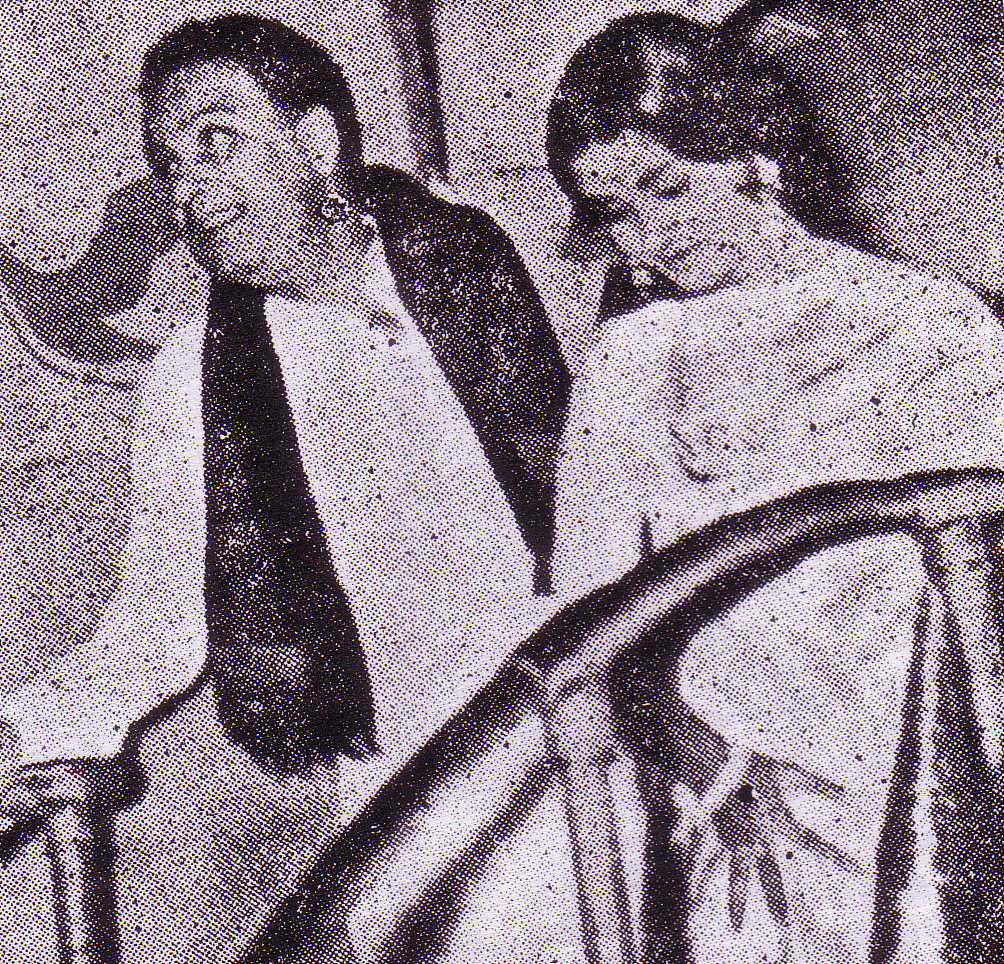
MGR and Sarojadevi arriving at Palali, Jaffna airport
As an aside, I should record that, in hindsight (after 50 years!), with my 79 year old mom still living and in declining health, I now realize that moms are always correct. If only, my MGR craze was a degree or two lower than what I had then, my professional career would have changed a lot. This is what MGR also had preached in his numerous ‘Thai’ (Mother)-titled movies. Thus, I did betray the trust my mother had then, and disobeyed MGR’s ‘teachings’. Why I write this extended MGR biography now after 50 years, is a sort of symbolic ‘penance ritual’ of my guilt-ridden soul! [Note to readers: In Part 31, I had exposed a plagiarism act by an MGR fan. One method of tackling this sort of rampant plagiarism in internet of my writing, is to insert personal tags and descriptions about my life within my story of MGR’s life, so that the plagiarist(s) have to take extra-pain to delete these sort of asides. Hope, readers will bear this with me.]
Now, let me return to MGR’s visit to Ceylon in October 1965. I was then a 12 year old boy, studying at Colombo Hindu College, Ratmalana. I provide excerpts from my remembrance of this visit of MGR with his then co-star B. Saroja Devi, as I had recorded in my 2004 autobiography, ‘Tears and Cheers’.
“Our school being located adjacent to the Colombo (Ratmalana) airport provided good opportunities for us to welcome the visiting dignitaries from other countries. When the dignitary was a political giant [like India’s primeminister Jawaharlal Nehru or China’s prime minister Chou-en Lai] we ‘semi-officially received ‘half a day holiday’ to go to the airport. In 1965, there happed a humorous extension to this accepted routine. In October of that year, the then Tamil move idol M.G. Ramachandran [MGR] visited Ceylon with his co-star B. Saroja Devi. Though he was a celebrity, he had not entered (active) politics at that time. Thus, he was not on par with the prime ministers of India or China. The day prior to his arrival in Ratmalana airport, senior batch students had approached our dear ‘suruttu Kanagar’ – the indefatigable eccentric teacher T. Kanagaratnam – and had expressed their wish to welcome MGR the following day after servicing the teacher with his daily quota of arrack liquor.
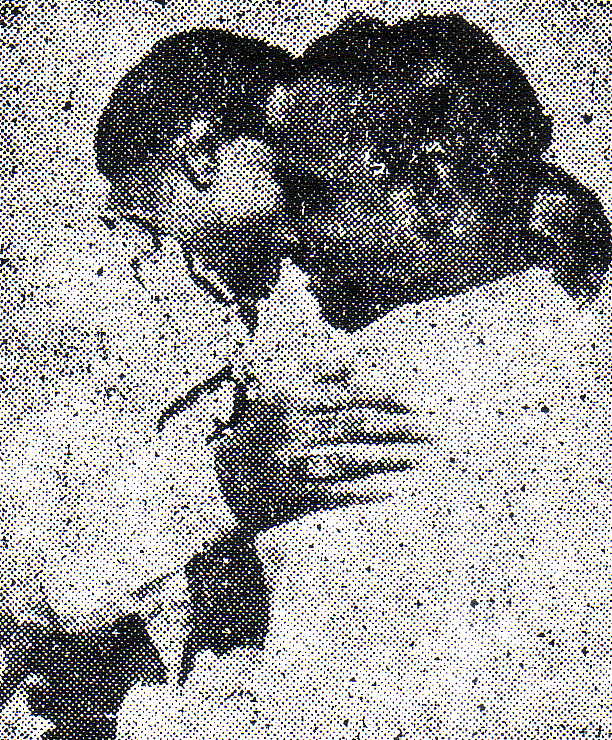
MGR greeted by C. Rajadurai at Batticaloa
The very next day, when the school session was about to begin, there came ‘suruttu Kanagar’ with his cane in hand and chased all the boys in the class to ‘Go to the airport to welcome MGR. What have you to study here today?’ This was against the protocol, and I wonder how the principal would have reacted to ‘suruttu Kanagar’s command. And how the eccentric Kanagar would have faced the principal. But for us, it was the thrill of seeing MGR in person which dominated our mood. And MGR and his then co-star B. Saroja Devi were given a rousing welcome by the Colombo Hindu College boys at the airport on that October day in 1965. We all admired our Kanagar’s unorthodox command on that day. It was also a practical lesson by our beloved teacher that for exceptional occasions (and seeing the legendary MGR in person was no doubt an exceptional occasion!), even routine protocols and rules need be abandoned, if one is strong-willed and willing to accept the consequences.”
The available photo of MGR at Ratmalana airport shows that he was walking with a sun glass, probably with his writing assistant Ravindar to his left. Saroja Devi, follows two steps behind. He has his wrist watch in his right hand. The white cap (with which his image came to be known in later years) was missing. He was then 48. Unfortunately, MGR himself has failed to record a word about his Ceylon visit, in his two volumes of autobiography. Why? No one knows for sure. MGR and Saroja Devi were invited by the Davasa Newspaper Group of Newspapers (Sinhalese ownership), based in Colombo. Though the owners were Sinhalese, the group also had a Tamil language daily named Thinapathi, with its weekly Tamil edition called ‘Chintamani’. To cater to the semi-literate working class, it also brought out a tabloid with the name Radha filled with cinema news, court stories of murder and divorce. Thinapathi’s editor was S.D. Sivanayagam from East Ceylon, who jumped ship from Federal Party’s organ Sutantiran, over personal issues with the then young star politician A. Amirthalingam. The question of why MGR’s wife Janaki Ramachandran did not accompany her husband on this trip remains unanswered too.
When MGR and Saroja Devi visited Colombo, their super hit color movie Enga Veettu Pillai (Our Own Child), of Vijaya Productions, was released for Deepavali festival. In Tamil Nadu, the same movie was released in January 1965 for Thai Pongal festival. Few titles of MGR’s movies are difficult to translate into English. Literal translation can be done, but it doesn’t do justice to the essence of the plot summary capsulated in Tamil title. Enga Veettu Pillai is one of these. While I opt for ‘Our Own Child’ (a figurative translation), fellow biographer M.S.S. Pandian opted for ‘The Son of Our Home’ (a literal translation). On the plot construction, prominence and significance of this movie in MGR’s film and political careers, Pandian had covered much ground, though one should be cautious in accepting all the reasons he trots out to de-base MGR’s profile. Another MGR movie which offers this translation dilemma was Petral Thaan Pillaiya (1966), which would subsequently lead to the MGR – M.R. Radha shooting episode in January 1967.
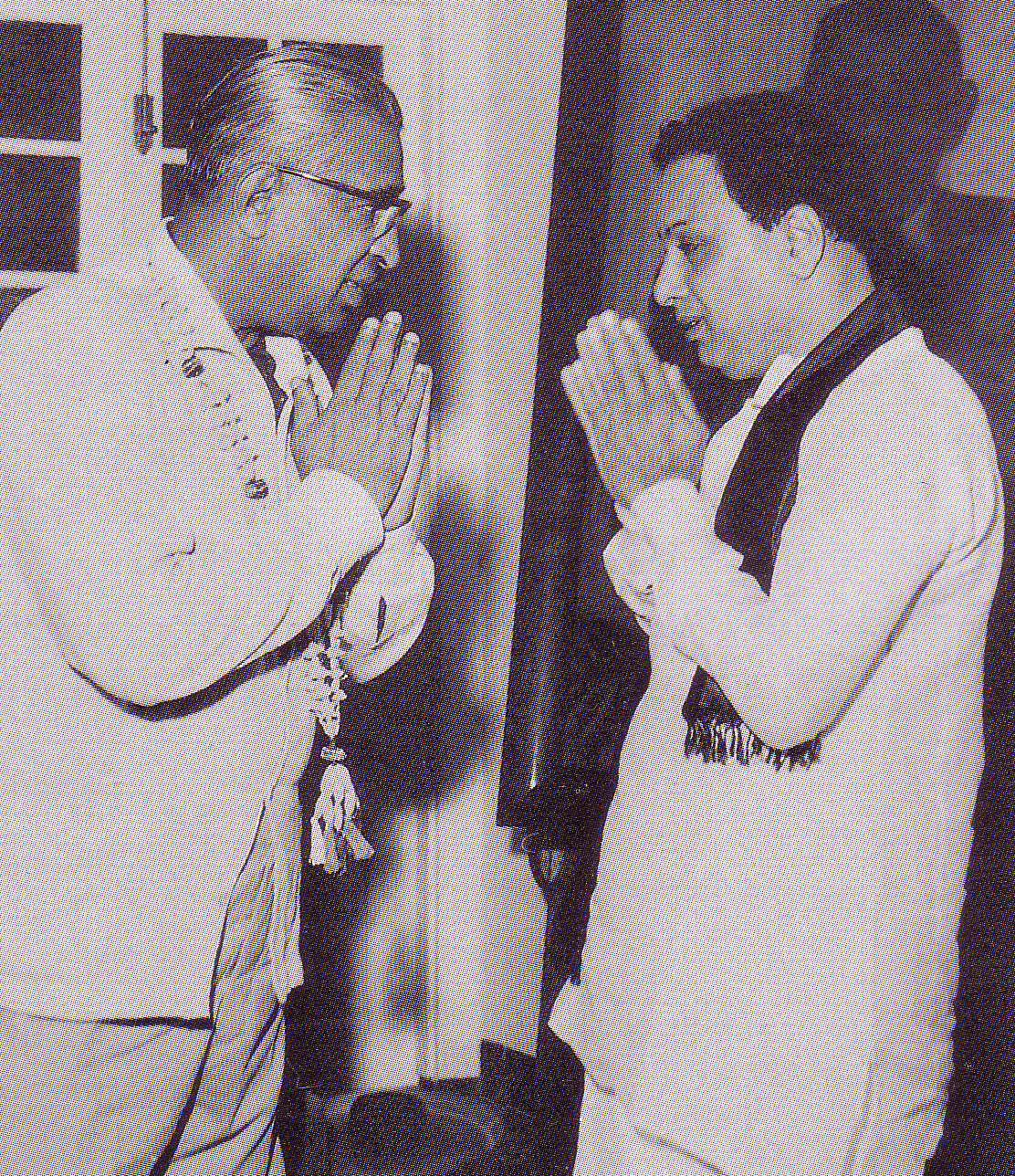
MGR greeting Dudley Senanayake 1965
While at Colombo, MGR also paid a courtesy call to the then prime minister Dudley Senanayake. It was noted that, in a bit of journalistic rivalry, as MGR’s trip was sponsored by Davasa newspaper group, the dominant Lake House newspaper group never opened their space to cover MGR-related stories in its Tamil daily. At Colombo, MGR stayed at Galle Face Hotel. Subsequently, he was a guest of movie mogul K. Gunaratnam of Cinema’s Ltd. for a few days.
Other than Colombo, MGR did visit Kandy, Jaffna, Batticaloa, Matale and Nuwara Eliya cities as well. At Batticaloa, he was greeted by Mr. Chelliah Rajadurai, then Federal Party MP. Among all the Federal Party politicians of that era, it was Rajadurai who had entertained good links with the DMK party leaders (like poet Kannadasan, Karunanidhi and others) from Tamil Nadu, long before 1972. Thus, MGR was no exception.
I could locate only one report about MGR’s visit to Ceylon, written by one S. Saravanapavan (Si.Sa) to the Kalaichelvi monthly (Nov. 1965), published from Chunnakam, Jaffna. It offers two answers he had provided in a news conference. First was, MGR had demanded that all the collections made at the functions in which he had participated in Ceylon should be donated to charity organizations. He also offered donation to the fishermen from Myliddy town (Jaffna peninsula) who had suffered damages due to a cyclone. A lame beggar had somewhat struggled and reached the podium to touch him, despite all the enforced protocols. Thus, instantly he offered this beggar 500 rupees in front of all.
The second story relates to a question directed to actress Saroja Devi by the reporters. She was asked a question, ‘With whom, you’d like to act?’ MGR interrupted to answer, “If she answers, that she would prefer to act with MGR, it may be only for the courtesy. She simply cannot mention the names of other actors. So, please refrain from asking such questions.”
Tackling ‘Upstart Producers of a Kind’
After he gained a firm foothold in the Tamil cinema world since mid-1950s, MGR had a ‘love-hate’ relationship with the movie producers. Thus, gained a reputation (for good or bad), that he was a ‘difficult character’ to deal with. I base this evaluation from the records of those (script writer Aroordhas and poet Kannadasan) who had dealt with him intimately. While MGR’s assistants Ravindar and Vidwan Lakshmanan had glossed over this theme, Aroordhas have offered valuable details on this topic. Thus, rather than paraphrasing his descriptions, I offer English translations of what he had written on MGR’s dealings with film producers.
MGR’s Angle:
According to Arurdhas, “When a producer reaches MGR with a mind of making a movie with him. MGR would ask him: ‘Are you taking the movie on your strength or on my strength?’ What this means is, ‘on my strength’ indicates that you’ll get funds from someone mentioning my name to produce this movie, or ‘on your strength’ indicates are you affluent to pay me’? Suppose if the producer states, ‘on your strength’, then MGR would analyze the situation. ‘Who is he? Is he a new guy or an old acquaintance? What is the benefit of helping him? Is he good or not good?’ He would find answers, and based on these answers, he may show the green flag. Or, red flag!

MGR in Ratmalana 1965
If the producer wanted MGR’s name to get funding from financiers, within a few months of shooting, there will be a direct line between MGR and the financier. Then, the producer’s half tuft will be on MGR’s hand and balance tuft will be on financier’s hand. (If this doesn’t happen, that depends on the producer’s trust and truth sense.) Once this situation develops, the producer will be demoted to the role of a broker. This is one type.
Another type of drama also occurs. The producer and financier may create a plot in collaboration first, and then they may come to MGR to dispense it, without any indication of the original plot. But the natural talent of MGR would somehow dig the original plot of producer and the financier. Then, how much that particular movie will develop, and how it will reach conclusion, neither producer nor the financier cannot predict. Even MGR himself couldn’t predict the outcome!
There were some who were trapped and drowned in this ‘MGR flood’. Then, there were others who luckily survived the flood and reached the shore. Some did make money. It all depended on how they behaved themselves! Those who had known MGR’s character in depth will realize that what I had written here reflects the accuracy. When the chariot called MGR faced some blocks in the road, the one who functioned as the fulcrum to make this chariot run, R.M. Veerappan (one of MGR’s then right hand) would attest to this.
Psychologically speaking, like how Jews were hated by Hitler, that sort of permanent ‘hate’ MGR had on producer tribe. He would even tell the reason for such antagonistic attitude. After so many years of trials and mental tribulations, he reached the hero status only when he reached 30, with the Jupiter movie ‘Rajakumari’ in 1947. Until then, he had to be satisfied with minor roles. Even those roles came to him, after utmost difficulties. He had told me that in those days, producers had hurt his feelings badly, by not offering him the hero status, but also by bullying him.
Before ‘Rajakumari’, a movie titled ‘Chaaya’ was announced with MGR as the hero, and T.V. Kumuthini (who had gained fame in ‘Ashokumar’ movie) as the heroine. But this movie was later abandoned. MGR had told me, ‘I could never recover from that lost opportunity. Though the movie was stopped for some other reason, producers had pointed at him as a luckless fellow.’ In this issue, MGR carried the trait of blaming the arrow as well as the shooter. When we hear his arguments from his mouth, we should realize that what he says was real. This is the truth.
When it comes to movie production, not only with other producers and directors, even in his own production and direction, MGR wouldn’t easily compromise! All the shots taken of him, he would repeatedly check and check. Even with the song sequences, the same checking would continue. He would ask for different lyrics, different tune and re-record the sequences. Occasionally, even after the shooting for song sequences with other actors were involved, if he was not ultimately satisfied with the sequences, he would chop it and re-record the same scene again.”
I have quoted in length what Arurdhas had written about MGR’s mentality about producers. Considering the overall facts, that (1) MGR held the top slot as the box office collection among Tamil movie stars for almost quarter century (since 1954 to 1977), (2) he did act ONLY as ‘the hero’ for over 100 movies. Thus, the value-added honorific nick name based on his initials, ‘Minimum Gurantee Ramachandran’ (MGR) holds true and he didn’t let down established producers who relied on him sincerely.
My analysis on this issue is as follows: MGR had no problem with either established studio moguls (Gemini or AVM or Vijaya or Jupiter Pictures or Modern Theatres, when the founders were in charge of movie production) or with his trusted producers like M.M.A. Sinappah Thevar (Devar Films) and T.R. Ramanna (R.R. Pictures). He also had no problem with established rival group (Sivaji Ganesan unit) producers who switched their allegiance to MGR such as B.R. Panthulu (Padmini Pictures). G.N. Velumani (Saravana Films) and director C.V. Sridhar (Chitralaya Productions). The conflicts MGR had was with upstart producers, who having earned a name in some other department of film became bitten by the bug of movie production, and depended on his labor and name to make money for themselves. Examples are as follows: actors turned producers (comedian J.P. Chandrababu, character actor cum villain S.A. Asokan), lyricists turned producers (Tanjai Ramaiah Das, poet Kannadasan). There is another untold angle too. By conviction, MGR was a teetotaler. If the so-called upstart producers are addicted to alcohol use (such as J.P. Chandrababu, Tanjai Ramaiah Das, Kannadasan, as well as M.R. Radha. I’m not sure whether actor Asokan also belonged to this group.), then MGR’s sensitive antennae probably warned him to nip their passion for making money using his name.
Kannadasan’s Extreme Anecdote
In his critical booklet titled, ‘MGR’s Interior and Exterior’ during the 1977 election year, lyricist Kannadasan provided an expose on MGR’s mean treatment of a producer of one of his movies, ‘Bagdad Thirudan’ (Bagdad Thief, 1960), the only movie in which MGR was paired with dancer Vyjayanthimala. No doubt that it was an extreme case. Excerpts from Kannadasan’s gripe follows:
“If a set was made for 30,000 rupees, the next day, he would ask to change for a new set. The already taken shots had to be re-taken, according to his wish. Golden Naidu, the producer, who had lived with respect was humbled beyond limit. It was estimated that when the shooting were over, there would be a loss for 500,000 rupees. MGR had firmly demanded that another 200,000 rupees had to be spent to finish the shooting. Naidu cried. One day, he even begged. But, MGR was adamant. Naidu returned home by cussing, ‘You devil. I’ll become a pauper now.’ His blood pressure increased. He retired to bathroom and didn’t return even after an hour. Those at home, forced open the bathroom door, and Naidu had died of heart attack.
None can forget how his family cried that day. All those in cinema gathered at that house. Almost everyone were cursing MGR. Suddenly, MGR arrived with a huge garland and casually threw that on his corpse. One by one all shouted, ‘After killing the guy, he had come to garland the corpse with his retainers.’ MGR and his gang fought with others. When Naidu’s servants repelled them, MGR and his retainers retreated in one car.”
Kannadasan himself himself had suffered from MGR’s highhandedness. He had written, “I also wanted to make movie ‘Oomaiyan Kottai’ (The Fort of the Dumb) and gave him 21,000 rupees. He didn’t even act for one hour. He also didn’t return the money given. In case, if I went to ask him a loan, he would ask for a promissory note and give money after I signed on it. His so-called donations were his tactic to ‘buy’ people.”
Interested readers can check my review on the merits and demerits presented in this minor book(let) of 48 pages by Kannadasan, in my 2011 review posted this website. [http://sangam.org/2011/10/Kannadasan_Booklet.php?uid=4486]
Unpleasant Experience with Genova movie
In his autobiography, MGR had described the unpleasant sentiments he faced with the Kerala-based producers, during the production of dual-language Genova (1953) movie. Some excerpts follows:
“They produced the Genova story simultaneously in both Tamil and Malayalam. I acted as hero in both languages. Though I couldn’t clearly read or write Malayalam language, I could use it at home. Thus, I could manage speaking that language. There were two who produced that story. Mr. Mathews was the one who looked after the shooting in Chennai. Mr. Eapen was another partner. They said, Mr. Nagoor, one of the partners of Newtone Studio, was also one of the partners. Mr. F. Nagoor was the director of that movie. They had contracted me in good faith….
In those days, in my contract, I made it sure that the producers had to abide some requirements. One of these requirement was that, ‘If the producer wanted another actor to act as my replacement, my permission should be first needed before shooting begins.’…Another requirement was, ‘In the movie I have acted, it should not be dubbed into any other language without my permission.’ These requirements were duly signed for Genova movie too. As I was acting in both Tamil and Malayalam versions of this movie, I made the following agreement.
‘Other than Tamil and Malayalam, this movie should not be dubbed in any other languages, without my signed permission.’ Only after this agreement, I acted in this movie.
One day, when I went to Newtone Studio, my blood boiled when I saw that scene. The Malayalam movie scenes in which I had acted speaking Malayalam, was being dubbed by another Malayalam actor. I shouted, ‘Where is Mr. Mathews?’ He came with a smile and greeted me: ‘Come, come. You had come at the correct time. I want to introduce this new arrangement, and he introduced me a guy Kunju or Kunju Bhagavathar. I had recognized his name in Kerala stage and cinema. Thus, I greeted him with respect…. Later, I called Mr. Mathews separately, and expressed my anger to him…. He replied: ‘Your Malayalam diction sounded like one who speaks in Tamil. The Malayalam tone is hardly missing. This is for your good, I say this.’
I shouted. ‘What gall you have? You insult me and then tell me that it’s for my good. Wait, I go and consult a lawyer and will put a stop for this.’ and left….
Mr. Mathew stopped me and said, ‘Please, don’t go to a lawyer. You will feel sorry, if he said that what I had done is appropriate.’ When, I heard this, I lost my temper.
‘What audacity you have?’
Until then, he was calm. Then, he exploded. ‘If I wish, I could change your voice in Tamil film version as well and can use another guy’s voice.’ I was shocked. He continued, ‘Will you listen to me with a calm mind?’
‘What is stated in our agreement? Other than Tamil and Malayalam, we should get your signature if dubbing should be in any other language. What is its meaning? We don’t have to have your agreement if dubbing is done in these two (Tamil and Malayalam) languages.’
I felt it hard and realized the weak position I had in this deal, and got a bit scared. I don’t care if they dubbed for Malayalam voice, but what’s my plight in Tamil, if they had dubbed (my voice with another’s) after I had successfully elevated myself as a Tamil actor. This contract will lit my prestige. What I had irresponsibly committed to do will harm my career in Tamil screen?…’
There is hardly any doubt, that it was this first-hand experience in 1953, which might have contributed to MGR’s tough approach with upstart movie producers. It was this sort of conflict with an upstart producer, one K.K. Vasu [who had borrowed money from character actor M. R. Radha to produce Petral Thaan Pillaiya (1966) movie, in which MGR acted in a Chaplinesque role] that culminated in the MGR – M.R. Radha shooting incident in January 12, 1967.
Cited Sources
Arurdoss: Cinema Nijamum Nizhalum [Cinema – Truth and Shadow], Arunthathi Nilayam, Chennai, 2001, pp. 64-65. (in Tamil)
Arurdhas: Naan Mugam Paartha Cinema Kannadigal [The Cinema Mirrors that I’ve Looked at], Kalaignan Pathippagam, Chennai, 2002, pp. 96-99, 193-198. (in Tamil)
Kavignar Kannadasan: MGRin Ullum Puramum (MGR’s Interior and Exterior), Muttiah Publisher, Chennai, 1977, pp. 29-30. (in Tamil)
Pandian, M.S.S.: The Image Trap – M.G. Ramachandran in Film and Politics, SAGE Publications, New Delhi, 1992.
MGR: Naan Yean Piranthen [Why I was Born?] Parts 1 and 2, Kannadhasan Pathippagam, Chennai, 2014. (in Tamil)
Si.Sa: Maragatha Theevil Makkal Thilakam [Makkal Thilakam in Pearl Island]. Kalai Chelvi (Chunnakam), Nov. 1965, pp. 36-39.
Sri Kantha Sachi: MGR Movies Revisited: Autobiographical Flashback of early teenage years. In: MGR Movies Revisited and Other Essays, Eureka Center, Fukuroi City, Japan, 1995, pp. 1-8.
Sri Kantha Sachi: Tears and Cheers – Tale of a Tamil Scientist, vol.1 (1953-1985), Bose Design, London, 2004, p.31.
Srivathsan A. The day M.R. Radha shot MGR. The Hindu (Chennai), June 5, 2013.
MGR Remembered – Part 33
M.R. Radha – a mentor to many
by Sachi Sri Kantha, February 4, 2016
Additional details on MGR’s 1965 trip to Ceylon
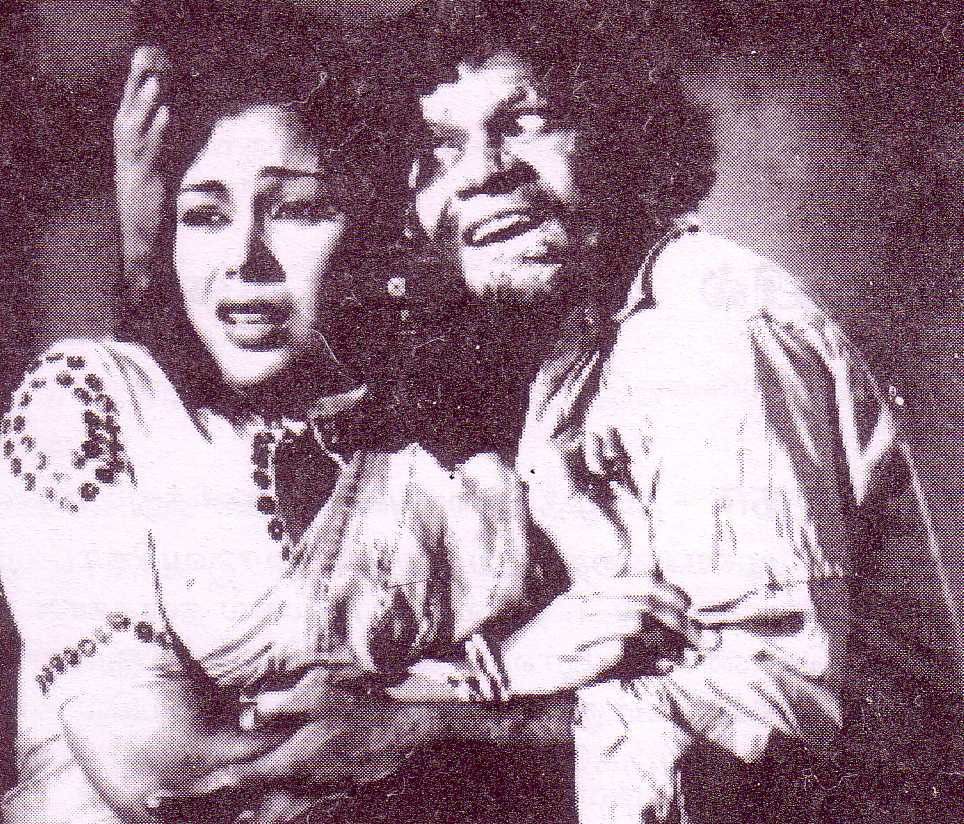
M.N. Rajam (lt) and M.R. Radha(rt) in ‘Rathak Kaneer’ movie
After reading Part 32, my friend and fellow MGR biographer R. Kannan had shared with me the information which had appeared in the DMK party’s organ Murasoli daily during October 1965, from Murasoli archives. I provide below the material he had extracted:
“The 19th October 1965 issue of Murasoli said that MGR would travel to Ceylon for a week from 22-28 October. MGR traveled to Colombo, his birth town Kandy, Jaffna, Batticaloa, Matale and Nuwara Eliya. The party organ said that he would judge a beauty contest among the plantation workers. MGR and his entourage arrived a day earlier on 21 October at 10.55 am at the Ratmalana airport. Earlier, MGR was seen off by Anna and other leaders at the Madras airport. Actress Saroja Devi and his manager R.M. Veerapan accompanied MGR.
Murasoli reported that thousands welcomed MGR with slogans of ‘Makkal
thilakam’, ‘Puratchi nadigar vazhga’ (Long live)’ renting the air. MGR traveled in an open car to Galle Face hotel some 10 kms away on the seaside. Murasoli said that fans breached the police cordon to ‘touch’ their favorite star. In the afternoon MGR took part in a lunch hosted by Satgurunathan, a friend. Despite keeping it a closely guarded secret, a large crowd was present outside the residence and there were traffic jams in places leading to the residence. At 1.30 pm MGR reached Satgurnathan’s house. He later waved to the crowd outside from the balcony.
MGR also gave an interview to Radio Ceylon. Renowned Mayilvahanam was the interviewer. Thousands had gathered outside the radio station to get a glimpse of the actor. Some stormed into the radio station, according to Murasoli. In the evening Cinema’s Ltd proprietor K. Gunaratnam hosted a dinner.
Earlier, speaking to the press at his hotel, MGR referred to Anna telling him when he had seen him off that there was no relationship between the DMK and the DMK in Ceylon. MGR said that he had come on a tour to Ceylon and his visit had not an iota of political motive. He said since the time he learnt that he was born in Kandy he had been anxious to visit Ceylon.
On 25 October, MGR’s entourage landed at the Batticaloa airport. MPs Chelliah Rajadurai, Chinnalebbai, S.M. Rasamanickam, S.G. Selvanayagam, Veerasingham and Manickam received them. MGR then traveled in an open car to the Jaffna sports stadium. Mursaoli reported that a retinue of 200 cars followed him. A crowd of 150,000 had braved the heavy rains to see and hear the visitor. Supreme Court judge Thambiah welcomed MGR.
On 27 October, Ceylon DMK hosted breakfast for MGR. That day MGR addressed a meeting of plantation workers at the Denmark Estate, extolling the virtue of hard work. He thanked them for their affection towards him. He would visit Vijaya Studios and watch a film shooting there. That day MGR called on the leader of the Tamils, S.J.V. Chelvanayakam at his residence.
Later Ceylon Film Chamber hosted tea in his honour. Speaking at the event, MGR said that he had come as an artist and not as a politician. In the evening according to Murasoli, Local Administration Minister [Thiru] Selvam hosted a dinner.
On 29 October, MGR addressed a meeting at Colombo’s Sughathadasa stadium where he said that fans were like a mother to their erring children as fans always forgave artists and were all graciousness. Later in the afternoon MGR reached Madras at 5.40 pm. Anna placed a garland to welcome him. Kalaignar [Karunanidhi], N.V. Natarajan, Sathyavani Muthu, Mayor Chittibabu, S.S. Rajendran and others had assembled to receive him. According to Murasoli, the crowd shouted ‘Long live Arignar Anna, Long live MGR’ ”(Murasoli, 19, 23, 26, 27, 29, 30 October 1965.)
http://murasoli.in:8080/murasoli/home.jsp
Murasoli reported that thousands welcomed MGR with slogans of ‘Makkal
thilakam’, ‘Puratchi nadigar vazhga’ (Long live)’ renting the air. MGR traveled in an open car to Galle Face hotel some 10 kms away on the seaside. Murasoli said that fans breached the police cordon to ‘touch’ their favorite star. In the afternoon MGR took part in a lunch hosted by Satgurunathan, a friend. Despite keeping it a closely guarded secret, a large crowd was present outside the residence and there were traffic jams in places leading to the residence. At 1.30 pm MGR reached Satgurnathan’s house. He later waved to the crowd outside from the balcony.
MGR also gave an interview to Radio Ceylon. Renowned Mayilvahanam was the interviewer. Thousands had gathered outside the radio station to get a glimpse of the actor. Some stormed into the radio station, according to Murasoli. In the evening Cinema’s Ltd proprietor K. Gunaratnam hosted a dinner.
Earlier, speaking to the press at his hotel, MGR referred to Anna telling him when he had seen him off that there was no relationship between the DMK and the DMK in Ceylon. MGR said that he had come on a tour to Ceylon and his visit had not an iota of political motive. He said since the time he learnt that he was born in Kandy he had been anxious to visit Ceylon.
On 25 October, MGR’s entourage landed at the Batticaloa airport. MPs Chelliah Rajadurai, Chinnalebbai, S.M. Rasamanickam, S.G. Selvanayagam, Veerasingham and Manickam received them. MGR then traveled in an open car to the Jaffna sports stadium. Mursaoli reported that a retinue of 200 cars followed him. A crowd of 150,000 had braved the heavy rains to see and hear the visitor. Supreme Court judge Thambiah welcomed MGR.
On 27 October, Ceylon DMK hosted breakfast for MGR. That day MGR addressed a meeting of plantation workers at the Denmark Estate, extolling the virtue of hard work. He thanked them for their affection towards him. He would visit Vijaya Studios and watch a film shooting there. That day MGR called on the leader of the Tamils, S.J.V. Chelvanayakam at his residence.
Later Ceylon Film Chamber hosted tea in his honour. Speaking at the event, MGR said that he had come as an artist and not as a politician. In the evening according to Murasoli, Local Administration Minister [Thiru] Selvam hosted a dinner.
On 29 October, MGR addressed a meeting at Colombo’s Sughathadasa stadium where he said that fans were like a mother to their erring children as fans always forgave artists and were all graciousness. Later in the afternoon MGR reached Madras at 5.40 pm. Anna placed a garland to welcome him. Kalaignar [Karunanidhi], N.V. Natarajan, Sathyavani Muthu, Mayor Chittibabu, S.S. Rajendran and others had assembled to receive him. According to Murasoli, the crowd shouted ‘Long live Arignar Anna, Long live MGR’ ”(Murasoli, 19, 23, 26, 27, 29, 30 October 1965.)
http://murasoli.in:8080/murasoli/home.jsp

M.R. Radha (lt) and Sivaji Ganesan (rt) in ‘Pavamannippu’ movie
The political context in Tamil Nadu and Ceylon during late 1965 deserves some description, as MGR had commented in the press interviews he had visited the island as “an artist and not as a politician.” At that time, he was not even an Member of Tamil Nadu Legislative Assembly. But, the visit happened after the Jan 1965 anti-Hindi riots in which DMK was strongly involved. So, like a good actor, MGR had to state those lines, for behaving like a good guest. Ceylon had a general election in March 1965, and for the first time, the Federal Party joined the UNP to form a ‘sort of’ National Government. I guess, under that pretext only, visa was issued for MGR to visit Ceylon. In all probabilities, Karunanidhi wouldn’t have been given a visa during that period, due to his involvement in anti-Hindi riots.
In addition, MGR also had great number of Sinhalese fans. I remember reading that he had stated that he couldn’t hurt the feelings of Sinhalese fans, when some political questions were asked. Again, he behaved nicely as a good guest. But Tamils in Ceylon were somewhat disappointed because, he didn’t come out strongly with a pro-Tamil view. Thus, from mid-1960s to 1983, Karunanidhi was considered by many Eelam Tamils as a far better Tamil political leader, than MGR. MGR was considered simply as an actor turned politician. Only after 1983, and with the emergence of Prabhakaran and LTTE as well as the eclipse of TULF leader A. Amirthalingam, situation changed due to Karunanidhi’s flip-flops and MGR’s firm stand on siding with the Tamil cause.
Influence of M.R. Radha on his junior contemporaries
In chapters 4 and 5, I had recorded MGR’s impressions (as reminisced in his autobiography) on Madras Rajagopalan Radhakrishnan aka M.R. Radha (1907-1979), extremely popular Tamil stage and cinema actor, who was a real life mentor to him. Not only MGR, even his friendly rival in cinema Sivaji Ganesan (1928-2001) had high regards to the talent of M.R. Radha (hereafter abbreviated by the initials MRR). Last year, personal memories of actress M.N. Rajam, who had shared billing with all three reputed stars (MRR, MGR and Sivaji Ganesan) was posted in the youtube, when she was one of the chief guests with her singer husband A.L. Raghavan, at the Chennai Humour Club function [ check, https://www.youtube.com/watch?v=1yhz95Dhh-8]. What Sivaji Ganesan had reminisced about MRR in his autobiography was corroborated by M.N. Rajam too. Here are some bare-bone facts about him. (1) MRR was illiterate, and he didn’t bother to read Tamil, even after he gained fame. (2) What he would usually do was to ask one of his retainers to read the newspapers or drama scripts to him, and immediately he could grasp the essence and nuance of the material read to him, to use it instantly in his dialogues that very day itself. (3) That MRR had an inborn talent cannot be denied; he was also well versed in all aspects of practical work including car mechanics, electricity repair and stage craft. (4) In 1940s and 1950s, MRR was shrewd and brave to attack the government of the day. Even when his dramas were banned by the government authorities, the very next day, he would stage the same drama with the same plot, under a different fake title. (see below, for a Madras High Court judgement, on this point.)
MRR was affiliated to social reformist Periyar Erode Ramasamy Naicker’s (1879-1973) Dravida Kazhagam Party, and was an atheist by conviction. The same Periyar was also a mentor to C.N. Annadurai (1909-1969), who subsequently split with his mentor and founded the DMK in 1949. It was MRR who had brought the then 12 year old boy known as Ganesamoorthy, aka V.C. Ganesan, for the first time to Chennai in 1940. I provide below, what Sivaji Ganesan (who was 21 years junior) had reminisced about MRR’s acting and organizational talent.
“Sri Radha was a father figure to us. He was extremely affectionate and caring, and we would gladly do all the odd jobs for him and likewise he did things for us. He would clean the place where we slept, even clean out bathrooms. He would comb the children’s hair. He was a man with love in his heart….In those days, the only actor who could ‘fight’ to perfection as the play demanded, was Radha Annan. On one occasion the scene called for my having to yank his hair and stamp him. I hesitated as he was a father figure to me. He lay down on stage pretending to be writhing in pain, moaning and groaning and gesturing to me discreetly, but frantically, to really hit him. I hit him only after this. If I had not complied out of sheer respect for him, he would have hammered me after the curtains came down….
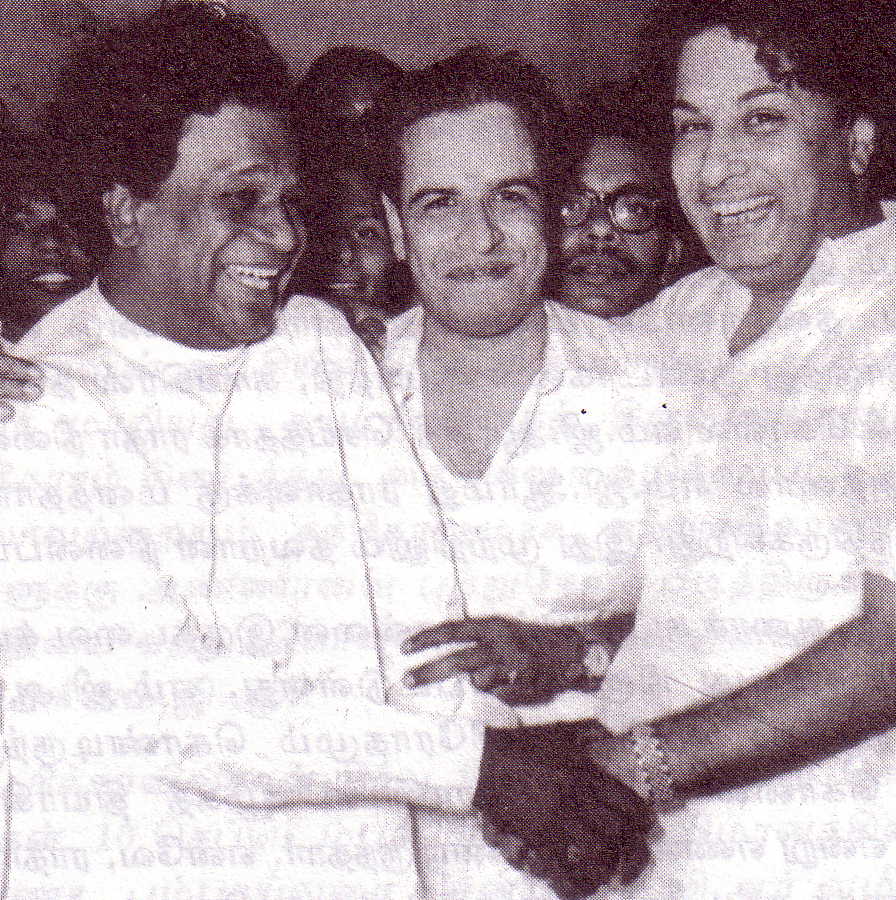
M.R. Radha (lt) and MGR (rt) at a social function (pre-1967)
Radha annan was truly a genius and an all-rounder, well-versed in all departments of theatre. He could take on electrical jobs, play a comedian, a villain or a hero and was able to hold his own in any role with finesse.”
A similar reminiscence was humorously told by actress M.N. Rajam too last year at that Chennai Humor Club presentation, about an episode in the shooting of ‘Rattha Kanneer’ (1954; Tears of Blood) movie. In that landmark Tamil movie, MRR’’s character Mohanasundaram was that of a lothario who later comes to suffer from leprosy. Rajam played a vamp character named Kantha. She had to kick MRR in a scene, and she simply refused to do that out of respect. After MRR being adamant that Rajam should play the role according to the script, when she kicked him for the first time with force, she fell down while MRR was standing! – a direct opposite result happened unexpectedly. Then, MRR had told her sternly, ‘Let’s finish this scene, in one take and get it done, without numerous repetitions.’
According to a note in Aranthai Narayanan’s work, Krishnan-Panju duo who directed that trend-setting ‘Rattha Kanneer’ movie in 1954 had reminisced in 1967 that there was an agreement to grant a certain remuneration for MRR for that movie. But, when that movie was completed, MRR had demanded three times the agreed amount from the producer of that movie. Eventually, this sort of financial finagling by him proved the truth in the popular idiom of feeding the snake with milk, only to be bitten later! When the rate for lead Tamil movie heroes (like K.R. Ramasamy) was around 30,000 to 40,000 rupees in early 1950s, MRR did receive an unprecedented sum of 125,000 rupees for this movie. The producer of Rattha Kaneer movie, P.A. Perumal Mudaliyar, was the same individual who produced Parasakthi (1952), the debut movie for Sivaji Ganesan. Krishnan-Panju duo were the directors for Parasakthi movie too. Probably one of the reasons why Sivaji Ganesan was retained for this movie, despite objections from another prominent sponsor of Parasakthi movie, A.V. Meiyappa Chettiar, was that as a debut hero Sivaji Ganesan was hired at a measly rate of 250 rupees per month, compared to the 40,000 rupees remuneration K.R. Ramasamy received then.
Nevertheless, MRR was very considerate to new actors, as attested by comedian Nagesh, in his autobiographical reminiscences about his first experience in associating with MRR in his debut movie Thamarai Kulam (1959, Lotus Pond). The problem with MRR was that he was too eccentric and individualistic in his character traits, that he wouldn’t stick around with the same drama troupe and he faced recurrent financial issues with the sponsors and promoters of his dramas and movies. This had been recorded in Sivaji Ganesan’s autobiography too. On top of that, MRR was also a lothario and polygamist in his real life! His wives and paramours include Prema, Saraswathi, Dhanalakshmi, one Geetha (from Wennapuwa, Sri Lanka). This may partly explains his financial problems.
That MRR was an uncrowned king of Tamil drama stage in 1940s and 1950s is a fact. DMK leader Annadurai had praised Radha’s stage talent as akin to that of Hollywood stage and movie actor Paul Muni (1895-1967). When talkies became the rage, MRR debuted in a Modern Theatre’s movie Sandana Devan (1939), and starred in a couple of movies Bombay Mail (1949) and again a Modern Theatre’s production Sathyavaani (1940). Then, he retreated from cinema (due an accident in shooting) to concentrate on dramas. One of his successful dramas was ‘Rattha Kanneer’, was scripted by Tiruvaroor Thangarasu, who also belonged to the Dravida Kazhagam group. When the same drama was adopted to cinema in 1954, MRR returned with a bang to play the same role (as London-returned Mohanasundaram) he had originated in the stage.
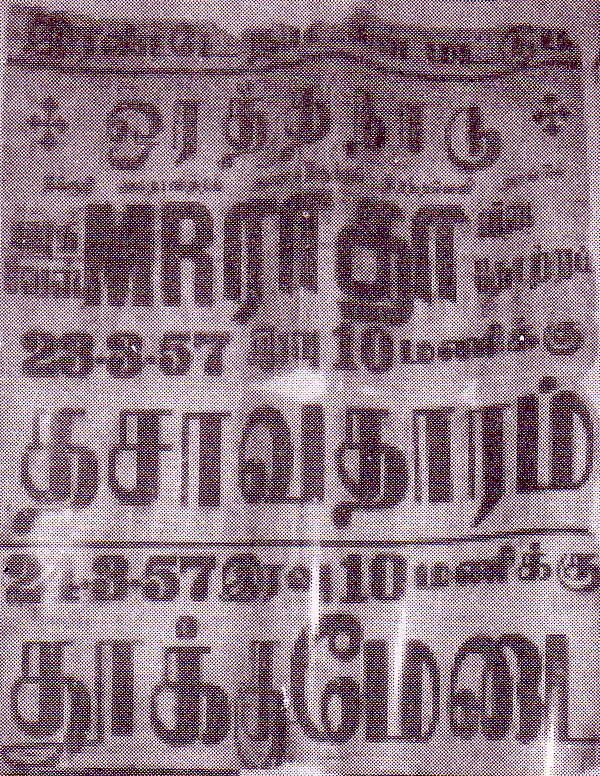 In their 2015 study investigating the idea of foreignness in Tamil cinema, Preeti Mudliar and Joyojeet Pal makes a passing mention to this Rattha Kanneer movie. To quote,
“in Ratha Kaneer (Tears of Blood) the specific issue of a conflict between tradition and westernized modernity was explored vividly. In Ratha Kaneer, M.R. Radha played the role of Mohan, who returns home after being educated abroad…in Ratha Kaneer the foreign influence of the West that corrupts is intensely etched in every aspect of Mohan’s behavior – his appearance, his financial carelessness, his sexual debauchery. His long-suffering wife, in contrast, represents native purity with her culture, values and compassion…Ratha Kaneer remains a landmark film…the sin of foreignness is neutralized by a chaste Tamil woman, the virtuous wife…”
Radha’s tact and skill in staging the same plot under two different names
From the internet, I picked up a Madras High Court judgement delivered by J. Sadasivam on July 11, 1962 related to a case that MRR had staged a drama Kathal Bali (Love Sacrifice), which had substantially the same plot to the drama Thooku Medai (Hanging Platform), that was prohibited by government order in April 1959. The guy who wrote the Thooku Medai was none other than M. Karunanidhi, then a fire-brand of DMK party! The verdict contain 18 items. Excerpts from a few items are provided below for relevance.
Item “1: Petitioner M.R. Radha has been convicted under Section 7(1) of the Madras Dramatic Performance Act, 1954 and sentenced to pay a fine of Rs. 200 in default to simple imprisonment for three weeks by the learned Second Presidency Magistrate, George Town, Madras.”
Item “2: The prosecution case is that on 19th July, 1959, between 7 and 10 pm at Thegaraja College, Open Air Theatre, Washermanpet, Madras, the petitioner staged the drama Kathal Bali, which is substantially the same as the drama Thooku Medai, the performance of which has been prohibited by the Government in G.O. No. 1193, dated 25th April 1959. But before staging the drama, the script of the drama was submitted to the Commissioner of Police and a licence was obtained to stage the drama on the basis of the script so furnished…”
Item “11: …The characters in both the dramas are the same and even the names of several of the characters are identical. Theagaraja Mudaliar, Paramarthika Iyengar, Munjan, Vellagan, Kanakam and Ardhanari are the same characters in both the dramas. The characters Pandiya, Veni and Vanitha in Thooku Medai appear as Maran, Mala and Kamala respectively in Kathal Bali. The learned Public Prosecutor has prepared a long list of objectionable passages which are common in both the dramas…”
Item “12: G.O. Exhibit P-8 shows that the drama Thooku Medai has been prohibited as an objectionable play on the ground that it deliberately intended to outrage the religious feelings of a class of citizens of India and also on the ground that it is indecent, scurrilous and obscene. Thus the drama appears to have been banned on the ground mentioned in Clauses (a) and (vi) of Section 2(1) of the Madras Dramatic Performances Act. There can be no doubt that several passages in Thooku Medai which have been held to be objectionable having regard to Clauses (v) and (vi) of Section 2(1) of the Madras Dramatic Performances Act, 1954, also find a place in Kathal Bali….”
Item”14: It is true that some of the passages such as passages attacking religious beliefs opposed to scientific principles may be of educative value and may be considered fair criticism. But as pointed in Explanation II to Section 2 of the Madras Dramatic Performances Act in judging whether any performance is an objectionable performace, the play, pantomime or other drama should be considered as a whole. The proper test is whether one who knows the banned drama Thooku Medai attends the drama Kathal Bali without being informed about the title of the play would get the impression that he is witnessing the banned drama. Judged by this standard there can be no doubt that the play Kathal Bali which contains most of the objectionable passages found in Thooku Medai is substantially the same as Thooku Medai not only as regards the story, characters, dialogue and: plot but also as, regards objectionable passages.”
Item “18: The conviction of the petitioner under Section 7(1) of the Madras Dramatic Performances Act is therefore correct. But having regard to the fact that the Commissioner of Police erroneously granted a licence to the petitioner to enact the drama the prosecution of the petitioner by the same Commissioner appears to be anomalous and hence justice would be met by releasing him after due admonition under Section 3 of the Madras Probation of Offenders Act. I therefore set aside the sentence of fine and admonish him under Section 3 of the Madras Probation of Offenders Act. The fine amount if collected is ordered to be refunded to the petitioner.”
MRR’s supporters alleged that this Madras Dramatic Performances Act was formulated in 1950s specially to tackled his atheist propaganda. When K. Kamaraj (1903-1975) was the Chief Minister of Madras State during the 1950s, MRR was arrested by the police for over 50 times. Even before Indian independence, in 1946 MRR conducted a drama with the caption ‘Por VaaL’ (War Sword). When that drama was banned by the then government of the Madras Presidency, under Tanguturi Prakasam (1872-1957), MRR reformulated the same plot by omitting a few scenes and cavalierly staged it with spurious names like Sarvadhikari (The Dictator) and Mahatma Thondan (Servant of Mahatma)!
Due to his commanding dialogue delivery and derisive humor, MRR became a regular in the movies of both MGR and Sivaji Ganesan since 1959. Then, until the end of 1966, he held his own in villain cum comedy roles. The titles of some MGR movies in which he featured since 1961 include, Thai Sollai Thattathe (1961), Sabash Mapillai (1961), Nallavan Vazhvaan (1961), Thayai Kaatha Thanayan (1962), Paasam (1962), Madapura (1962), Koduthu VaithavaL(1963) , Kanji Thalaivan (1963), Periya Idathu Penn (1963), Ananda Jothi (1963), Dharmam Thalai Kaakum (1963), En Kadamai (1964), Thayin Madiyil (1964), Thazhampoo (1965), and Petral thaan Pillaiya (1966). A financial conflict related to the last mentioned movie (touted as an adoption of Chaplin’s successful 1921 silent movie The Kid, in which MGR played a Chaplinesque role) released on December 9, 1966, would ferment an antagonism between MGR and MRR that ended in a shooting incident on January 12, 1967 at MGR’s house.
Coda
I wish to inform the readers of this series, that to protect the text material from copyright infringement, I had arranged chapters 1- 32 and 5 appendices (4 Tables and One Essay), and uploaded them in the Research Gate website. It can be accessed via URL
I have titled this book manuscript as, ‘Minimum Guarantee Ramachandran: A Life in Cinema and Politics’, with the following preface. A DOI was generated for this publication in Feb 2, 2016.
It is DOI: 10.13140/RG.2.1.1703.7847
“I present here the text of first 32 chapters of my biography on charismatic Maruthur Gopalan Ramachandran, aka MGR (1917-1987), one of the foremost drama cum cinema actor of his era in India, who later switched to politics and became the three times elected Chief Minister of Tamil Nadu state. I have been serializing this biography in the website of Ilankai Tamil Sangam [sangam.org] Association of Tamils of Sri Lanka in the USA, since Dec, 2012. MGR’s lengthy career in movies and politics in India [half a century, from 1936 to 1987!] can be simply equated in terms of his illustrious American contemporaries, as a mix of both John Wayne’s in movies and Ronald Reagan’s in politics.
As MGR’s first birth centenary is approaching, it is my wish to assemble all chapters of this series in a single file for ready reference. Though there are hundreds of books and booklets in Tamil language about MGR’s life in cinema and politics as well as philanthropy, his contributions to the Tamil society in India and elsewhere had been poorly served by handful of available English biographies. This biography is an attempt to rectify the currently prevailing lacuna.
As I have observed lately (and indicated in chapter 31), plagiarized versions of this series (including the tables which I had prepared originally) had appeared as separate components in the internet, without permission either from me or from the owners of the Ilankai Tamil Sangam website. Thus, to protect the dignity of my research and labor, I adopt this strategy of registering this document via Research Gate site.
I politely request that those who wish to cite this unpublished document for research or any other purposes, should have the courtesy to contact me before-hand.
Sachi Sri Kantha”
Cited Sources
- Chandramouli (compiler). Sirithu Vazha Vendum – Nageshin Vazhkai Anubavangal [To Smile and Live – Life Reminisences from Nagesh], Vanathi Pathippakam, Chennai, 3rd ed., 2009, pp. 78-80, 84-88.
Randor Guy: Blast from the Past – Rattha Kanneer (1954). The Hindu, Chennai, July 31, 2009.
Manaa (S.D.Lakshmanan): M.R. Raadha: Kaalaththin Kalaignan [M.R. Radha: An Artist of the Eera], Uyirmmai Pathippagam, Chennai, 2007, 216 pp.
MGR: Naan Yean Piranthen (part 2) [Why I was Born? – autobiography], Kannadhasan Pathippagam, Chennai, 2014, chapters 125 and 126, pp. 1402-1413.
Aranthai Narayanan: Thamizh Cinemavin Kathai [The Story of Tamil Cinema], New Century Book House, Chennai, 2nd ed, 2002, pp. 444-445.
- Sadasivam, Madras High Court verdict. M.R. Radha vs Unknown on 11 July 1962.
Website URL: Indian Kanoon-http://indiankanoon.org/doc/1711772/ (accessed Feb. 4, 2016)
Sivaji Ganesan: Autobiography of An Actor, English translation by Sabita Radhakrishna, Sivaji Prabhu Charities Trust, Chennai, 2007, pp. 42-45, 52-56.
Preeti Mudliar and Joyojeet Pal: Watching from an arm’s length: the foreign hand in Tamil cinema. Communication, Culture & Critique, 2015. 19 pages,
doi: 10.1111/cccr.12108


Comments
Post a Comment